

Scheme Name: Establishment of Goat Valley
· Department: Animal Husbandry Department, Government of Uttarakhand
· Year of Launch: 16 Nov 2022
· Approval: Go. No. 1556/XV-I/22-7(15)/2022, Dated 07 Nov 2022, Pashupan Anubhag- 01 (Annex-1)
· Geographical Coverage: All 13 districts of Uttarakhand
· Status: Ongoing
Problem Addressed and Objective
The scheme was launched to address low productivity, fragmented goat farming, poor market linkage and limited livelihood opportunities in rural and hilly areas.
The objectives are:
· Develop district-wise Goat Valleys through a cluster approach.
· Promote self-employment and increase rural household income.
· Strengthen organized goat value chains through cooperatives/FPOs and market linkages.
Scheme Design and Key Interventions
The scheme converges the Animal Husbandry Department's State & District Plans, Cooperative Department (NCDC) to promote cluster-based goat rearing. Beneficiaries receive 10 female goats+1 buck with 90% subsidy (₹63,000 per unit), along with technical support, vaccination, training, insurance facilitation and bank credit. They purchase 5 additional goats through NCDC loans to complete the unit. Beneficiaries are members of MPACS, Primary Sheep & Goat Cooperative Societies, FPOs and SHGs. Each Goat Valley is established as a cluster in a defined geographical area with a minimum of 100 beneficiary farmers.
Financial Outlay and Expenditure
|
Year |
Budget (₹ Crore) |
Expenditure (₹ Crore) |
Utilization (in %) |
Source of Fund |
|
2022-23 |
0.84 |
0.84 |
100% |
1. State Plan 2. District Plan 3. NCDC Loan |
|
2023-24 |
14.88 |
14.88 |
100% |
|
|
2024-25 |
20.46 |
20.46 |
100% |
|
|
2025-26 |
22.41 |
22.41 |
100% |
|
|
Total |
58.586 |
58.586 |
100% |
Physical Outputs
· Units established: 6,271 (Annex-2)
· Goat Valleys established across all 13 districts - 41
· Goats inducted: 95091 (88,820 Female Goat and 6271 Male Goat)
Employment and Livelihoods Generated
· More than 6271 rural families supported through self-employment.
· Majority beneficiaries are members of Primary Sheep & Goat Cooperative Societies/FPOs.
· Each beneficiary unit has the potential to produce 10–12 kids annually, generating approximately ₹50,000–₹60,000 additional income in the first year, with further annual growth. Women constitute approximately 41% of beneficiaries, while SC and ST beneficiaries account for 31% and 8%, respectively. Smallholders form a major share of the beneficiaries.
Ground-Level Outcomes and Impact
The scheme has significantly strengthened organized goat farming in Uttarakhand. Farmers have gained better access to quality breeding stock, veterinary services and institutional marketing. Under the food supply chain, goats worth ₹9.754 crore have been supplied to defence organizations such as ITBP, Army and SSB, with payments made directly to farmers through DBT, eliminating middlemen and improving farmer incomes.
Evidence and Success Story
Shri Madan Pant (Takoli Village, Hawalbagh, Almora): Received assistance for 15 female goats and 1 buck (2023-24). By selling 20 goats in 2025-26, he earned over ₹1.20 lakh, which supported his daughter's marriage, while maintaining his breeding flock for sustained income. (Annex-3)
Implementation Challenges and Corrective Action
Challenges include limited digital literacy, the rising cost of quality breeding stock, inadequate housing infrastructure in hilly areas, and the need for continuous capacity building. These are being addressed through convergence with REAP, MGNREGA, ATMA, cooperative institutions, capacity-building programmes and strengthened market linkages.
Present Status and Way Forward
The Goat Valley Scheme is operational across all districts and continues to expand through the Hub-and-Spoke model. During the current year, 2,326 units are proposed to be established. At present, market linkage is being provided through the ITBP Supply Chain Initiative. Future priorities include expanding Goat Valley clusters, strengthening integrated veterinary and extension services, improving fodder and housing infrastructure, expanding organized marketing channels, and converging with NLM-EDP, REAP and other livestock development programmes for sustainable livelihood generation.
Success Stories of Goat Valley Scheme
1. Success Story of Shri Gokarna Singh Ram (Bageshwar)
Name: Shri Gokarna Singh Ram
Village: Kalapar Kapdi, Kapkot, Bageshwar
Shri Gokarna Singh Ram, a resident of Kalapar Kapdi village in Kapkot Block of Bageshwar district, was traditionally engaged in small-scale agriculture and livestock rearing. Although goat farming was an important part of his livelihood, the limited flock size, lack of access to quality breeding stock and scientific management practices restricted his income. He enrolled under the Goat Valley Scheme with the objective of expanding his livestock enterprise and improving the economic condition of his family.
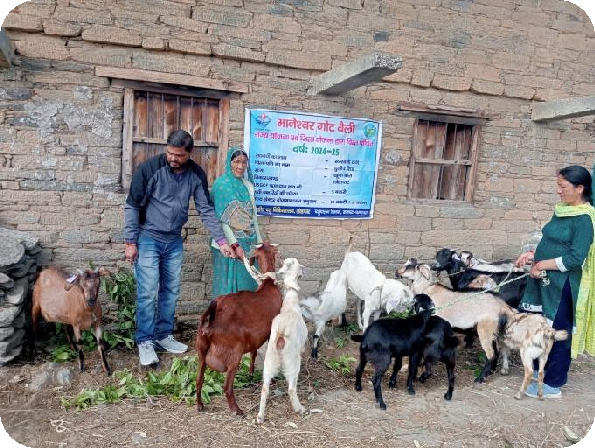
Under the scheme, Shri Gokarna Singh Ram received financial assistance for establishing a 15+1 goat unit (15 female goats and one breeding buck). In addition to financial support, he regularly received technical guidance, veterinary healthcare, vaccination services and scientific management practices from the Animal Husbandry Department. These interventions enabled him to improve breeding efficiency, reduce mortality and manage his flock in a systematic manner.
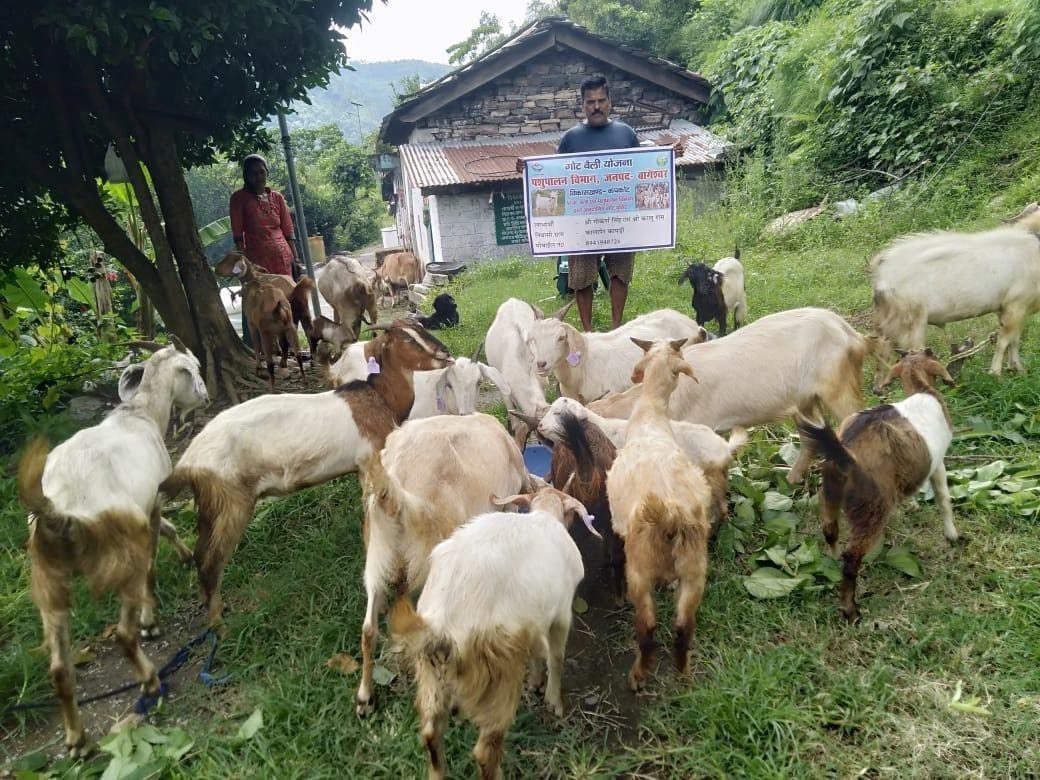
With continuous technical support and proper flock management, his goat population has increased to more than 30 goats. Today, he generates regular income through the sale of breeding goats, kids, goat milk and organic manure. The additional income has significantly strengthened his household economy and reduced his dependence on traditional agricultural income. Goat farming has now become his primary source of livelihood, providing year-round employment for his family.
2.Success Story of Shri Madan Pant (Almora)
Name: Shri Madan Pant
Village: Takoli, Hawalbagh, Almora
Shri Madan Pant, a resident of Takoli village in Hawalbagh Block of Almora district, joined the Goat Valley Scheme during 2023–24 with the objective of creating a reliable and sustainable source of income through scientific goat farming. Before joining the scheme, goat rearing was carried out on a limited scale with low productivity and limited commercial returns.
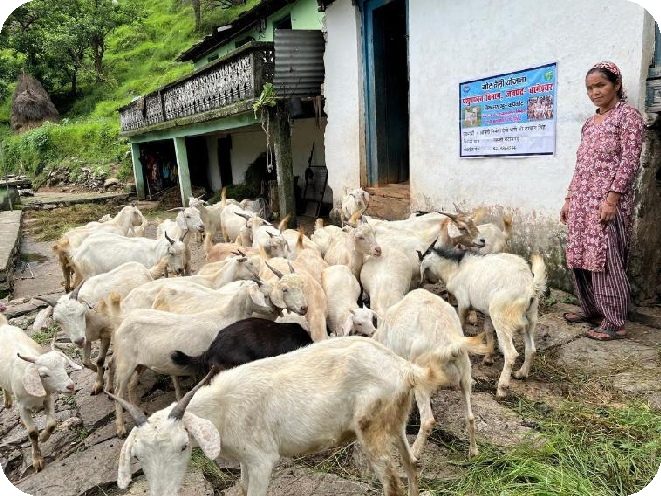
Under the Goat Valley Scheme, Shri Madan Pant received assistance for establishing a 15+1 goat unit (15 female goats and one breeding buck). Along with financial assistance, he benefited from regular veterinary care, vaccination, deworming, technical guidance and scientific breeding practices provided by the Animal Husbandry Department. These interventions improved the health and productivity of his flock, enabling him to expand his goat farming activities successfully.
As a result of systematic management and improved breeding, Shri Madan Pant was able to sell 20 goats during 2024, earning more than ₹1.20 lakh. The income generated from goat farming played a significant role in meeting the expenses of his daughter's marriage without financial distress. Even after the sale, he continued to maintain 15 goats for future breeding and income generation, ensuring the long-term sustainability of his enterprise.
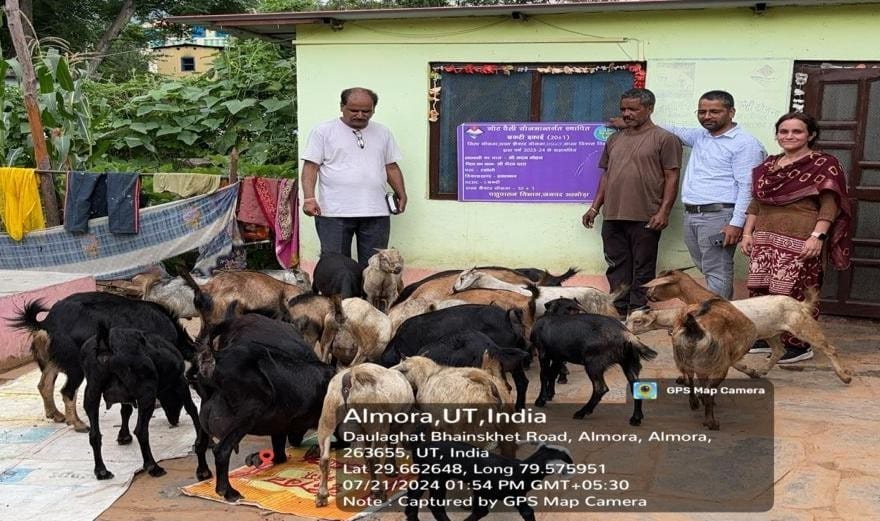
The Goat Valley Scheme has transformed goat farming from a traditional subsistence activity into a profitable livelihood for Shri Madan Pant. His success reflects the effectiveness of the scheme in enhancing rural incomes, promoting self-employment and improving the socio-economic condition of farming families in the hill districts of Uttarakhand. His achievements have encouraged other farmers in the area to adopt scientific goat farming under the Goat Valley model.
