

What Information Theory Reveals About the Loneliness of Men in Their Forties
Today I came across a tweet from a man in his forties. His story felt familiar, almost as if I could have written it myself.
"I am 42, senior IT job, house in Chennai, supportive wife, two kids. On paper, perfect. But my phone rarely rings for anything personal. At home, I am just 'Appa' — the person who pays school fees and fixes the Wi-Fi. At work, I must appear confident and strong, even when I quietly worry about keeping up with new technologies. Sometimes I drive home slowly just to spend a few extra minutes in the car, listening to college songs. For those fifteen minutes, I am not a manager or a father. I am simply myself. I haven't had a real conversation about my feelings with anyone in years. Old friends exist mostly as names on WhatsApp — birthday messages, nothing more. If I tell my family I feel lonely, they say, 'But we are all here with you.' They don't understand that a person can be surrounded by people and still feel like they are on a desert island. Society teaches men that if they provide money and security, they have succeeded. But no one teaches us how to deal with the silence that comes with it."— Anonymous, 42M, Chennai
I read this three times. By the third reading, I felt a knot in my chest. It wasn’t just the sadness—it was how clearly his story was structured. His life hadn’t failed. It was his information channels that had.
There are many ways to look at this. Psychology is one approach. But I found the most insight from a framework in the mathematics of communication: Information Theory.
What Psychology Says: Role Engulfment
The clinical term for this is role engulfment. This happens when someone’s identity is completely taken over by a role, like father, provider, or manager, and their true self fades away. Psychologist William James said that each person has many social selves, one for each group that knows them. In this man’s case, all his social selves have merged into a single, blurry image.
The Male Role Norms framework adds another layer. Men often believe they must be stoic and self-reliant, which acts like a filter that blocks any sign of vulnerability. He can’t tell his team he’s tired. He can’t tell his boss he’s struggling. The channel is there, but the message never gets sent.
The Information Theory Explanation
Claude Shannon’s 1948 insight was simple: information isn’t about meaning, it’s about surprise. The more predictable a message is, the less information it has. He called this unpredictability entropy (H).
Think of a person as a source and a relationship as a channel. The real question is: how much genuine, unpredictable information about who you are actually moves through each channel in your life?
Channel Capacity Collapse
In his twenties, his channels were wide open. Friends didn’t know what he’d say next, and he was still figuring himself out. By his thirties, routines narrowed things: apartments, EMIs, and work trips. By his forties, every channel sends just one predictable message: the role. ‘Appa’ at home. ‘The senior guy’ at work. ‘Happy Birthday’ on WhatsApp.
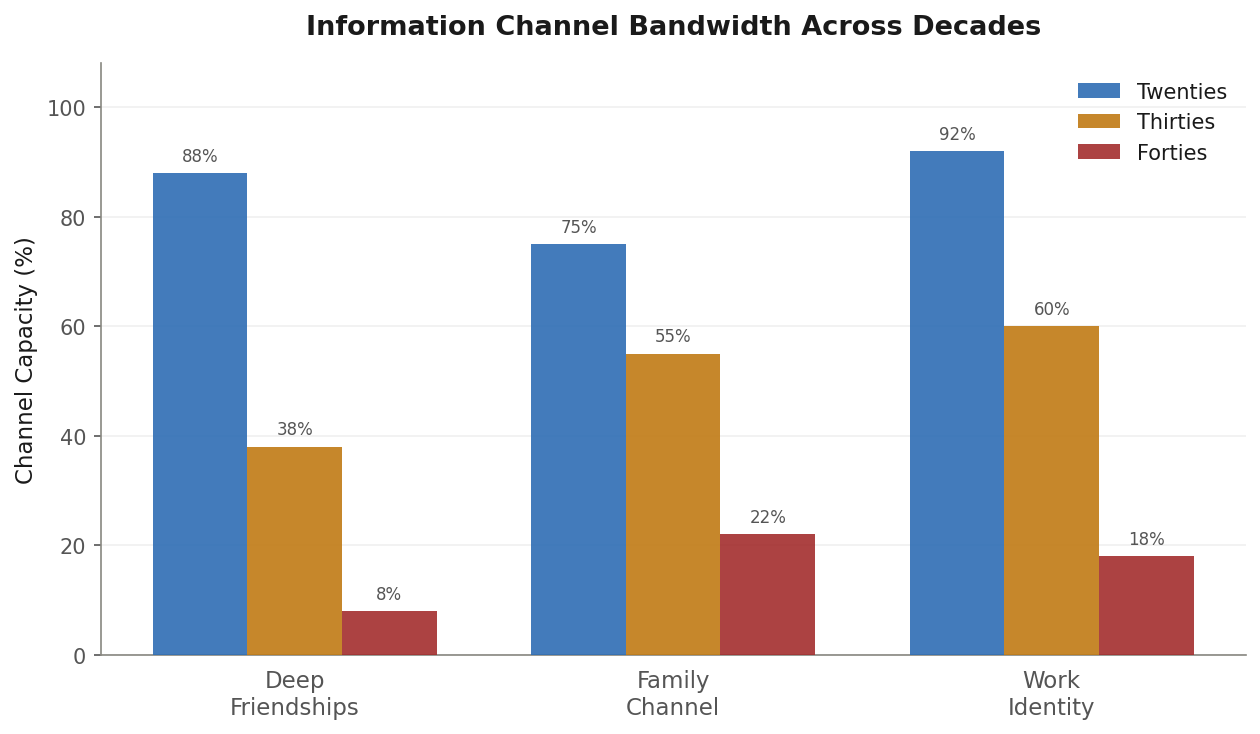
Figure 1: Channel capacity across decades. Genuine information flow collapses sharply by the forties across every major relationship.
The total social entropy H, which is the sum of all channel capacities, follows the same path. It’s not that he’s become less interesting, but that everyone else has stopped seeing him in new ways.
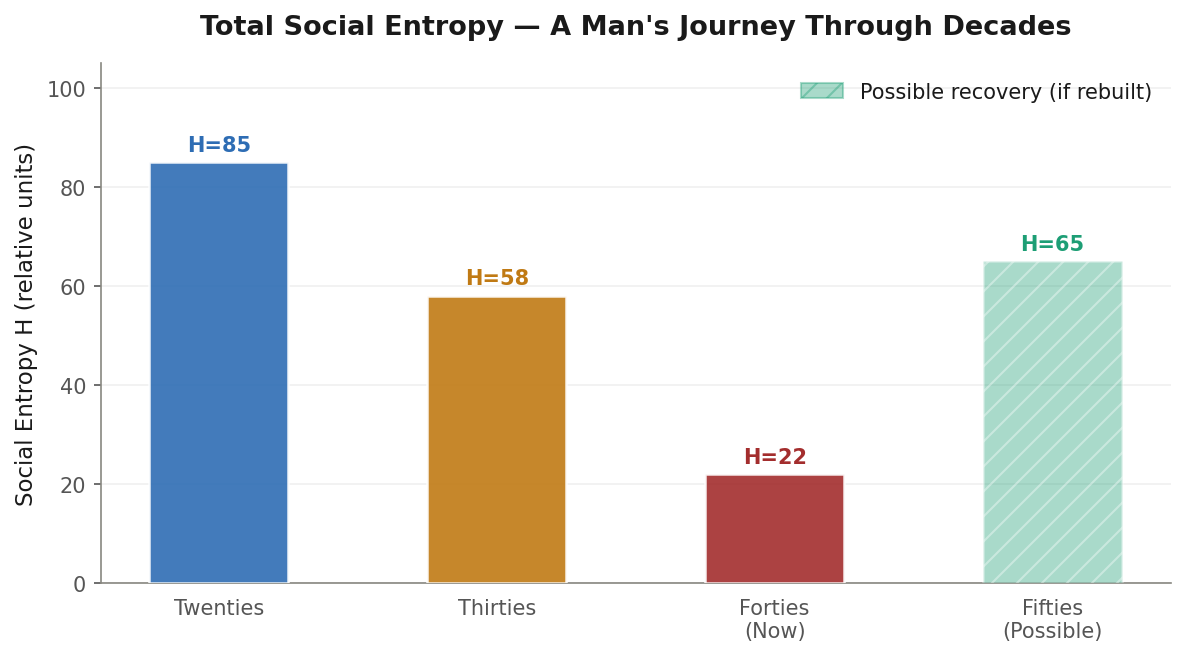
Figure 2: Total social entropy across life stages. The dashed bar shows potential for recovery if even one high-bandwidth channel is rebuilt.
Mutual Information: Who Actually Knows Him?
Mutual information I(X; Y) shows how much two people really learn from each other. His family sees ‘Appa’. His colleagues see ‘the manager’. His WhatsApp friends just send predictable festival greetings, so nothing real is shared. The one exception is his car ride. Old songs bring back memories that aren’t tied to any current role. For those fifteen minutes, he is himself, not just filling a role for others.
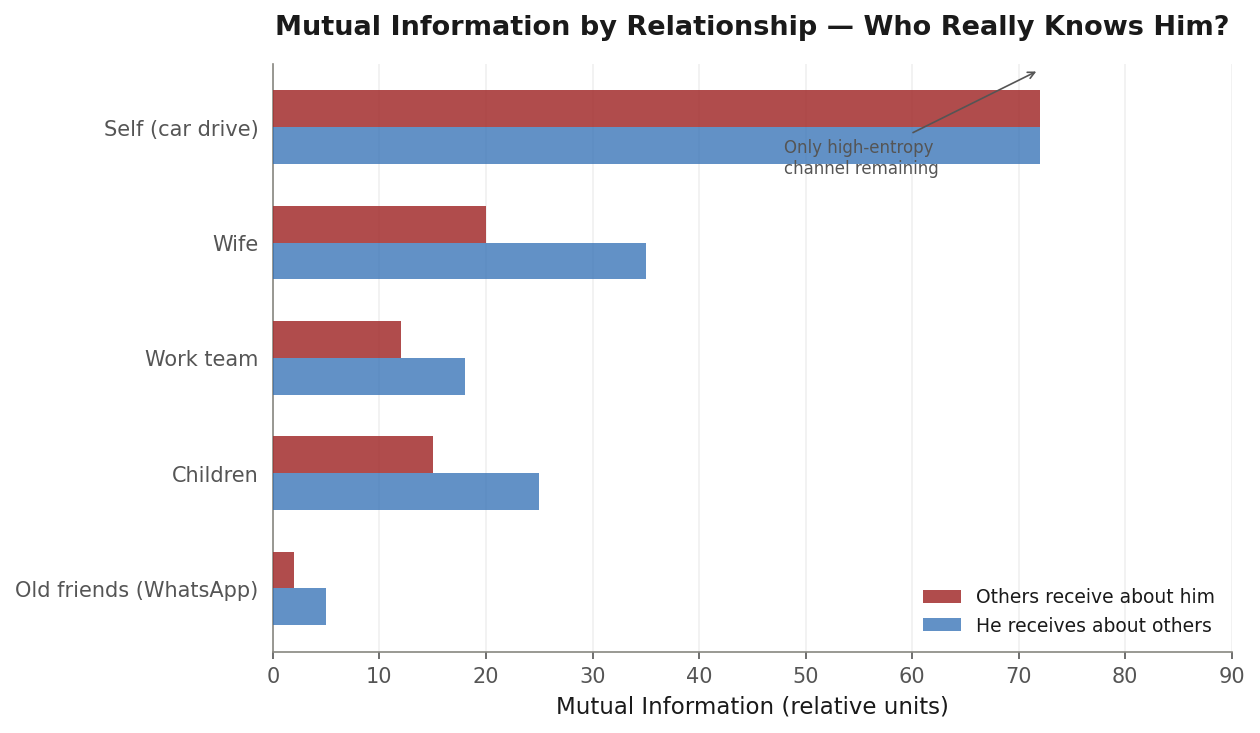
Figure 3: Mutual information by relationship. Only the self-channel achieves genuine high-entropy communication.
The Loneliness Gap
H_internal (self) = richness of who he actually is [HIGH]
H_received (self) = richness received by the world [LOW]
Loneliness Gap = H_internal − H_received
He is not transmitting less. He is being received less.
He’s surrounded by people, but they all see the same blurry version of him. This is the desert island paradox he describes. A desert island has little repetition. His home has lots of repetition but almost no real understanding of who he is.
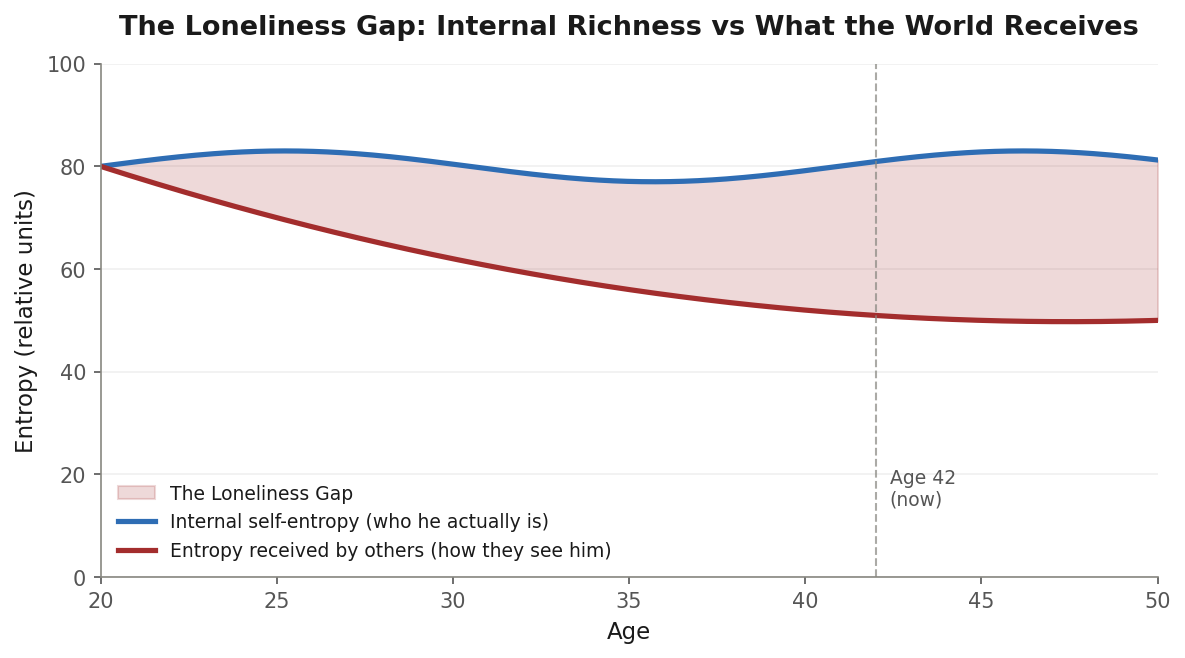
Figure 4: The loneliness gap widens with age as the world's perception diverges from a man's inner richness. At 42, the gap is measurable — and not inevitable.
The Concepts, Applied
What This Means
He ended his tweet with quiet resignation: 'And maybe… this is what life in your forties feels like.'
Information theory offers a more precise—and more hopeful—view. His loneliness isn’t about age, drifting apart, or failure. It’s a problem with communication: every channel now sends only a predictable role, and the world has stopped seeing him as he really is. He’s sending a signal, but no one is receiving it.
Shannon’s ideas also suggest a solution. You don’t have to fix every channel at once. You just need one—a relationship where real surprise is still possible, where someone asks you something they don’t already know. Even one strong connection can help restore what’s been lost.
The car isn’t the answer. But it shows exactly what’s missing.
