

Introduction: The New Infrastructure of Intelligence
Every age has had its decisive resource. Empires once competed for fertile land and navigable ports. The industrial era was built on coal, steel, and factories. The twentieth century ran on oil and electricity. The early internet age was won by those who controlled software and platforms. The contest of our time is of a different kind: nations will increasingly compete for access to intelligence itself.
Foundational AI models, which are large systems trained on extensive data to reason, write, translate, code, tutor, and analyse, are becoming the underlying infrastructure of modern life. They now support education, governance, healthcare, agriculture, financial services, law, scientific research, defence, public service delivery, and daily productivity. The provider of this base layer supplies the cognitive foundation for the entire economy.
This presents a critical question for India. If millions of Indians rely on AI for learning, work, agriculture, and government services, and these interactions are powered by foreign-built and governed models, India risks becoming a consumer rather than a producer of intelligence. No major civilisation should accept this position by default. The argument is not to reject foreign models, but to ensure India also develops its own foundational intelligence infrastructure through a strategic public-private partnership.
Importantly, India is not starting from scratch. Initiatives such as Sarvam, Project Indus, and BharatGPT demonstrate that Indian teams can build effective models, especially for local languages and contexts. However, these efforts require greater scale, including more compute resources, high-quality data, deeper talent pools, and sustained capital to match global leaders. A government–private consortium should invest decisively and at scale. History shows that closing technology gaps requires substantial, multi-year funding for capable teams, not scattered pilot projects. Capital should be allocated generously, with appropriate safeguards, benchmarks, and accountability, combining boldness with discipline.
What Is a Foundational Model?
A foundational model is a large AI system trained on enormous quantities of text, code, images, and other data, which can then be adapted to a wide range of tasks rather than a single narrow one. The same model can answer questions, draft documents, translate between languages, write and debug software, reason through problems, tutor a student, analyse data, review contracts, support a decision, and increasingly handle voice and images together.
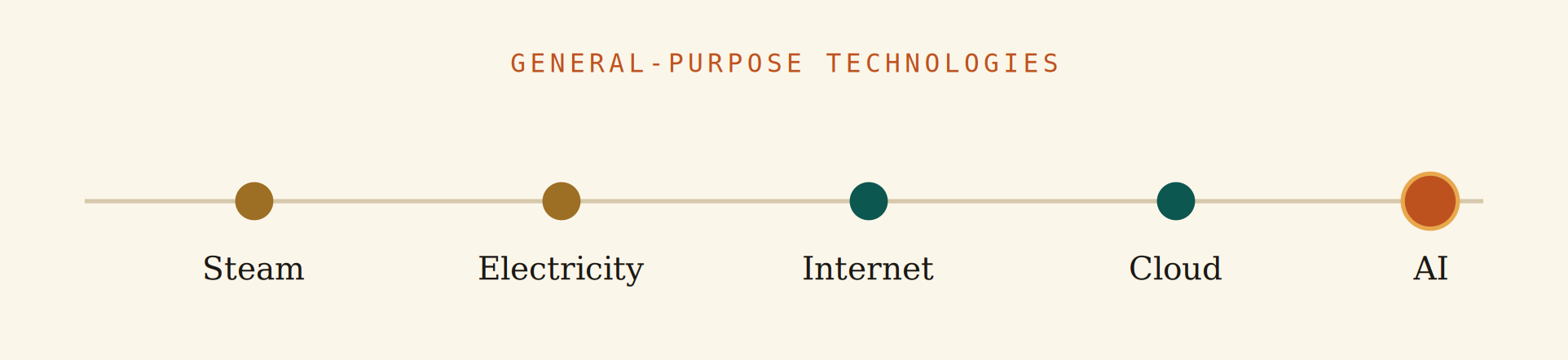
The key consideration is the economic impact, not technical specifics. Foundational models are general-purpose technologies, similar to electricity, engines, the internet, and cloud computing. These technologies extend across all sectors, reduce essential input costs, and increase productivity. Treating them solely as products to purchase, rather than capabilities to develop, would be as shortsighted as a nation in 1920 choosing not to generate its own electricity.
Why India Cannot Depend Only on Foreign AI Models
While leveraging the best global models is practical, relying exclusively on them is not advisable. Five key risks require careful consideration.
Foreign exchange outflow- If tens of millions of Indians pay monthly subscriptions in dollars to overseas providers, a significant and recurring sum leaves the country every year. The figures in the appendix make the scale concrete.
Data sovereignty- Sensitive Indian data — governmental, commercial, medical, legal — increasingly flows into AI systems controlled by foreign companies and subject to foreign jurisdictions. Even with good intentions on all sides, the locus of control matters in a crisis.
Cultural and linguistic mismatch- Models primarily trained on English and Western data often perform poorly with Indian languages, legal terms, administrative vocabulary, agricultural realities, and social context. A tutor unfamiliar with the syllabus or an advisor unaware of local markets offers limited value.
Strategic dependence- Access that is reliable today can become restricted, throttled, or priced punitively tomorrow — through export controls, sanctions, commercial disputes, or geopolitical pressure. Critical national infrastructure should not sit at the mercy of decisions taken in another capital.
Innovation capture- If Indian startups are limited to building applications on foreign APIs, India risks becoming a permanent reseller at the application layer. Core capabilities and value would accrue elsewhere, and Indian talent would focus on integration rather than innovation.
The Cost of Building Indian Foundational Models
What would it cost? Honest cost estimation matters, because hype on either side corrodes good policy. Building and running foundational models involves a recognisable set of cost heads: GPU clusters; data centres and the power to run them; high-speed networking; the training runs themselves; inference infrastructure to serve users; data acquisition and cleaning; the construction of high-quality Indian-language datasets; safety testing and alignment; cybersecurity; the salaries of researchers, engineers, and infrastructure teams; compliance, governance, and audit; and continuous upgrades, since a model is never "finished."
Costs vary enormously with ambition. Three scenarios bracket the realistic range over a five-year horizon.
India does not need to begin at the frontier. A practical path starts with efficient, smaller models; builds sector-specific foundational models; optimises aggressively for Indian languages and use cases; leans on open-source and mixture-of-experts architectures to stretch every rupee of compute; and scales capacity gradually as adoption and capability grow. The aim is not to win a parameter-count race but to own a capable, sovereign, and economically useful base layer.
Benefit 1 — Foreign Exchange Savings
Direct subscription savings. Consider a conservative scenario: 3 crore Indian taxpayers using AI tools, each paying about USD 20 a month to a foreign provider. That is USD 600 million per month, or USD 7.2 billion per year — roughly ₹68,594 crore at ₹95.27 per USD. If even half of that usage shifted to Indian foundational models, India would retain close to ₹34,300 crore every year within its own economy. That money would not vanish; it would circulate — through AI startups, data centres, the semiconductor ecosystem, domestic cloud providers, researchers, engineers, universities, and Indian SaaS firms — compounding rather than draining.
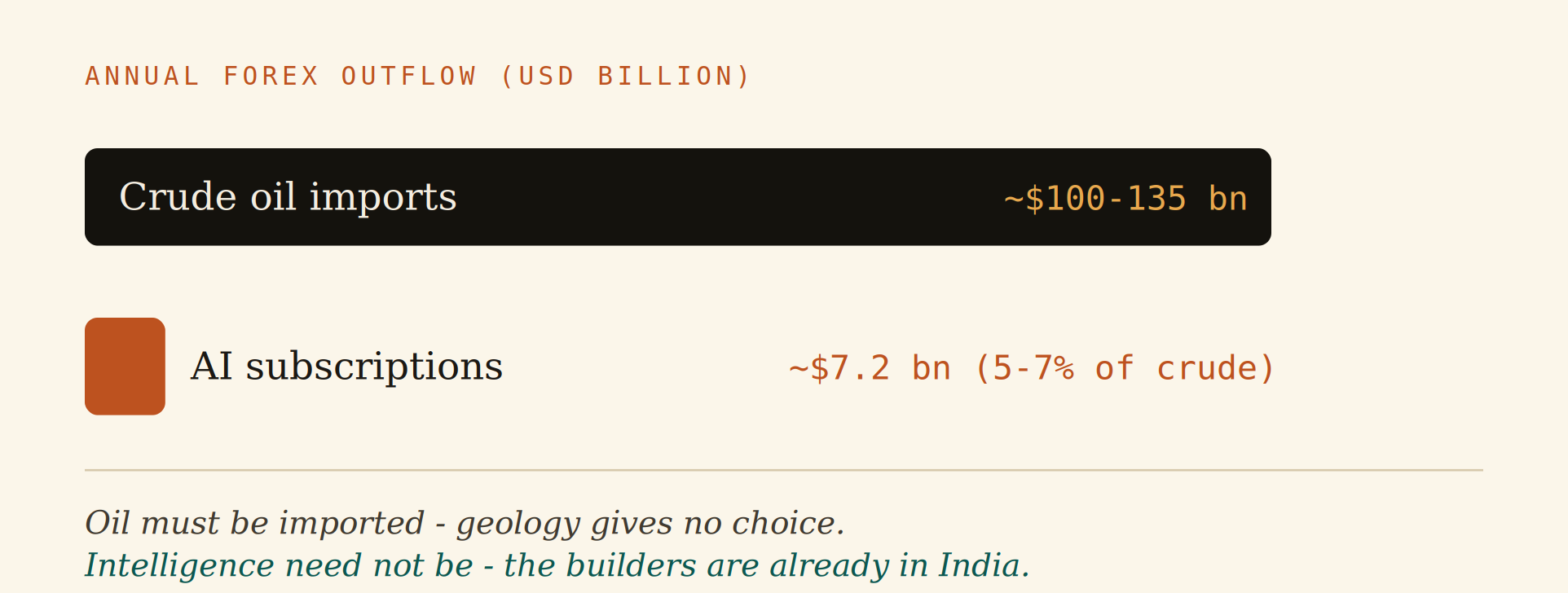
Unlike oil, this outflow is avoidable. For context, India spends USD 100–135 billion annually on crude oil imports due to limited domestic reserves. In comparison, an AI subscription outflow of around USD 7.2 billion represents about 5–7% of the oil import bill, a significant share. While oil imports are unavoidable, importing intelligence is not. India already has the talent and expertise to build world-class foundational models. Dependence on oil is dictated by geology; AI dependence on foreign AI would result from a lack of investment. Among major foreign-exchange expenditures, this is one India can choose to retain domestically.
Benefit 2 — Productivity Gains for Citizens and Workers
The broader benefit is significant. If 3 crore knowledge workers, students, professionals, entrepreneurs, and public servants each save 30 minutes per working day using AI, over 250 working days and at ₹200 per hour, this results in approximately ₹75,000 crore in annual productivity gains (see appendix). This estimate is conservative, as AI also enhances decision quality, learning speed, error reduction, access to expertise, small business productivity, public service delivery, tax compliance, legal awareness, agricultural advice, and health information—benefits not fully captured by time saved alone.
Benefit 3 — Knowledge Improvement of Citizens
Affordable Indian AI models can democratise access to expertise that has traditionally been scarce and unevenly distributed. AI tutors in Indian languages can support students in mathematics, science, coding, English, history, and exam preparation. AI advisors can assist farmers with crop planning, pest management, irrigation, weather risks, market prices, credit, and insurance. Small businesses can benefit from AI support for GST filing, digital marketing, business planning, inventory management, customer service, and compliance. Citizens can access information on government schemes, legal rights, health, pensions, land records, and grievance redressal. Public servants can use AI for drafting, policy analysis, file review, grievance classification, monitoring, and decision-making. When delivered effectively and affordably, such a system becomes a national knowledge utility.
Benefit 4 — The Social Impact of a More Productive Society
Beyond individual benefits, AI can enhance social productivity through faster government service delivery, improved learning outcomes, lower transaction costs, better credit access, reduced compliance burdens, increased health awareness, better-informed farmers, expedited administrative and judicial processing, support for disabled and elderly citizens, and broader access to knowledge in Indian languages.
These benefits are difficult to quantify, so a conservative estimate is appropriate. If AI-enabled systems improve productivity by just 0.25% of India's GDP, in a USD 3.7 trillion economy, this equates to USD 9.25 billion or approximately ₹88,125 crore annually. Even a modest gain of this scale justifies significant investment.
Benefit 5 — Strategic and Industrial Benefits
Many critical returns are not easily quantified, such as developing advanced Indian AI talent, building a domestic GPU and data centre ecosystem, establishing AI chip design capabilities, enhancing defence and strategic autonomy, advancing Indian language technology, exporting affordable AI services to the Global South, fostering Indian AI startups, reducing reliance on foreign APIs, strengthening bargaining power with global AI firms, and building robust public-sector AI capacity. Foundational models can serve as the foundation for India's next phase of digital public infrastructure.
A Public-Private Consortium Model
The government should not bear the entire cost. The optimal approach is a consortium that includes the Government of India, major IT firms, cloud and telecom companies, data centre operators, financial institutions, IITs and universities, AI startups, semiconductor and hardware companies, and digital public infrastructure organisations.
The government's role is to provide leverage rather than direct funding. This includes policy support, regulatory clarity, standards and safety frameworks, access to non-sensitive public datasets, public procurement commitments, challenge grants, regulatory sandboxes, tax incentives, a coordinating AI mission, clear data-sharing protocols, and subsidised compute access for startups and academia. The private consortium is responsible for funding and operating the core infrastructure, including GPUs, data centres, training runs, cloud platforms, inference APIs, enterprise products, sector-specific models, and commercialisation. This division of responsibilities has proven effective in initiatives such as Aadhaar, UPI, and ONDC, combining public infrastructure with private innovation.
Cost-Benefit Comparison
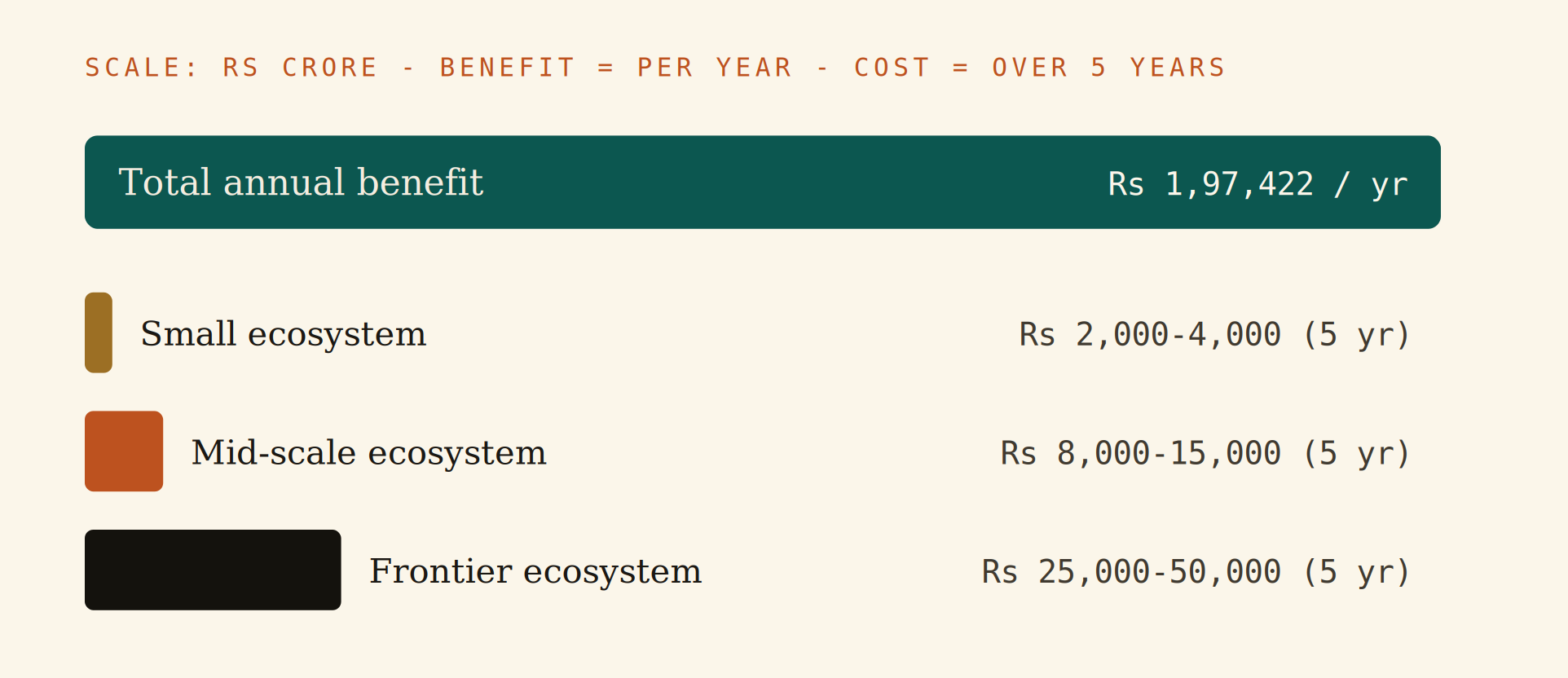
Against this stands the five-year investment: ₹2,000–4,000 crore for a small ecosystem, ₹8,000–15,000 crore for a mid-scale one, and ₹25,000–50,000 crore for a frontier-scale effort. The arithmetic is striking. Even the mid-scale national ecosystem, if adoption succeeds, would be repaid many times over within a single year of benefits — and would keep paying for years thereafter.
Risks and Safeguards
While the case is compelling, it is not without risks. Key concerns include cost overruns, GPU supply constraints, underperforming models, underutilization due to slow adoption, data privacy failures, bias and hallucination, cybersecurity threats, regulatory misuse, concentration of control among a few large firms, and unnecessary duplication of global models without clear Indian advantages.
These risks call for careful design, not withdrawal. Appropriate safeguards include independent AI safety audits, transparent benchmarks, public-interest licensing, competition among multiple model developers, open standards, robust privacy regulations, sector-specific evaluations, rigorous Indian-language benchmarks, parliamentary and expert oversight, and regular, transparent cost-benefit reviews with a willingness to adjust strategy as needed.
Conclusion: India Should Not Rent Its Intelligence Forever
India should utilise the best global AI models where appropriate, but should not rely on foreign systems as the permanent foundation of its national intelligence infrastructure. The fundamental decision is whether to remain solely a market for AI or to become a creator of it.
India has demonstrated its ability to build digital public infrastructure that sets global standards, such as Aadhaar, UPI, CoWIN, ONDC, and the Account Aggregator framework. Foundational intelligence represents the next, and potentially most significant, phase of this progress.
India cannot afford to rely indefinitely on external intelligence systems. A nation of 1.4 billion people must build, own, and shape the intelligence infrastructure that will determine its future.
Appendix: Back-of-the-Envelope Calculations
These figures are indicative, not final econometric estimates. They are intended to convey the scale of the opportunity, and each rests on stated assumptions that reasonable people may dispute. Exchange rate used throughout: ₹95.27 per USD.
A note on the "3 crore taxpayers" assumption. India files roughly 7–8 crore income-tax returns in a recent assessment year, but a large share of filers — on the order of 5 crore — report nil tax after exemptions and rebates. The number of individuals with an actual positive direct-tax liability is therefore much smaller, in the region of 2.5–3 crore. This blog uses 3 crore as an upper-bound estimate of the number of likely AI users among direct taxpayers. Two caveats: (i) the Budget 2025 rebate, making income up to ₹12 lakh effectively tax-free under the new regime, is expected to reduce the number of actual taxpayers by roughly a crore in the coming years; and (ii) these figures should be confirmed against the latest CBDT / Income Tax Department time-series before publication.
1. Forex outflow from foreign AI subscriptions
- Assumptions: 3 crore users; USD 20/month; ₹95.27/USD
- Monthly outflow = 3 crore × USD 20 = USD 600 million/month
- Annual outflow = USD 600 million × 12 = USD 7.2 billion/year
- Rupee value = USD 7.2 billion × ₹95.27 = ₹68,594 crore/year
- If 50% shifts to Indian AI = ₹68,594 crore × 50% = ₹34,297 crore retained annually
- Comparison with crude oil: USD 7.2 billion ÷ ~USD 100–135 billion crude oil import bill ≈ , 5–7% of the crude oil bill(crude figure approximate; confirm against the latest Ministry of Commerce trade data)
2. Productivity gain from AI use
- Assumptions: 3 crore users; 30 minutes saved/working day; 250 working days; ₹200/hour
- Daily hours saved = 3 crore × 0.5 = 1.5 crore hours/day
- Annual hours saved = 1.5 crore × 250 = 375 crore hours/year
- Value = 375 crore × ₹200 = ₹75,000 crore/year
3. GDP-level productivity gain
- Assumptions: GDP USD 3.7 trillion; 0.25% improvement; ₹95.27/USD
- Gain = USD 3.7 trillion × 0.25% = USD 9.25 billion
- Rupee value = USD 9.25 billion × ₹95.27 = ₹88,125 crore/year
4. Total indicative annual benefit
- Forex retained: ₹34,297 crore
- Individual productivity gain: ₹75,000 crore
- GDP-level productivity gain: ₹88,125 crore
- Total = ₹1,97,422 crore/year
Caution: these are illustrative aggregates. They overlap in places, depend heavily on adoption rates, and should be treated as an order-of-magnitude argument for why the investment merits serious study — not as a guaranteed return.
