Knowing When Persistence Stops Being Progress
A decision framework for India's exam aspirants, written by someone who failed three times before finally finding the right path.
I sat for the Medical entrance exam three times. Three times, the MBBS seat I was chasing did not come. The walls of my room carried the posters every aspirant knows, the war cries — "Winners never quit. Quitters never win". I read them at two in the morning when I couldn't sleep, and those words made me feel worse, not better, because they answered a question relevant to a war context, not one I wasn't asking. I did not need to be told to be brave. I had no shortage of bravery; I had a shortage of clarity.
What I needed was someone to tell me whether bravery was even the right instrument for the decision before me — and nobody in that ecosystem was equipped to say. But here's the part of my story I want you to notice, because it sums up this whole essay. I didn't spend a fourth or fifth year trying to open the same closed door. That same year, I took the Veterinary Council of India's entrance exam, was selected, and started studying Veterinary Science (B.V.Sc.). It wasn't the path I had first imagined, but it was a real opportunity, a genuine profession, and a solid qualification. I chose to move forward rather than wait outside a door that wouldn't open. Then something unexpected happened. In my fourth year of veterinary studies, I started preparing for the civil services exam. That eventually became the path that truly suited me. I cleared it, faced my own share of setbacks, and built a life I never could have imagined back in that first rented room. room.
I'm not sharing this to add another "I-made-it' story to a country already full of them. I'm sharing because the most crucial decision I faced wasn't about working harder. Instead, it was: 'Is this still the right door, or is there a better one nearby?" I found my answers more through instinct and chance than a formal method. This essay aims to give you the framework I wish I had, so you can make these decisions more quickly, clearly, and on your own terms.
This blog is for anyone working hard for exams like UPSC, NEET, JEE, SSC, Banking, Railway, State PCS, Judiciary, GATE, CAT, or Defence services. Still, the ideas here apply to everyone. The same thinking about when to keep going or change direction works whether you are choosing about an exam, a job, a degree, a business, or even a city you moved to for your dreams.
Before we start, I want to be clear: this is not about giving up easily or saying perseverance is bad. Sometimes, your best choice to continue or change direction should be based on evidence and self-respect, and not out of fear, shame, or simply to stick with something, even when it feels slow or thankless.
The emotional trap that often goes unnoticed
In India, we talk a lot about perseverance but rarely about how to quit in a healthy way. So when a student in places like Mukherjee Nagar, Old Rajinder Nagar, Prayagraj, Patna, Jaipur, Kota, or Hyderabad starts to feel doubt—maybe this isn't working—that doubt often feels like a personal failure. Instead of thinking, I should look at this honestly, the student thinks, I am being weak.
This confusion stems from several pressures at once. First, there is identity fusion: after a year or two, you are no longer just a young person preparing for an exam. You become known as "a UPSC aspirant." Quitting now can feel like losing your sense of self. Second, there is the weight of others' investment—parents who have spent their savings and put their pride on the line, and conversations you keep avoiding. Third, the coaching system often encourages you to stay enrolled, even if leaving might be better for you. Fourth, there are stories of late success, like the senior who passed on the seventh try. These stories are true, but they are examples of survivorship bias. We hear about the one person who succeeded after many tries, not the ninety who tried just as hard but did not make it. One striking story does not show the whole picture.
This is not a contest between courage and cowardice
Let me say what others often avoid: continuing is not always brave, and quitting is not always weak. Both choices can be wise or foolish. What matters is not how much courage you have, but whether your approach fits your situation, based on real evidence.
So stop asking the wrong questions. Are you strong enough to keep going? Most likely, yes; people can handle a lot of unnecessary hardship, which is why simply enduring does not make a wise choice. Will people call you a quitter? Some might, but they will soon move on. These questions do not help you decide what to do. Here is the question that matters:
Considering my current performance, age, finances, emotional and physical health, and the real options I have, is continuing still the best use of my time, skills, money, and energy compared to the other paths I could take?
A wise person does not worry about being called a quitter. Instead, they ask, "What is the best next move from here?"
Herbert Simon — decide before you are certain
Part of what held me back was hoping for total certainty. I kept waiting for a clear sign to make the decision easy, but that sign never comes. Economist Herbert Simon, who won a Nobel Prize, explained this with the idea of bounded rationality: we never have perfect information and must decide with limited time, money, feedback, and emotional noise. His solution was a term he created, satisficing: instead of searching endlessly for the perfect choice, pick the first option that meets reasonable standards and commit to it. Searching too long has its own costs, and when it comes to exam preparation, those costs can mean losing years of your limited youth.
So stop asking, "Could I possibly succeed at this someday?" The answer is almost always yes, and that is the trap. Instead, ask yourself, "Is one more focused, well-planned year a good bet for me right now?" Then answer honestly: What do my last two attempts show? Am I making progress or just repeating the same mistakes? Can I explain why I failed? Will I change my approach, or just try harder? If you cannot answer these questions, that is your answer: your first step should not be another year of preparation, but an honest review of your situation.
Annie Duke: That past effort is data, not debt
This is the thinking that keeps so many people trying one more time:
I have already given so many years. My family has spent so much. I was so close. If I stop now, all of it is wasted.
Each of these thoughts sounds logical, but they are really emotions dressed up as logic. Annie Duke calls this the sunk-cost fallacy, which means letting past costs you can't recover influence a future decision that they shouldn't affect. The only thing that should matter is the expected value of continuing from today onward.
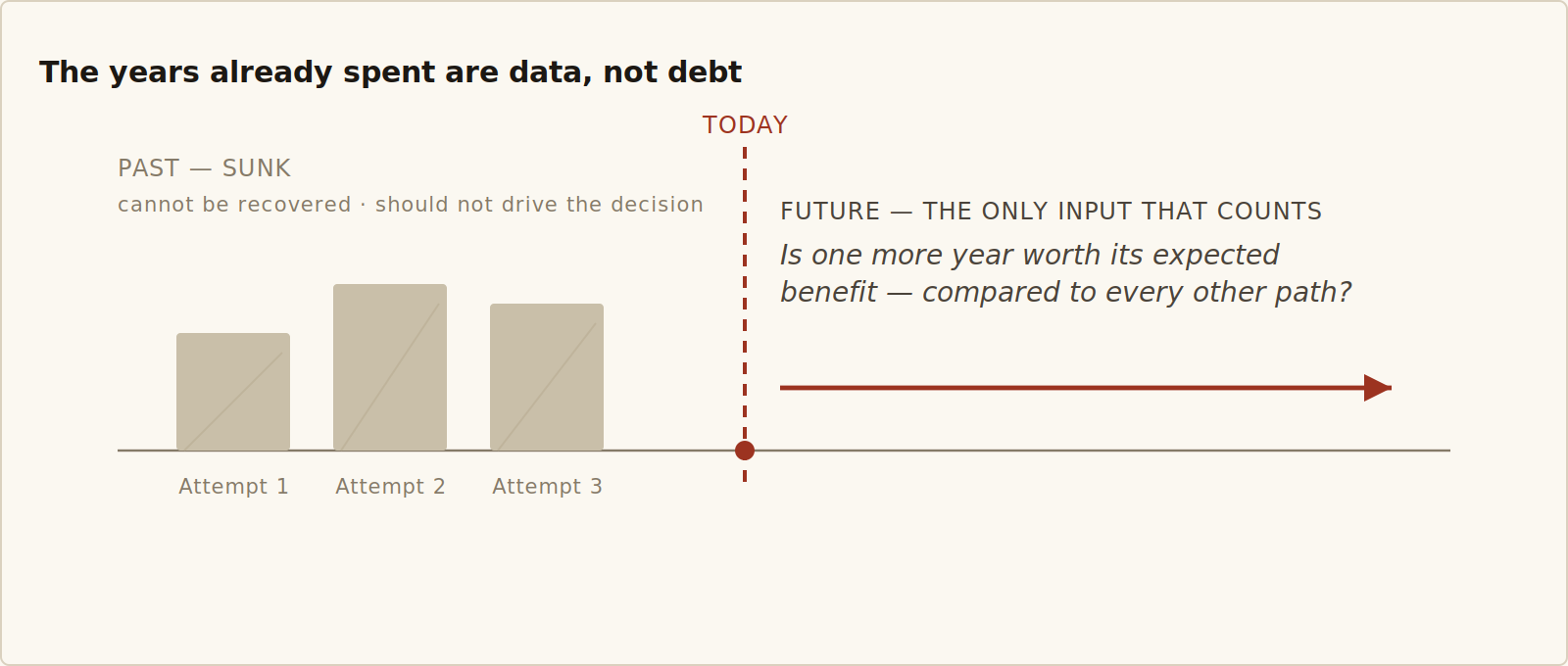
Why is this fallacy so powerful? Loss aversion is the reason: we feel a loss about twice as strongly as we feel an equal gain. Walking away means admitting those years are a loss, and that hurts so much that we might spend another year just to avoid that feeling. The fifth year does not erase the loss; it makes it bigger. Here is the sentence that breaks the spell:
The years already spent are not an argument for spending more years. They are data, not debt.
You pay off a debt over time, but you use data to learn and grow. Your effort was never wasted; it helped you build discipline, stamina, writing, and reasoning skills. You honour that effort not by giving up your future for it, but by taking its lessons with you to new opportunities. Honestly, what helped me move on from trying to take the medical entrance again wasn't willpower. It was that I already had a real alternative to pursue. The best way to avoid the sunk-cost trap is to have another option ready that is truly worth moving toward.
Opportunity cost: your twenties are compounding capital
When I added up the cost of trying again, I thought about fees, books, and rent. Almost everyone makes this mistake. The real costs are the ones you do not get a bill for: opportunity cost. This includes salary you did not earn, experience you did not gain, skills you did not build, and a network you did not join. What makes your twenties especially valuable is compounding. The first steps you take early do not just add value once; they raise the base for all your future growth.
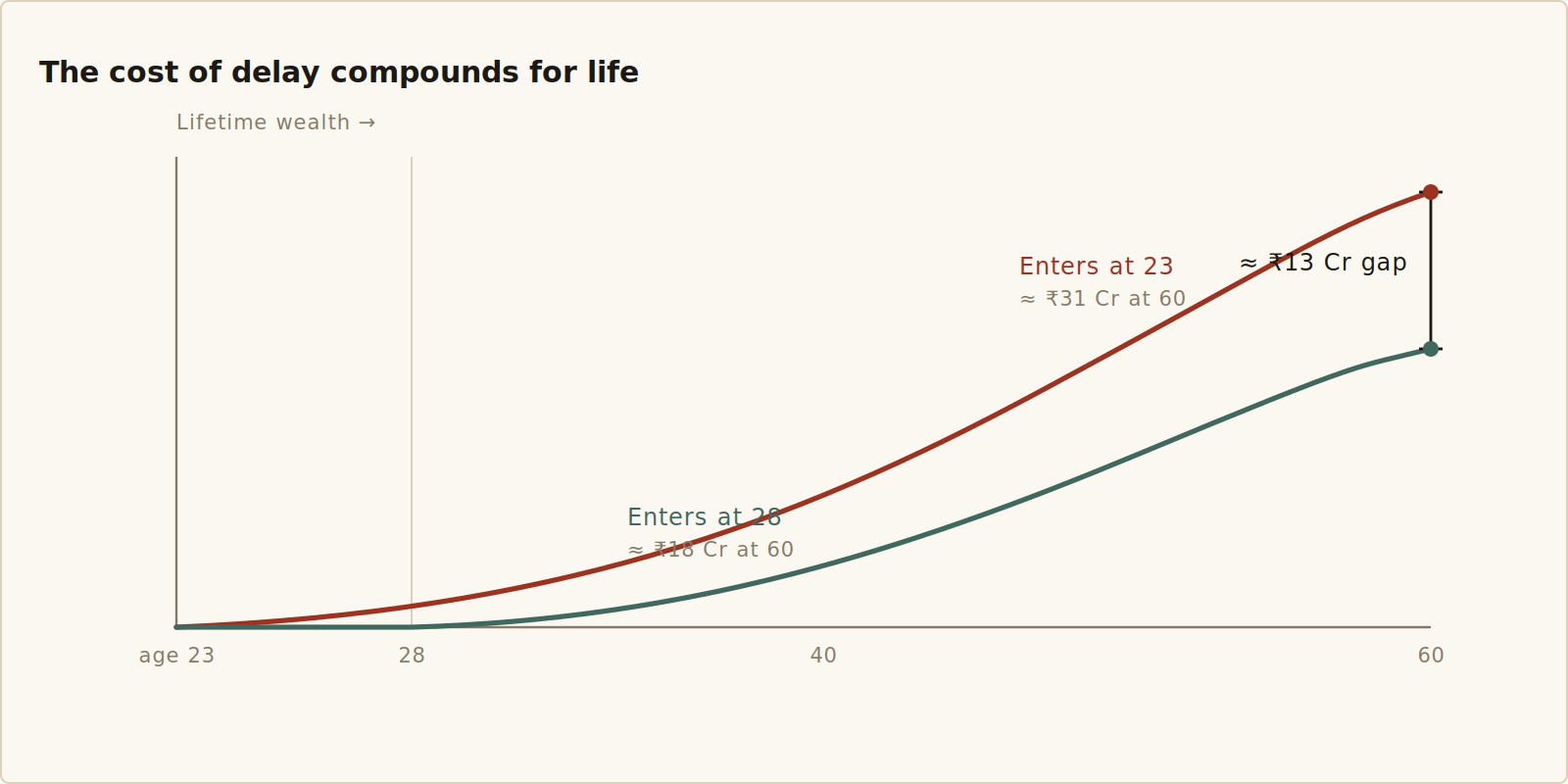
This does not mean that a year of preparation is never worth it. The main point is that you need to consider the real cost, not just the cash cost, or you might quietly mislead yourself about your own life.
The Marginal Value Theorem: Are You Still Gaining?
Behavioural ecologists found that an animal feeding in one area should leave as soon as the next bite it gets there is smaller than the average bite it could get by moving to a new area. This idea is called the Marginal Value Theorem. The key is to focus on the marginal value—not how much is left, but how much the next bit of effort will give you.
So the real question is not "is there anything left to learn?" (there always is). The real test is whether the next year is likely to give you much more than the last one, and more than you would get by spending that year somewhere else. Are your scores improving each time? Are your mistakes getting easier to fix, or are you just repeating them? Has your strategy changed, or are you just working harder at the same approach? If your marginal gain is still high, keep going. If it has dropped and a better option is available, then it is time to move on, without judgment.
Exploration vs. Exploitation: Don't Get Trapped in One Identity
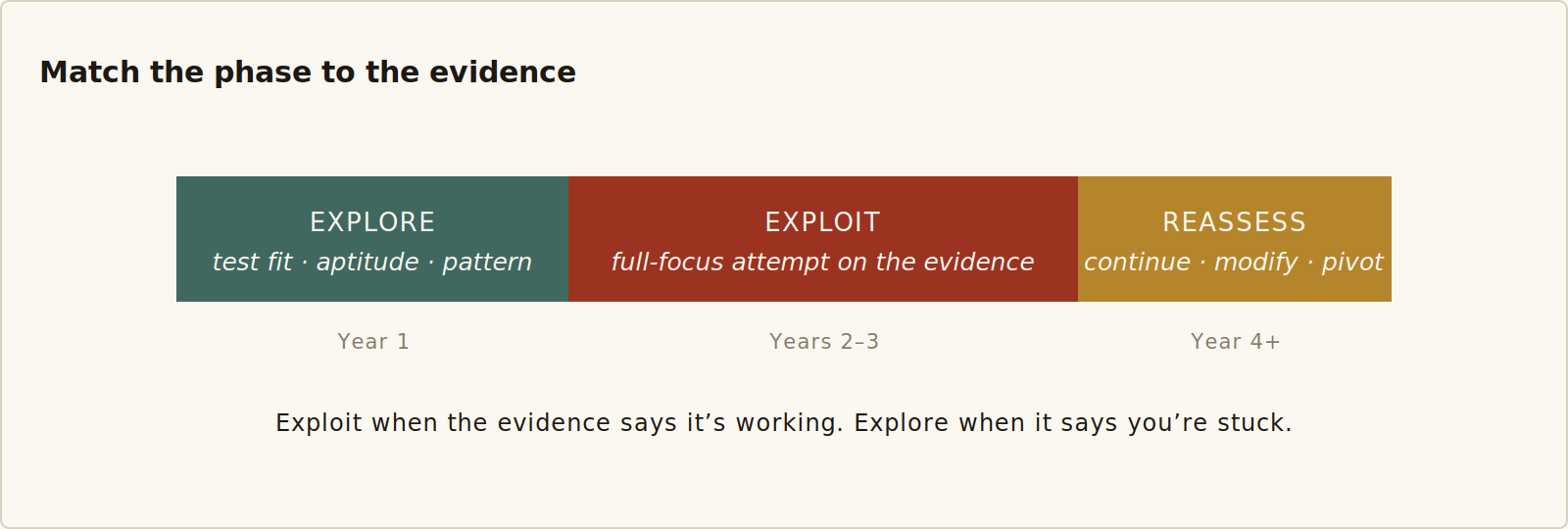
Computer scientists call this the exploration-exploitation trade-off. Imagine slot machines with unknown payouts: you can keep using the one that has paid best so far, or try a new one to see if it pays better. If you exploit too soon, you might put all your effort into a mediocre machine. If you explore for too long, you never get the rewards. Some people settle too early—one exam, six years, no test of fit. Others keep exploring—UPSC, SSC, Banking, CAT all at once, but never master any. The key is to match your approach to the evidence you have.
Expected value and the 37% rule: deciding when to decide
Two tools help you decide not which option to pick, but when to make your decision. The first is expected value:
Expected value = ( probability of success × value of success ) − cost of continuing
A civil-services post can be very valuable, which might make a low chance of success seem worth it for some time. But if your chances stay low and the yearly costs keep rising, the expected value can quietly become negative, even if the goal still looks attractive. This is not about reducing life to a spreadsheet; it is about not relying only on hope.
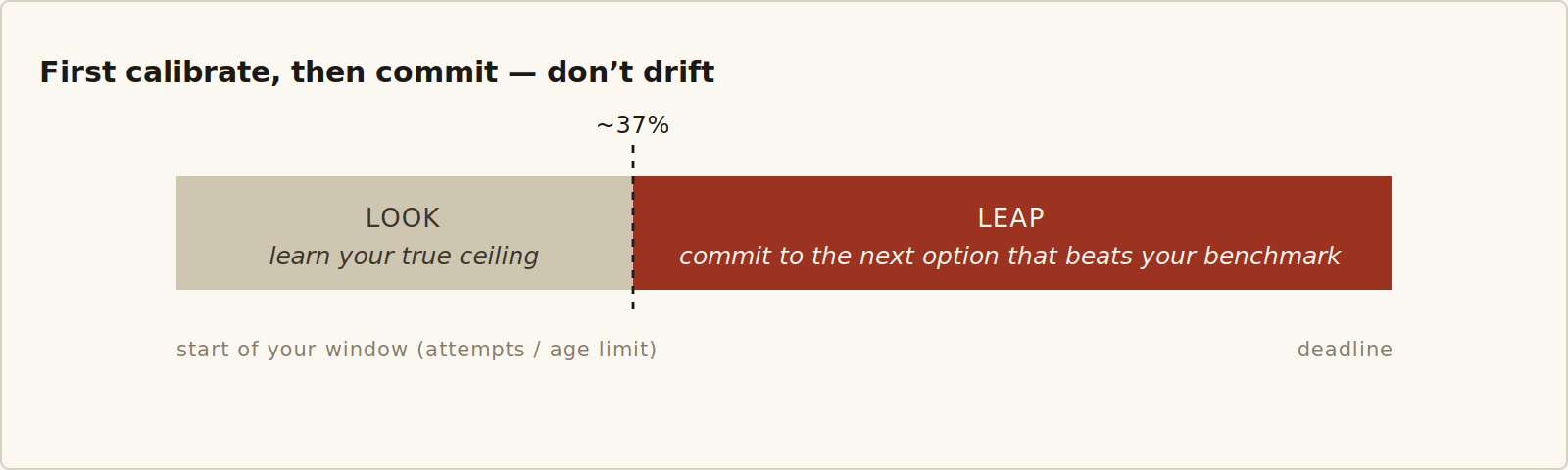
The second tool is the 37% rule from optimal-stopping theory. When you need to pick the best option from a series within a deadline, use the first 37% of your time just to explore and avoid making any commitments. After that, choose the next option that is better than all the ones you have seen so far.
A similar idea is Jeff Bezos's regret-minimisation approach. Imagine yourself at age eighty and ask which choice you are least likely to regret. This helps you look past your current fears and focus on what will matter most over your lifetime.
The Continue · Pivot · Quit dashboard
Run yourself, honestly and on a calm day, across five dimensions. This is not a verdict of "failure" — it is a dashboard. A cluster of greens says continue. A field of yellows says continue, but change the plan. Three or more reds are a signal to redesign or change doors before another year is spent.
| Dimension | 🟢 Continue | 🟡 Modify | 🔴 Pivot / Quit |
|---|---|---|---|
| Performance trend | Marks rising; gap to cutoff closing | Improvement in some papers only | Same mistakes, stagnant 2–3 cycles |
| Probability of success | At/above cutoff in mocks | Within reach but erratic | Far from cutoff, no fixable reason |
| Financial sustainability | Supported without strain | Manageable but tightening | Borrowing heavily; family stressed |
| Mental & physical health | Stable; motivated by the goal | Stressed but coping | Anxious, isolated; avoiding shame |
| Opportunity cost & alternatives | Building parallel skills; backup exists | Some backup, underdeveloped | Single-door life; no Plan B |
One gut-check sits underneath the whole table: are you continuing toward something you want, or only away from the fear of what people will say? The first is a reason. The second is the trap.
After a pivot: reallocating ambition, not abandoning it
Leaving an exam is not leaving ambition. A pivot is a junction, not a cliff — and your preparation is real capital if you deliberately convert it. UPSC/State PCS knowledge translates into public policy, development and management consulting, CSR, think tanks, research roles, governance-tech startups, fellowships (LAMP, Gandhi Fellowship, CMGGA), political consulting, journalism, law, teaching, and data and policy analytics. SSC/Banking/Railway aptitude transfers into sales and operations, insurance, banking-correspondent networks, fintech operations, accounting and taxation, and digital upskilling. NEET/JEE rigour transfers into allied health sciences, biotechnology, public health, psychology, nursing, pharmacy, and into design, data science, software, and management.
I mean that literally. The MBBS seat I first wanted never came — but the veterinary science I studied instead was no consolation prize. The biology, the clinical training, the years of relentless study walked with me everywhere; when I later worked on agriculture, animal husbandry, dairy, and rural development, that veterinary grounding mattered more than I could have guessed as a disappointed teenager. You do not lose the climb when you change the mountain.
How to quit well: design the exit, don't stumble into it
A panicked exit shares the same flaw as a fearful continuation: emotion deciding rather than design. So: set the decision date before the attempt, with written criteria, while you are calm. Define measurable signals in advance (the dashboard above). Run a premortem (Gary Klein's technique): imagine it's two years later and the decision went badly — why? Run it both ways. Talk to mentors, not only peers — peers share your biases. Build a six-month transition plan before you need it: one skill, one income source, one network. And keep your dignity — you learned your true coordinates and made a mature decision on evidence.
Do not quit in shame. Exit with strategy.
Conclusion: The Door is not the Building
India needs disciplined, hardworking young people not only behind government desks, but in business, technology, civil society, education, healthcare, agriculture, law, media, research, and public policy. The exam is one door into one room of an enormous building. It is a fine door. It is not the building.
I reached the door that was finally mine by a route I never planned — the medical seat didn't come, so I walked through veterinary science, and from inside that degree, I found the civil services. None of it felt like a master plan; it felt like making the best of a disappointment, one decision at a time. In hindsight, taking the open door instead of battering the closed one — and staying alert enough to find the next from inside it — was the most self-respecting thing I did. I did it by instinct, the long way around. These frameworks are my attempt to give you that clarity on purpose, and early.
The purpose of preparation is not to prove that you can suffer endlessly. The purpose is to build a meaningful life. Sometimes that life begins by continuing. Sometimes it begins by courageously choosing another door.
Whatever you decide, decide it with evidence and decide it with dignity. And whichever way the evidence points — choose, instead of drifting. The drifting is the only real failure. Everything else is just a path.
A Note on the Numbers: Where the Odds and the Costs Come From
Two arguments here deserve hard numbers — the probability of success inside any expected-value calculation, and the opportunity cost of each additional year. I worked through both in a separate analysis of UPSC service-allocation lists from 2021 to 2024.
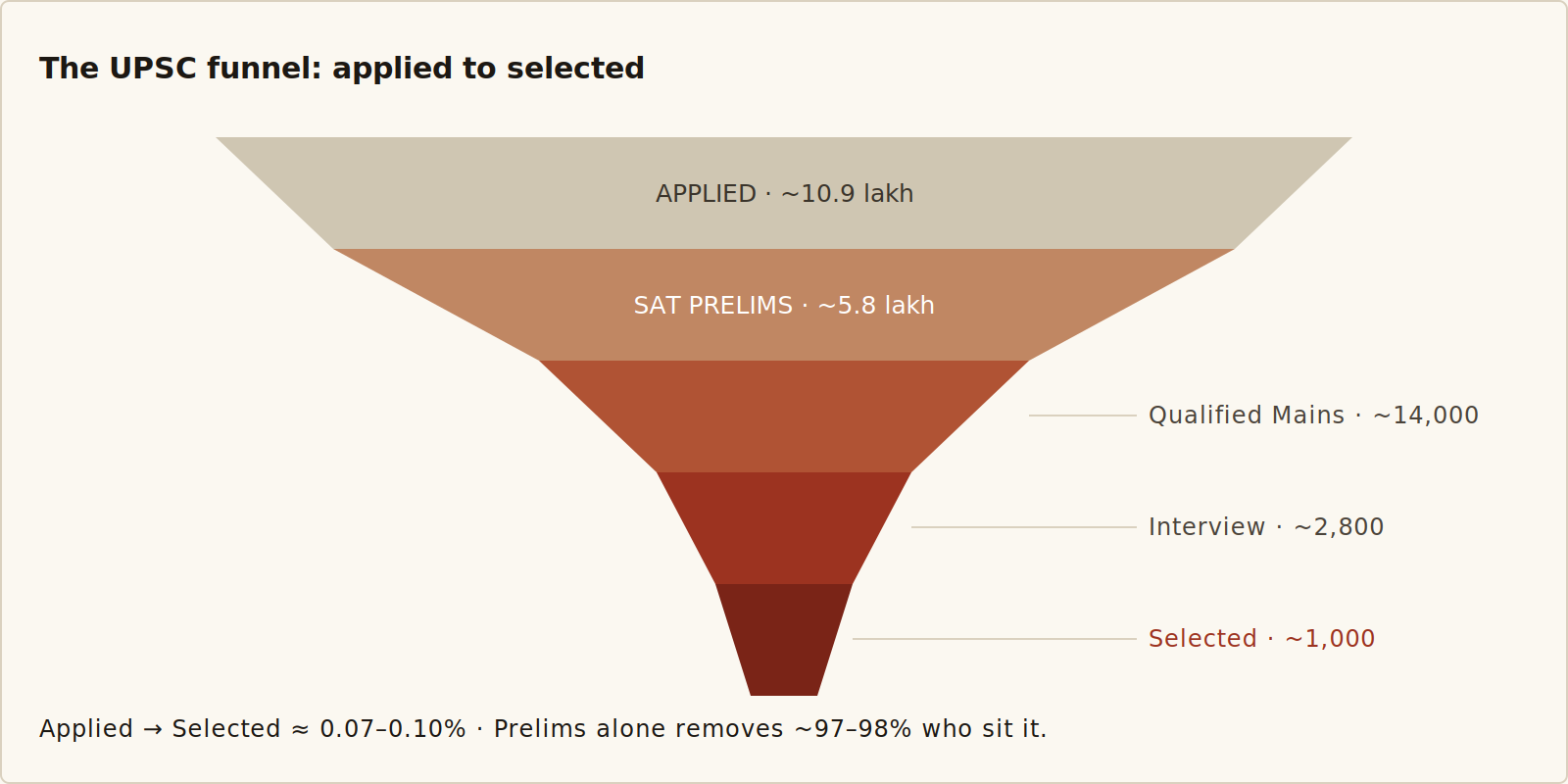
A few findings worth carrying with you:
- Repetition is not a reliable route to the top service. Among candidates selected more than once, only about a third ultimately reached the IAS — nearly two-thirds did not, despite clearing multiple times.
- The opportunity cost is higher than almost everyone estimates. A five-year delay can erase roughly ₹4–17 crore in lifetime financial value when you account for foregone salary, lost compounding, a lower terminal pay level, and reduced pension.
Read the full analysis → Selection Patterns and Economic Variables in the Civil Services Examination: A Probabilistic Assessment of Service Allocations and Opportunity Costs (2021–2024)
One caution / Discliamer, numbers only describe the overall picture. They can show you the general odds, but not your personal chances. Use them to guide your decision, but do not let them decide for you. That choice is always yours.