

An India-focused comparison of Apple Mac mini, NVIDIA DGX Spark, AI subscriptions, and metered APIs — September 2026
Executive Summary
Running an open-weight language model locally offers privacy, offline availability, low marginal inference cost, and freedom from provider quotas. It does not automatically produce the lowest total cost—or the best business result.
For most individuals, hosted subscriptions and economical APIs remain cheaper than buying dedicated AI hardware. Local hardware becomes attractive when three conditions are met:
- The workload is large and consistent.
- A suitable open model produces acceptable results.
- Local processing eliminates enough cloud spending to recover hardware, maintenance, and employee time.
The main conclusions are:
1- Light users: Use a hosted subscription or inexpensive API.
2- Regular professionals: Hosted access is usually cheapest and most capable.
3- Heavy users: A hybrid setup is normally best. Local hardware can absorb private and repetitive work while frontier services handle difficult tasks.
4- API-heavy automation: Local inference can win against flagship API pricing, but inexpensive hosted models remain surprisingly competitive.
5- Mac mini M6: The most economical entry point when 32GB is enough.
6- Mac mini M5 Pro: Worth considering when 48–64GB of memory is genuinely required.
7- DGX Spark: Primarily justified by large-model capacity, CUDA compatibility, concurrency, privacy, or research requirements—not ordinary personal productivity.
8- Mandatory privacy or offline access: Local processing becomes a requirement rather than a conventional cost comparison.
Raw compute economics favour well-utilised local hardware. Business-value economics often favour frontier models because better outputs reduce retries, human review, and costly errors.
Scope and Assumptions
The analysis covers professional knowledge work:
1-Writing and editing
2-Coding and debugging
3-Research and synthesis
4-Document analysis
5-Summarization
6-Brainstorming
7-Data analysis
8-Automated and agentic workflows
The hardware configurations are:
1-Mac mini M6 with 32GB unified memory
2-Mac mini M5 Pro with 48GB unified memory
3-Mac mini M5 Pro with 64GB unified memory
4-NVIDIA DGX Spark with 128GB coherent unified memory
Usage profiles
| Profile | Working time | Monthly tokens | Representative use |
|---|---|---|---|
| Light | 1 hour per workday; 22 hours/month | 3M input + 0.5M output | Occasional writing, research and coding |
| Regular | 4 hours per workday; 88 hours/month | 18M input + 3M output | Daily professional knowledge work |
| Heavy | 8 hours per workday; 176 hours/month | 72M input + 12M output | AI-first professional workflow |
| Automation-heavy | Continuous or scheduled | 300M input + 50M output | Batch analysis, agents and document pipelines |
API calculations assume:
1- 20% of input tokens receive the cached-input rate.
2- ₹95 per US dollar.
3- API figures exclude GST because treatment varies by billing arrangement.
4- Subscription estimates add 18% GST.
5- Search, images, audio, regional processing, long-context premiums and priority processing are excluded.
Local TCO assumes:
1- Electricity at ₹10/kWh.
2- Three-year principal useful life.
3- 8% annual cost of capital.
4- Professional labour at ₹1,500/hour.
5- Eight setup hours and one maintenance hour per month for Macs.
6- Twelve setup hours and two maintenance hours per month for DGX Spark.
7- Three-year resale of 45% for Macs and 30% for DGX Spark.
These are modelling assumptions, not manufacturer guarantees.
Comparison Methodology
The local economic cost is:
Economic TCO = hardware + accessories + electricity + maintenance + cost of capital + employee time + replacement costs − resale value
Hosted API cost is:
API cost = uncached input × input rate + cached input × cached rate + output × output rate
The more important business metric is:
Cost per acceptable completed task = (AI cost + review labour + retries + expected error loss) ÷ accepted tasks
That final equation prevents a weak but cheap model from appearing more economical merely because its tokens cost less.
Hardware and Service Overview
Apple’s current Mac mini supports an M6 with up to 32GB of unified memory and an M5 Pro with up to 64GB. Apple lists up to 170 GB/s of memory bandwidth for the M6 and 307 GB/s for the M5 Pro. Apple specifications
NVIDIA specifies 128GB of coherent LPDDR5x memory, 273GB/s of bandwidth, 4TB NVMe storage, a 140W GB10 TDP and a 240W power supply for DGX Spark. NVIDIA says it can run models of up to 200 billion parameters, although fitting a model does not mean it will run interactively. NVIDIA specifications
| Device or service | Price | Memory | Practical local models | Context constraints | Expected performance | Power | Upgradeability and support |
|---|---|---|---|---|---|---|---|
| Mac mini M6, 32GB/512GB | Approx. ₹135,900 including tax | 32GB; up to 170GB/s | 7B–27B Q4/Q5; selected 30B–35B or sparse MoE models | Usually 8K–32K; longer context consumes model headroom | Early independent results suggest about 8 tok/s for a 27B Q4 model and roughly 14 tok/s for a small-active-parameter MoE | Estimated 45–70W under inference | Memory and internal storage fixed; one-year warranty |
| Mac mini M5 Pro, 48GB/512GB | ₹281,900 including tax | 48GB; 307GB/s | 27B–40B Q4/Q5; 70B Q4 is usually too tight for comfortable operation | Approximately 16K–64K depending on model and KV cache | A community dataset reports about 14.5 tok/s for a 27B Q4 model | Estimated 65–110W | Memory fixed; Thunderbolt storage; one-year warranty |
| Mac mini M5 Pro, 64GB/512GB | ₹329,900 including tax | 64GB; 307GB/s | 32B models comfortably; 70B Q4 with constrained context | Large-model context can become the limiting factor | Similar speed to the corresponding 48GB chip; extra memory primarily increases capacity | Estimated 65–110W | Same limitations and support |
| NVIDIA DGX Spark | ₹542,499 observed in India; $4,699 NVIDIA US MSRP | 128GB; 273GB/s | 70B Q8, approximately 120B Q4/FP4 and large MoE models | 32K–128K can be practical, depending on runtime | Published results range from about 4.7 tok/s for dense 70B to around 59 tok/s for an optimized 120B MoE | 140W GB10 TDP; 240W PSU | Fixed memory; one-year published NVIDIA warranty |
| Hosted frontier model | No purchase | Provider-managed | Current proprietary models | OpenAI API models list up to 1.05M context; application limits vary | Provider-managed | Included in service fee | Continually upgraded; subject to limits and policy |
Performance figures come from different models, runtimes and test methods. They are not direct device benchmarks.
What Additional Memory Actually Buys
More memory expands the range of models and contexts that can fit. It does not guarantee proportionally faster generation.
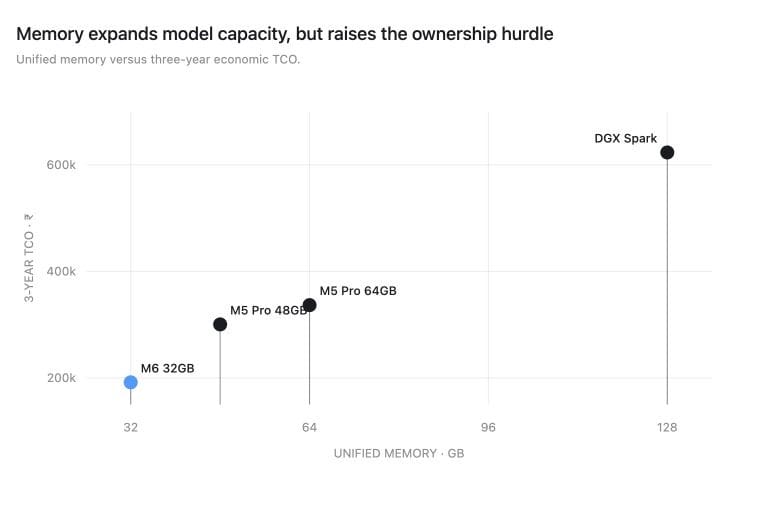
The M5 Pro’s 64GB tier is economically sensible only when the extra 16GB enables a materially better model or avoids context-related failures. DGX Spark’s 128GB is valuable for large local models, but its monetary hurdle is substantially higher.
Local-Model Total Cost of Ownership
Base Assumptions
| Item | M6 32GB | M5 Pro 48GB | M5 Pro 64GB | DGX Spark |
|---|---|---|---|---|
| Hardware | ₹135,900 | ₹281,900 | ₹329,900 | ₹542,499 |
| Accessories and storage | ₹18,000 | ₹16,000 | ₹16,000 | ₹8,000 |
| Annual electricity | ₹1,000 | ₹1,300 | ₹1,300 | ₹2,500 |
| Annual maintenance reserve | 1% of price | 1% | 1% | 1% |
| Setup labour | 8 hours | 8 hours | 8 hours | 12 hours |
| Ongoing labour | 1 hour/month | 1 hour/month | 1 hour/month | 2 hours/month |
| Three-year resale | 45% | 45% | 45% | 30% |
The accessory allowance assumes the user already owns a monitor. The Mac allowance includes external storage and basic peripherals. DGX Spark already includes 4TB of storage.
One-, three- and five-year TCO
Each cell shows cash TCO / economic TCO. Economic TCO includes labour and the opportunity cost of tied-up capital.
| Device | One year | Three years | Five years |
|---|---|---|---|
| Mac mini M6 32GB | ₹61,129 / ₹101,090 | ₹99,822 / ₹191,629 | ₹131,720 / ₹271,295 |
| Mac mini M5 Pro 48GB | ₹104,689 / ₹154,498 | ₹183,402 / ₹300,373 | ₹248,020 / ₹423,695 |
| Mac mini M5 Pro 64GB | ₹119,569 / ₹172,642 | ₹211,242 / ₹336,565 | ₹286,420 / ₹474,095 |
| DGX Spark | ₹232,925 / ₹321,965 | ₹411,524 / ₹623,114 | ₹535,874 / ₹854,824 |
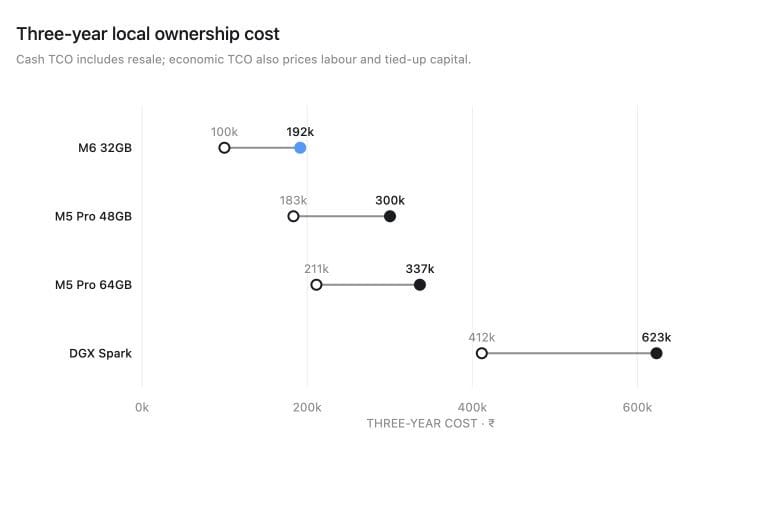
The gap between cash and economic TCO is the hidden labour and capital cost. This gap matters far more than electricity for most desktop systems.
Worked example: M6 over three years
- Purchase: ₹135,900
- Accessories: ₹18,000
- Electricity: 3 × ₹1,000 = ₹3,000
- Maintenance: 3 × ₹1,359 = ₹4,077
- Resale: 45% × ₹135,900 = ₹61,155
Therefore:
Cash TCO = ₹135,900 + ₹18,000 + ₹3,000 + ₹4,077 − ₹61,155
Cash TCO = ₹99,822
Labour is:
(8 setup hours + 36 maintenance hours) × ₹1,500 = ₹66,000
Adding approximately ₹25,807 of capital cost gives:
Three-year economic TCO = ₹191,629
A technically skilled owner may treat setup as recreation or learning. A business paying an employee cannot reasonably value that time at zero.
Hosted Subscriptions
India prices can be localized at checkout. These estimates convert published US prices at ₹95/$ and add 18% GST.
| Plan | Estimated monthly fee | Annual fee | Access and limitations |
|---|---|---|---|
| ChatGPT Plus | ₹2,241 | ₹26,892 | Advanced reasoning, uploads, research, Codex and Work; limits apply |
| ChatGPT Pro 5× | ₹11,207 | ₹134,484 | Approximately five times Plus usage; Pro reasoning |
| ChatGPT Pro 20× | ₹22,413 | ₹268,956 | Approximately 20 times Plus usage; highest individual tier |
| ChatGPT Business, annual | ₹2,802/user/month | ₹33,624/user | Dedicated workspace and administration; minimum two users |
| ChatGPT Business, monthly | ₹3,362/user/month | ₹40,344/user | Monthly billing; additional credits may be required |
| Claude Pro | Approximately ₹2,241 monthly | ₹22,884–₹26,892 | Projects, research and Claude Code; limits apply |
| Claude Max 5× | ₹11,207 | ₹134,484 | Five times Pro capacity |
| Claude Max 20× | ₹22,413 | ₹268,956 | Twenty times Pro capacity |
| Claude Team, annual | ₹2,802/user/month | ₹33,624/user | Five-seat minimum; Claude Code excluded |
| Enterprise | Contact sales | Contract-specific | Negotiated capacity, compliance and support |
Subscription access is not equivalent to reserved API capacity. “Unlimited” services remain subject to usage policies and abuse guardrails.
Subscriptions also do not include general API tokens.
Hosted API costs
Official list prices per million tokens:
| Model | Input | Cached input | Output |
|---|---|---|---|
| OpenAI GPT-5.6 Sol | $4.00 | $0.40 | $20.00 |
| OpenAI GPT-5.6 Terra | $2.00 | $0.20 | $12.00 |
| OpenAI GPT-5.6 Luna | $0.20 | $0.02 | $1.20 |
| Anthropic Claude Opus 4.8 | $5.00 | $0.50 | $25.00 |
Estimated monthly API spending
| Model | Light | Regular | Heavy | Automation-heavy |
|---|---|---|---|---|
| GPT-5.6 Sol | ₹1,885 | ₹11,309 | ₹45,235 | ₹188,480 |
| GPT-5.6 Terra | ₹1,037 | ₹6,224 | ₹24,898 | ₹103,740 |
| GPT-5.6 Luna | ₹104 | ₹622 | ₹2,490 | ₹10,374 |
| Claude Opus 4.8 | ₹2,356 | ₹14,136 | ₹56,544 | ₹235,600 |
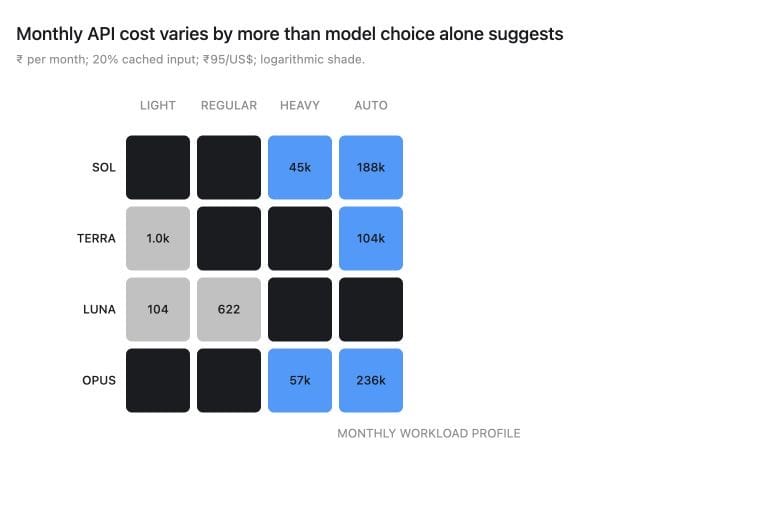
The model tier can change the monthly bill by approximately two orders of magnitude. Optimizing model selection frequently saves more than optimizing electricity or local hardware.
Worked API example
The regular profile uses 18M input and 3M output tokens.
For GPT-5.6 Sol:
- Uncached input: 14.4M × $4 = $57.60
- Cached input: 3.6M × $0.40 = $1.44
- Output: 3M × $20 = $60
- Total: $119.04
- At ₹95/$: ₹11,309 per month
Long contexts, search, images, fast processing and regional processing can add further charges.
Cost per Unit of Work
Three-year economic cost per month
| Device | Monthly economic cost |
|---|---|
| M6 32GB | ₹5,323 |
| M5 Pro 48GB | ₹8,344 |
| M5 Pro 64GB | ₹9,349 |
| DGX Spark | ₹17,309 |
Local cost per million combined tokens
| Device | Light | Regular | Heavy | Automation-heavy |
|---|---|---|---|---|
| M6 32GB | ₹1,521/MTok | ₹253 | ₹63 | ₹15 |
| M5 Pro 48GB | ₹2,384 | ₹397 | ₹99 | ₹24 |
| M5 Pro 64GB | ₹2,671 | ₹445 | ₹111 | ₹27 |
| DGX Spark | ₹4,945 | ₹824 | ₹206 | ₹49 |
The automation column is an allocation calculation, not a capacity promise. A single small system may be unable to generate 350M tokens per month, particularly with large dense models.
Local inference cost depends on utilization because most expenses are fixed. If usage halves, cost per token roughly doubles. If usage doubles, cost per token approximately halves—until the device reaches its throughput ceiling.
Cost per productive hour
| Device or plan | Light | Regular | Heavy |
|---|---|---|---|
| M6 32GB | ₹242/hour | ₹60 | ₹30 |
| M5 Pro 48GB | ₹379 | ₹95 | ₹47 |
| M5 Pro 64GB | ₹425 | ₹106 | ₹53 |
| DGX Spark | ₹787 | ₹197 | ₹98 |
| ChatGPT Plus | ₹102 | ₹25 | ₹13 |
| ChatGPT Pro 20× | ₹1,019 | ₹255 | ₹127 |
Subscription cost per hour is only meaningful when the workload remains within the plan’s limits.
Representative Task
Assume a document-analysis or coding task uses 50,000 input and 5,000 output tokens.
| Option | Raw cost per task |
|---|---|
| GPT-5.6 Sol API | ₹25.08 |
| GPT-5.6 Terra API | ₹13.49 |
| GPT-5.6 Luna API | ₹1.35 |
| Claude Opus 4.8 API | ₹31.35 |
| M6 local at regular utilization | Approximately ₹13.93 |
| M5 Pro 48GB local | Approximately ₹21.84 |
| M5 Pro 64GB local | Approximately ₹24.50 |
| DGX Spark local | Approximately ₹45.32 |
The local calculation assumes generated tokens are useful. Retries and rejected answers increase the real cost.
Break-even Analysis
Against a high-tier subscription
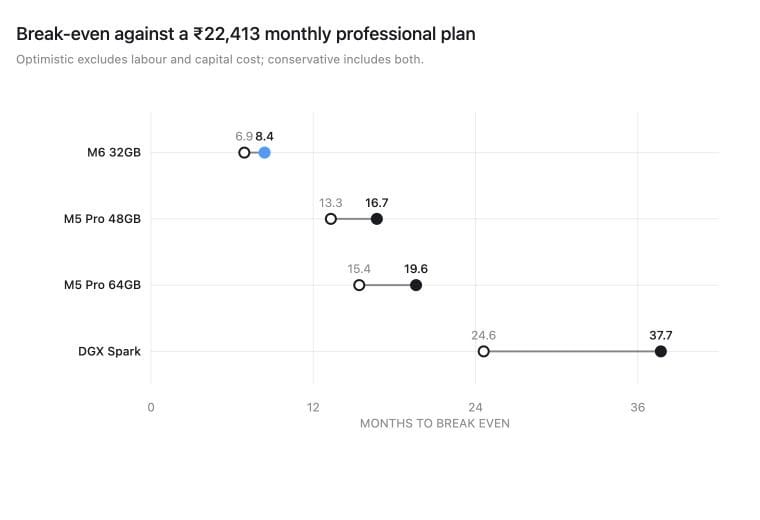
The next chart compares local hardware with a ₹22,413/month professional plan.
- Optimistic: Hardware and accessories only
- Conservative: Includes labour, electricity, maintenance and capital cost
| Device | Optimistic | Conservative |
|---|---|---|
| M6 32GB | 6.9 months | 8.4 months |
| M5 Pro 48GB | 13.3 months | 16.7 months |
| M5 Pro 64GB | 15.4 months | 19.6 months |
| DGX Spark | 24.6 months | 37.7 months |
Against a ₹2,241 Plus subscription, dedicated local hardware is difficult to justify. Even the M6 requires roughly 69 months to recover hardware and accessories before labour is included.
Against an ₹11,207 Pro 5× plan, optimistic break-even is approximately:
- M6: 14 months
- M5 Pro 48GB: 27 months
- M5 Pro 64GB: 31 months
- DGX Spark: 49 months
The Utilization Threshold
The decisive question is not “How many tokens can this machine generate?” It is “How much cloud expenditure will actually disappear?”
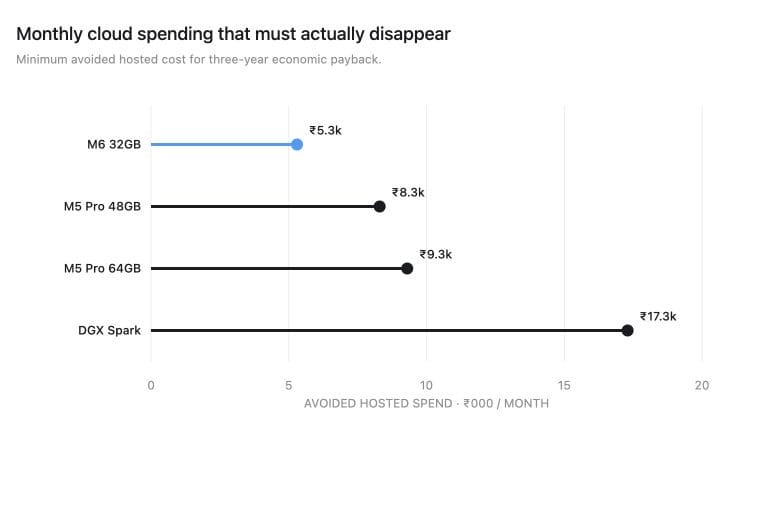
For three-year economic payback, the device must displace approximately:
- M6 32GB: ₹5,323/month
- M5 Pro 48GB: ₹8,344/month
- M5 Pro 64GB: ₹9,349/month
- DGX Spark: ₹17,309/month
If a local system merely supplements an existing subscription without reducing that subscription or its API bill, it has not generated the assumed saving.
Break-even against API tokens
| Device | Sol | Terra | Luna | Opus |
|---|---|---|---|---|
| M6 32GB | 356M tokens | 647M | 6.5B | 285M |
| M5 Pro 48GB | 558M | 1.01B | 10.1B | 446M |
| M5 Pro 64GB | 625M | 1.14B | 11.4B | 500M |
| DGX Spark | 1.16B | 2.10B | 21.1B | 926M |
The M6 threshold against Sol is approximately 9.9M tokens per month over three years. This is a financial equivalence—not a claim that a 27B local model equals a frontier model.
Advantages and Disadvantages
Local hosting
Advantages:
- Strong privacy and data control
- Offline availability
- Predictable marginal cost
- No provider message quotas
- Control over models and version changes
- Private retrieval and automation
- Ability to freeze a validated model and workflow
Disadvantages:
- Upfront capital expense
- Model-quality gap for difficult work
- Hard memory and context constraints
- Electricity, heat, noise and storage
- Setup, updates, security and backups
- Monitoring and recovery responsibility
- Model-specific commercial licences
- Rapid model and hardware obsolescence
- Models may fit in memory but run too slowly
Hosted frontier services
Advantages:
- Access to leading models
- Integrated research, coding, vision and tool use
- Low upfront cost
- Provider-managed reliability and upgrades
- Large contexts
- Business and enterprise administration
- Faster deployment
Disadvantages:
- Recurring and potentially unpredictable charges
- Rate limits and usage policies
- Data-retention and compliance questions
- Vendor lock-in
- Model retirement or behaviour changes
- Internet and provider dependency
- Subscription access is not guaranteed API capacity
Capability-adjusted Economics
Tokens are not interchangeable.
| Dimension | Local open-weight model | Hosted frontier model |
|---|---|---|
| Complex reasoning | Improving, but model-dependent | Usually strongest |
| Critical coding | Good for routine work | Better for difficult debugging and repository-scale changes |
| Multimodal support | Available but fragmented | Usually integrated |
| Tool use | Fully controllable but must be engineered | Mature hosted orchestration |
| Reliability | User-maintained | Provider-managed |
| Privacy | Strongest when secured and offline | Depends on plan and contract |
| Offline access | Yes | No |
| Setup time | Material | Minimal |
| Model stability | Can be frozen | Provider may update or retire models |
| Maintenance | User responsibility | Provider responsibility |
Cost per acceptable completed task
Consider an illustrative set of 100 analytical tasks:
- Local raw cost: ₹14/task
- Local first-pass acceptance: 75%
- Local review: 10 minutes/task
- Frontier raw cost: ₹25/task
- Frontier first-pass acceptance: 92%
- Frontier review: four minutes/task
- Professional labour: ₹1,500/hour
Local:
(₹14 + ₹250 review labour) ÷ 0.75
₹352 per acceptable task
Frontier:
(₹25 + ₹100 review labour) ÷ 0.92
₹136 per acceptable task
These acceptance rates are illustrative, not benchmark results. Organizations should measure them using their own documents, codebases and quality standards.
Frontier quality generally outweighs higher monetary cost when:
- An error creates legal, financial, security or reputational risk.
- The work requires difficult reasoning.
- Incorrect code will consume expensive debugging time.
- Integrated browsing, vision or computer use is required.
- The output is customer-facing.
- Senior employee review time is expensive.
Sensitivity Analysis
| Variable | Sensitivity | Likely result |
|---|---|---|
| Electricity | ₹6–₹18/kWh | Rarely changes the winner by itself |
| Utilization | 50%–200% of forecast | Halving usage roughly doubles local cost per token |
| Resale | Base case to zero | Adds ₹61K–₹163K to three-year TCO |
| Throughput | Expected speed to half-speed | Can double local cost per delivered token |
| API prices | Current to 50% lower | Approximately doubles local token break-even |
| Subscription price | Current to 20% higher | Shortens hardware break-even by about 17% |
| Hardware failure | None to full replacement | Can add the full device price and downtime |
| Labour value | ₹500–₹3,000/hour | Three-year Mac labour ranges from ₹22K to ₹132K; DGX from ₹42K to ₹252K |
| Model quality | High acceptance to frequent retries | Can overwhelm all compute savings |
| Useful life | Five years to two years | Short life materially raises monthly TCO |
Employee time, utilization, resale and model quality matter much more than small electricity-price changes.
The Hybrid Strategy
A hybrid setup assigns each workload to the economically appropriate model.
Use local models for:
- Confidential document retrieval
- Repetitive summarization
- Classification and extraction
- Draft generation
- Offline work
- Routine code explanation
- High-volume preprocessing
- Tasks with machine-checkable outputs
Use frontier services for:
- Difficult reasoning
- Critical coding and debugging
- Multimodal analysis
- Live research
- Complex tool use
- High-stakes writing
- Final review
- Customer-facing deliverables
For example, a local model can summarize and redact 500 confidential documents. A frontier model can then reason over the smaller, sanitized synthesis. This reduces API tokens and data exposure without forcing the local model to perform the hardest task.
Recommendations by Profile
Light user
Use hosted access.
GPT-5.6 Luna API costs approximately ₹104/month at the assumed volume. ChatGPT Plus or Claude Pro costs more but provides a complete interface with files, research, memory and multimodal tools.
Do not buy dedicated local hardware solely to save inference costs.
Regular professional
Start with a subscription or API.
A local M6 becomes attractive when it can eliminate at least ₹5,300 of monthly hosted spending and its 7B–27B-class models are good enough for the work.
Choose an M5 Pro only when additional memory enables a model or context length that measurably improves task acceptance.
Heavy professional
Use a hybrid setup.
An economical API can still be cheaper than owning hardware at the assumed volume. Local hardware becomes attractive for the portion of work that would otherwise use Sol-, Opus-, or high-tier subscription capacity.
The M5 Pro 64GB tier is appropriate when 70B Q4 models are necessary. It is not automatically the best choice merely because it has more memory.
Automation-heavy User
Benchmark the real pipeline before purchasing hardware.
At 350M combined tokens per month, estimated API costs range from about ₹10,374 for Luna to ₹235,600 for Opus.
Local inference can offer strong economics if:
- The system meets throughput requirements.
- The local model passes quality tests.
- Workloads remain steady.
- Engineering support already exists.
- Cloud expenditure actually falls.
DGX Spark is most defensible when large local models, CUDA, concurrent agents, or strict data control are required.
Final Verdict
1- Which option is cheapest for light users?
Hosted access. A low-cost API is cheapest monetarily; Plus or Claude Pro is usually the best complete productivity product.
2- Which is cheapest for regular professionals?
Usually a subscription or economical API. An M6 only becomes attractive when it consistently replaces more than about ₹5,300/month of hosted work.
3- Which is cheapest for heavy users?
An economical API can still be cheapest. Local hardware wins against expensive frontier API usage when enough suitable work is moved locally. Subscriptions remain excellent value when their limits are sufficient.
4- At what utilization does local hardware become attractive?
Approximately 10M combined tokens per month for the M6 when compared with Sol pricing over three years. The corresponding thresholds are roughly 16M for M5 Pro 48GB, 17M for M5 Pro 64GB and 32M for DGX Spark.
5- When does frontier quality outweigh higher monetary cost?
When better reasoning reduces retries, review, debugging, factual errors or business risk.
6- Which workloads genuinely benefit from local hosting?
Private retrieval, confidential analysis, repetitive extraction, offline work, stable classification and high-volume preprocessing.
7- Is hybrid best for most professionals?
Yes. It captures local privacy and marginal-cost advantages while retaining frontier quality for consequential tasks.
8- What changes if privacy or offline access is mandatory?
Local processing becomes the default. The decision shifts from “local or hosted?” to “which local device meets the requirement?”
Decision Matrix
| Requirement | Best starting point |
|---|---|
| Light use | Subscription or low-cost API |
| Regular work with integrated tools | Hosted subscription |
| Automation below ₹5K/month | API |
| Private 7B–27B work | Mac mini M6 32GB |
| Private 30B–40B work | Mac mini M5 Pro 48GB |
| Local 70B Q4 work | Mac mini M5 Pro 64GB |
| Local 70B–120B, CUDA or concurrency | DGX Spark after benchmarking |
| Difficult reasoning or critical coding | Frontier model |
| Mandatory offline processing | Local hardware |
| Little technical maintenance capacity | Hosted service |
| Mixed private and high-quality work | Hybrid |
| Uncertain future volume | Run a 30–60 day API pilot |
Methodology Limitations
1- M6 independent benchmark coverage remains limited.
2- Benchmark results use different models and runtimes.
3- Subscription limits can change without being stated as token quantities.
4- India prices may differ at checkout.
5- API taxes depend on the customer’s billing arrangement.
6- Quantization changes both memory use and quality.
7- Resale values are estimates.
8- The model does not assign monetary value to privacy or offline resilience.
9- Organizations must measure their own acceptable-task rates.
10- The charts use templates from Lieflat Charts. Review its PolyForm Noncommercial licence before commercial publication.
Sources
- Apple Mac mini specifications
- Apple India Mac mini store
- Apple M5 Pro 48GB configuration
- Apple M6 and M5 Pro announcement
- NVIDIA DGX Spark specifications
- NVIDIA DGX Spark marketplace
- NVIDIA price-change announcement
- NVIDIA DGX Spark warranty
- OpenAI ChatGPT pricing
- OpenAI API model pricing
- OpenAI multi-currency billing
- OpenAI Pro tiers
- Anthropic subscription pricing
- Anthropic plan comparison
- Anthropic API list prices
- M5 Pro benchmark dataset
- DGX Spark benchmark report
- Lieflat Charts repository
