
There is a peculiar kind of mental vertigo that strikes the deeply curious. You ask why something is true. Someone gives you an answer. You ask why that is true. They give you another answer. And then you ask again. And again. Until, somewhere around the fifth or sixth iteration, the person you are questioning either falls silent, or reaches for a phrase like “that’s just how it is,” or “everyone knows this,” or “it has always been done this way.”
That moment — that exact moment of silence — is philosophically the most interesting place in any conversation. And it is the doorway to first principles thinking.
This essay is about that doorway, and how you can learn to find it deliberately.
What Is Infinite Regress?
Infinite regress is a concept from philosophy and logic. It describes a situation where every justification for a belief, action, or explanation itself requires a further justification — and that justification requires yet another, and so on, without end.
It sounds abstract. Let us make it concrete.
Suppose a junior officer presents a policy recommendation: “We should continue subsidising this input because the farmers need it.”
You ask: “Why do the farmers need it?”
“Because without it, their input costs will rise.”
“Why does that matter?”
“Because it will reduce their net income.”
“Why is that a problem?”
“Because poor farmers cannot absorb income shocks.”
“Why can they not absorb income shocks?”
“Because they have no savings buffer.”
“Why do they have no savings buffer?”
“Because their income is irregular and low.”
“Why is their income irregular and low?”
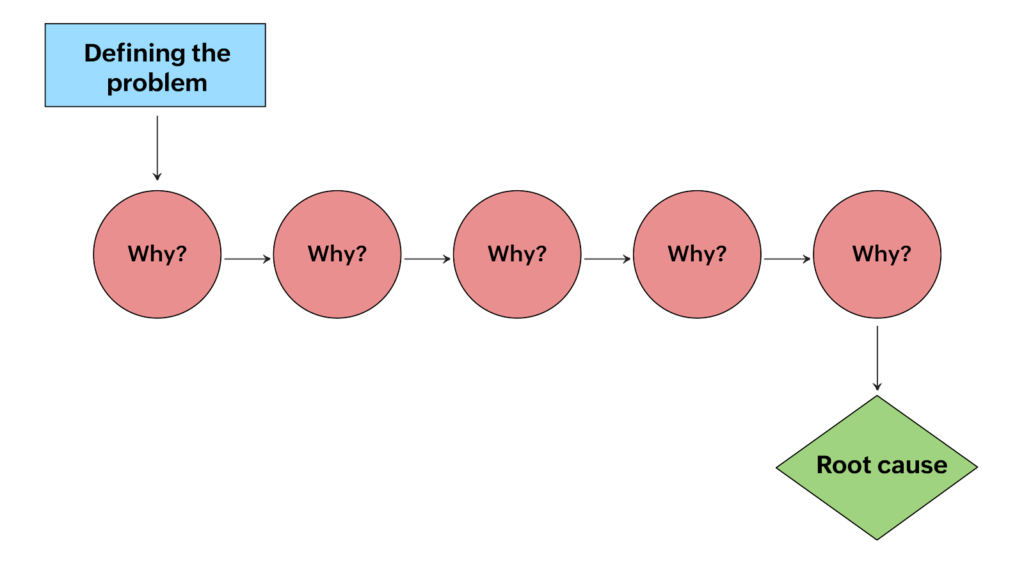
Root Cause Analysis: Steps, methods, & process
If the officer reaches this point and says “because… that is just the nature of agriculture,” you have arrived at an unjustified assumption. And unjustified assumptions, masquerading as bedrock truths, are the source of most bad policy.
This is the infinite regress in action. Not as a problem to be feared, but as a diagnostic tool of extraordinary power.
The Ancient Roots of This Inquiry
The Greeks were the first to systematise this kind of questioning. Aristotle, grappling with the problem of infinite regress in his Posterior Analytics, recognised that if every piece of knowledge required prior knowledge as its justification, and that prior knowledge required yet more prior knowledge, the chain could never begin. Knowledge itself would be impossible.

Aristotle Marble Bust: Classical Greek Philosopher Portrait Stock Image – Image of knowledge, rhetoric: 406407673
His solution was to posit what he called “first principles” — archai — basic truths that were self-evident and did not themselves require proof. These were the bedrock on which the entire edifice of knowledge could rest.
But Aristotle did not ask us to simply accept first principles on faith. He asked us to arrive at them through rigorous examination. The regress is the method of arrival. You keep asking “why” until you reach a claim that cannot be reduced further — and then you examine that claim with all the scrutiny you can muster.
In the Indian philosophical tradition, a parallel inquiry runs through the Nyaya school of logic. The Naiyayikas were deeply interested in pramana — valid sources of knowledge — and wrestled with similar questions about what ultimately grounds our claims to know anything at all. The concept of anavastha (non-termination or infinite regress) was explicitly identified as a logical fallacy in Nyaya philosophy, meaning a chain of reasoning that never terminates is considered defective reasoning. Good reasoning must terminate somewhere solid.
Both traditions, separated by thousands of miles and centuries, converged on the same insight: you must follow the chain of “why” until you hit bedrock — and bedrock must be examined, not assumed.
The Modern Articulation: Elon Musk and the Battery Problem
The most widely cited contemporary example of first principles thinking is Elon Musk’s approach to battery costs in the early days of Tesla. His articulation of the method is worth pausing on.
When he was told that battery packs for electric vehicles cost around $600 per kilowatt-hour and would always be expensive “because that’s what they cost,” he applied what he explicitly called first principles reasoning. He asked: what are batteries actually made of? Cobalt, nickel, lithium, carbon, and a polymer separator. What do these materials cost on commodity markets? Roughly $80 per kilowatt-hour at the time. So the $600 cost was not a physical law — it was an industrial and organisational assumption, a product of how things had always been done.
Recognising this, Tesla built its own manufacturing infrastructure and drove costs down dramatically.
This is the power of locating unjustified assumptions through the regress and then replacing them with what is actually, verifiably true.
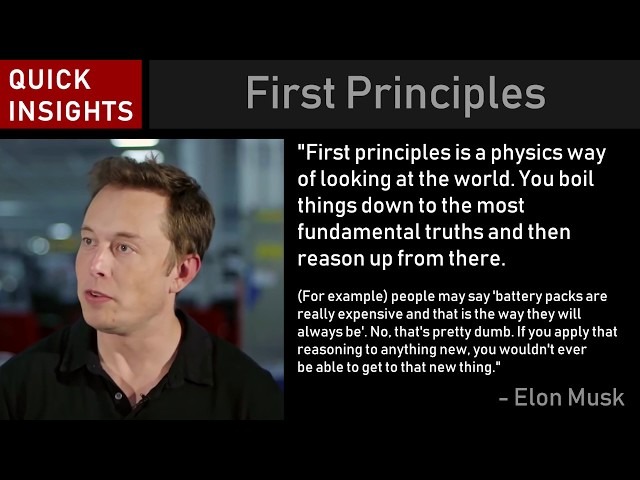
supplychaintoday.com First Principles: Elon Musk Method of Thinking. https://www.youtube.com/watch?v=ZqhN2YWTw0M
But notice what made this possible: Musk was willing to be in the vertigo of the infinite regress long enough to see where the chain of “because” actually terminated — and to notice that it was terminating not in bedrock, but in sand.
The Regress as a Mental Clearing Tool
Now we come to the deeper psychological point, which is less discussed but more profound.
Most of us carry around an enormous weight of inherited beliefs — about how organisations work, about what is politically possible, about what people are capable of, about what counts as a good life. These beliefs were not chosen. They were absorbed. From family, from education, from professional culture, from the accumulated sediment of lived experience interpreted through frameworks we never consciously selected.
The infinite regress, practised honestly, is a method for clearing this sediment.
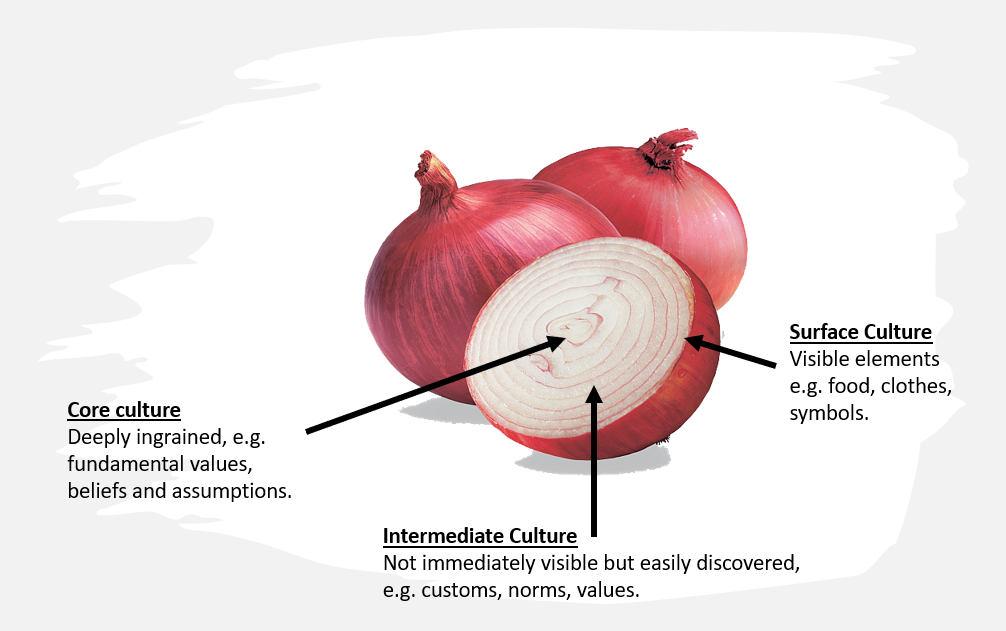
tips.targettraining.eu .Boost your Business Communication Skills- Part 1 → The Onion Model of Culture – Target Training GmbH
Here is the technique, applied inwardly:
Take any belief you hold strongly. Not a trivial one — a consequential one. Something like: “Decentralisation always improves governance outcomes.” Or: “Technology is the primary driver of rural poverty reduction.” Or even something personal: “Hard work is always rewarded.”
Now apply the regress.
Why do you believe this?
Identify the reason you would give.
Why do you believe that reason is true?
Go one level deeper.
And why is that true?
Keep going. Do not stop at the first moment of discomfort. The discomfort is the point. It means you have hit a layer of belief that has not been examined.
At some point, one of three things will happen:
First, you will arrive at a genuinely self-evident claim — something like “I believe suffering is bad, and this policy reduces suffering.” That is solid ground. You can build on it.
Second, you will arrive at an empirical claim that can be tested — “I believe this because studies show X.” Good. Now you can ask whether the studies are reliable, whether the conditions apply to your context, whether the data has been updated.
Third, and most revealingly, you will arrive at nothing at all. Just a vague feeling, an old habit of thought, a remembered authority figure saying something you never questioned. This is the gift of the regress — it shows you where your thinking is hollow.
That hollow space, once identified, can be rebuilt with something real.
Why This Is So Difficult: The Psychological Resistance
Practicing this technique sincerely is harder than it sounds, because the mind has powerful defenses against the infinite regress.
The first defence is authority substitution. Instead of following the chain of reasoning, we substitute a respected name. “The World Bank says so.” “Our training taught us this.” “My mentor always said this.” But authority is not an argument. It is a placeholder for argument. A first principles thinker accepts authority only as a starting point for inquiry, not as an ending point.
The second defence is complexity as camouflage. When a chain of reasoning becomes genuinely complex, it is easy to retreat into the complexity itself and pretend that complexity means depth. But genuine complexity, when traced patiently, still resolves into basic claims. The regress does not become invalid just because the domain is complicated.
The third defence is emotional investment. Some of our beliefs are identity-constituting. We believe certain things not because the evidence supports them but because ceasing to believe them would require us to revise our sense of who we are. The regress, when it threatens these beliefs, triggers not intellectual curiosity but something closer to anxiety or anger. This is the most important moment to stay in the regress — and also the hardest.
The philosopher Daniel Dennett described a useful practice he called “holding a belief lightly” — maintaining a belief as a working hypothesis rather than a fixed conviction, always available for revision when the regress reveals a crack. This is the mental posture that first principles thinking requires.
Where the Regress Terminates: Types of Bedrock
When you follow the chain of “why” long enough, there are several types of bedrock you can legitimately reach.
Logical necessity. Some things are true because their negation is a contradiction. “A statement cannot be both true and false at the same time.” This is bedrock.
Empirical observation. “I have directly observed this phenomenon, repeatedly, under varied conditions.” This is bedrock, though it requires you to hold it with appropriate tentativeness — because observation is fallible.
Shared value commitments. “I believe this because it follows from my commitment to the dignity of the individual.” This is also a legitimate termination point — not a fact about the world, but a foundational value claim that you are consciously endorsing.
Pragmatic axioms. “I assume this because without it, reasoning itself becomes impossible.” The assumption that our senses roughly track reality, for instance, is not something we can prove without already assuming it. But we adopt it as a working axiom because the alternative is intellectual paralysis.
What is not legitimate bedrock is any claim that terminates in “because everyone believes this,” “because it has always been so,” or “because this is not my department.” These are exactly the termination points that infinite regress exposes as fraudulent.
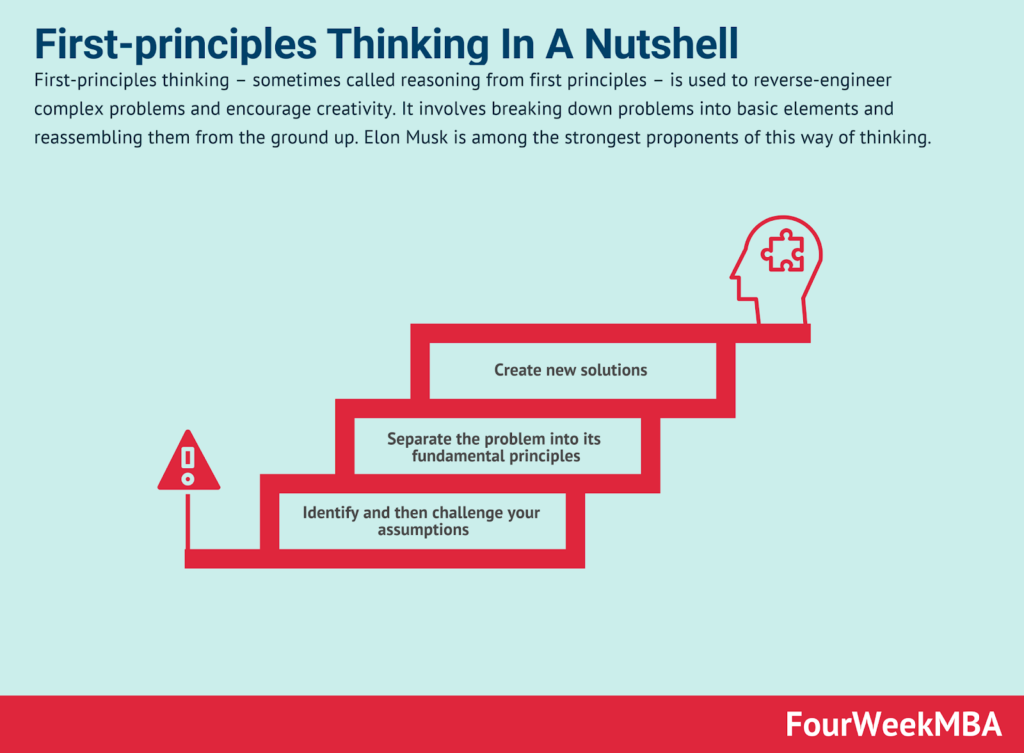
fourweekmba.com . First-principles Thinking In A Nutshell
Applying This in the Real World: A Framework
The infinite regress, as a practical tool for first principles thinking, can be applied in at least three domains.
1. Policy and Institutional Design
When evaluating any existing policy or institutional arrangement, the regress question is: “Why does this exist in this form?” Follow the chain. Often, you will find that a policy exists because of a problem that no longer exists — or because of a political constraint that has since shifted — or because of a technology landscape that has been completely transformed. The policy remains; the justification has dissolved. The regress makes this visible.
2. Problem Solving
When faced with a complex problem, the regress operates as a causal drilling tool. You ask not just “what is the problem?” but “why does this problem exist?” and then “why does that condition exist?” The deepest cause you can reach, that is still actionable, becomes your lever point. Interventions at this level are typically far more effective than interventions at the surface.
3. Personal Belief Auditing
Periodically, it is worth selecting a set of beliefs you hold about yourself, your work, and your world, and running the regress on them. Not to destroy them — many will survive the process strengthened, because they will have been consciously examined and found to be genuinely solid. But the ones that do not survive deserve to be let go.
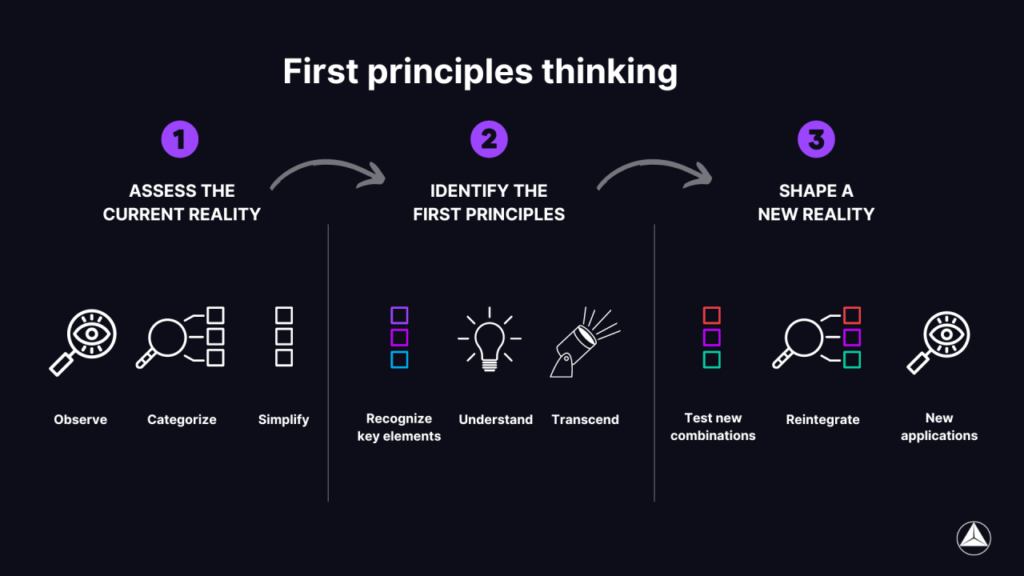
linkedin.com Understanding and Applying the First Principles Thinking
The Regress and the Clarity of Mind
There is a meditative dimension to this that is worth naming directly.
The ordinary mind is cluttered. It carries unexamined beliefs, inherited frameworks, borrowed opinions, and habitual thought patterns. Most of this clutter operates below the surface — it shapes what we see, what questions we ask, what solutions we can imagine. We do not know we are carrying it. We think we are perceiving reality; we are actually perceiving our accumulated assumptions about reality.
The infinite regress, practised consistently, is a tool for exfoliating this clutter layer by layer.
Each time you follow “why” down to a hollow place and name the hollow, you have freed yourself from one more unexamined assumption. Each time you rebuild a belief from bedrock, you carry something solid rather than something borrowed.
This is not a one-time exercise. It is an ongoing practice. The mind does not become permanently clear after one session of philosophical excavation. New assumptions accumulate. Old habits reassert themselves. But the practice, sustained over time, produces a qualitatively different kind of thinking — slower to conclusions, more tolerant of uncertainty, more capable of seeing problems as they actually are rather than as convention would have you see them.
The philosopher and mathematician René Descartes famously tried to clear his mind of all inherited belief by imagining a demon that deceived him about everything, and then asking: what could he be certain of even in that scenario? The exercise itself — this willingness to dissolve everything to bedrock — is what produced his famous insight, cogito ergo sum, I think therefore I am. The insight matters less than the method: radical, systematic, fearless excavation.

thecollector.com Why Did René Descartes Say “I Think, Therefore I Am”? | TheCollector
A Note on Humility
First principles thinking, arrived at through the discipline of infinite regress, does not produce arrogance. It produces something closer to the opposite.
When you have honestly followed a chain of reasoning to its terminus and examined what is there, you know exactly how far your knowledge extends and exactly where it stops. You know which of your beliefs rest on solid empirical ground and which rest on working assumptions. You know the difference between “I know this” and “I am assuming this” and “I do not know this.”
This precision about the limits of one’s knowledge is the foundation of genuine intellectual humility — not the performative humility of saying “I might be wrong” while secretly believing you are always right, but the structural humility of someone who has traced their own reasoning carefully enough to know where the cracks are.
And it is from this humble but clear-eyed position that the most genuinely original thinking tends to emerge.
Conclusion: The Regress as a Gift
The infinite regress is often presented as a problem — as evidence that human knowledge is fundamentally insecure, that no belief can be fully grounded. And in one reading, it is exactly that.
But in a more useful reading, it is a gift.
It is the mechanism by which a curious and honest mind can peel away layer after layer of inherited assumption until it reaches something real. It is the engine of first principles thinking. It is the method by which convention is distinguished from necessity, habit from wisdom, received opinion from earned belief.
The next time you are told “that is how it has always been done,” treat it not as an answer but as an invitation. The regress begins.
Follow it.
The author writes at the intersection of governance, philosophy, and technology. The views expressed are personal reflections on analytical methodology and epistemology and AI Cluade and Grok are used to prepare this Blog.
References
- Aristotle. (c. 350 BCE). Posterior Analytics. (Translated by G. R. G. Mure, 1928). Oxford: Clarendon Press.
- Gautama (Aksapada). (c. 2nd century BCE). Nyāya Sūtras. See also: Matilal, B. K. (1971). Epistemology, Logic, and Grammar in Indian Philosophical Analysis. The Hague: Mouton.
- Musk, E. (2013). “First principles is a physics way of looking at the world…” (Interview excerpt widely cited in profiles; full context in Isaacson, W. (2023). Elon Musk. Simon & Schuster, pp. 92–94).
- Dennett, D. C. (2013). Intuition Pumps and Other Tools for Thinking. New York: W. W. Norton & Company.
- Descartes, R. (1641). Meditations on First Philosophy. (Translated by J. Cottingham, 1984). Cambridge: Cambridge University Press.