The Strange Case of the Self-Sabotaging Brain
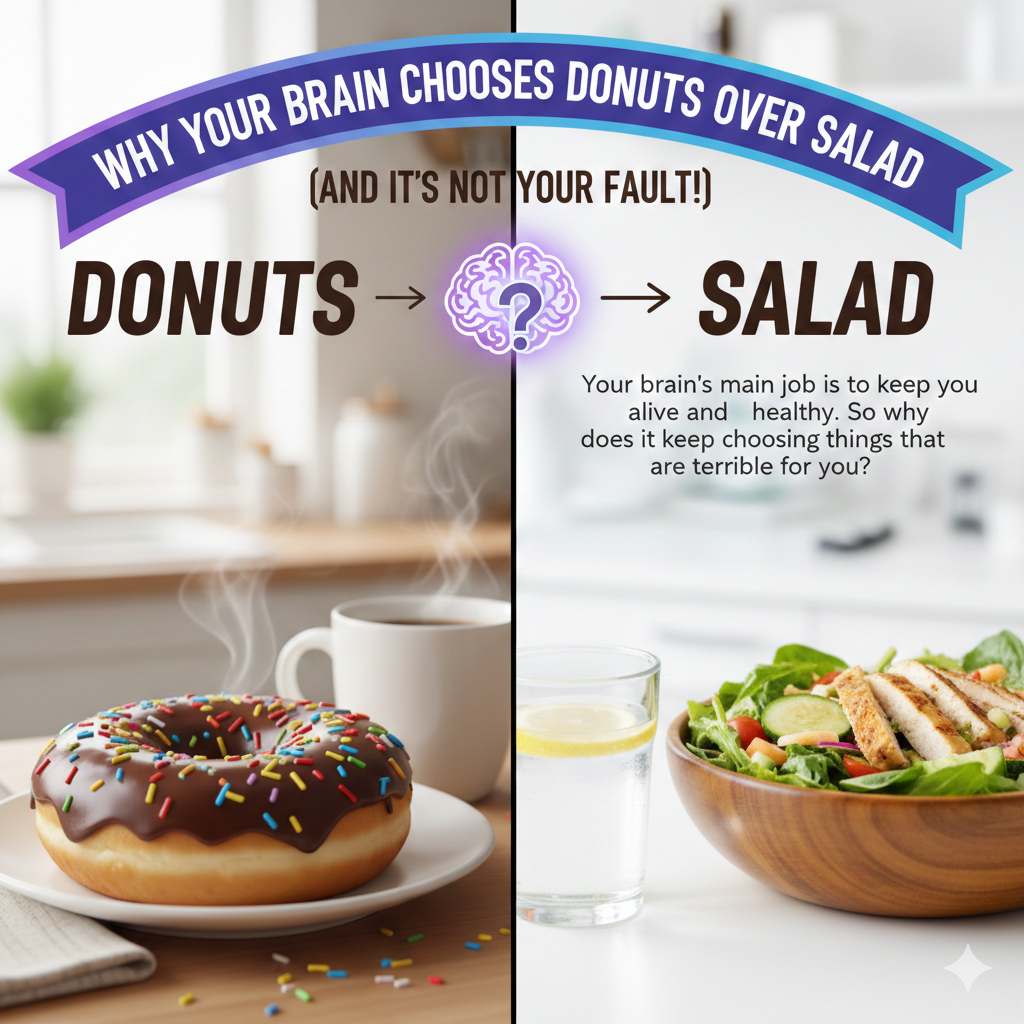
Here’s a puzzle that’s been bothering scientists for years: Your brain’s main job is to keep you alive and healthy. So why does it keep choosing things that are terrible for you?
Think about it. Your brain knows smoking causes cancer. It knows that third slice of pizza will make you feel bloated. It definitely knows that scrolling Instagram at 2 AM isn’t helping your sleep. Yet somehow, you find yourself doing these things anyway.
Are we just weak-willed? Lazy? Self-destructive?
Actually, no. The problem is much more interesting—and understanding it might help you finally break those stubborn bad habits.
Your Brain Isn’t Playing Chess, It’s Playing Whack-a-Mole
Neuroscientist Lisa Feldman Barrett has spent decades studying how the brain works, and she’s discovered something crucial: your brain is not a long-term planner. It’s a crisis manager.
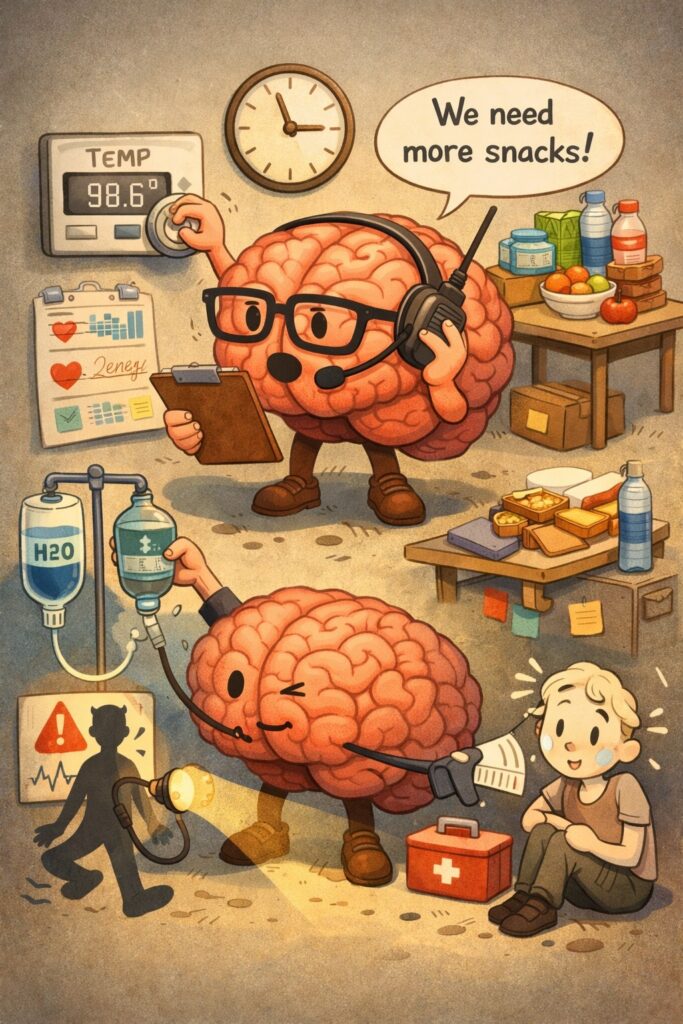
Your brain’s real job is something called allostasis—basically, keeping your body’s systems running smoothly right now and predicting what you’ll need in the next few minutes or hours. Think of it like a very anxious event coordinator who’s constantly adjusting the room temperature, ordering more snacks, and making sure nobody’s about to pass out.
The brain does this by:
- Constantly predicting what your body will need (energy, safety, water, rest)
- Adjusting your heart rate, hormones, and breathing before problems hit
- Operating on a tight energy budget (because your brain uses 20% of your body’s energy)
Here’s the catch: the brain optimizes for “getting through today with minimal stress” not “being healthy in 20 years.”
And that’s where the trouble starts.
Why That Cigarette Feels Like a Good Idea
Let’s say you’re stressed. Your brain registers this as a problem—cortisol is up, your body budget is out of balance, there’s a metaphorical fire to put out.
You light a cigarette. Within seconds:
- Stress drops
- Cortisol comes down
- Your brain thinks: “Problem solved! We fixed the energy crisis!”
From your brain’s perspective, the cigarette was a brilliant solution. It reduced immediate metabolic load. It made the prediction error (the gap between “I feel terrible” and “I want to feel okay”) disappear.
The fact that it’s shaving years off your life? That’s happening in some distant, abstract future that your brain’s prediction system doesn’t really “see.”
To your brain, the cigarette is like a fire extinguisher. The lung cancer is like climate change—real, but too far away and too slow to trigger the alarm bells.
The Dopamine Trap: When “Working Solutions” Become Prisons
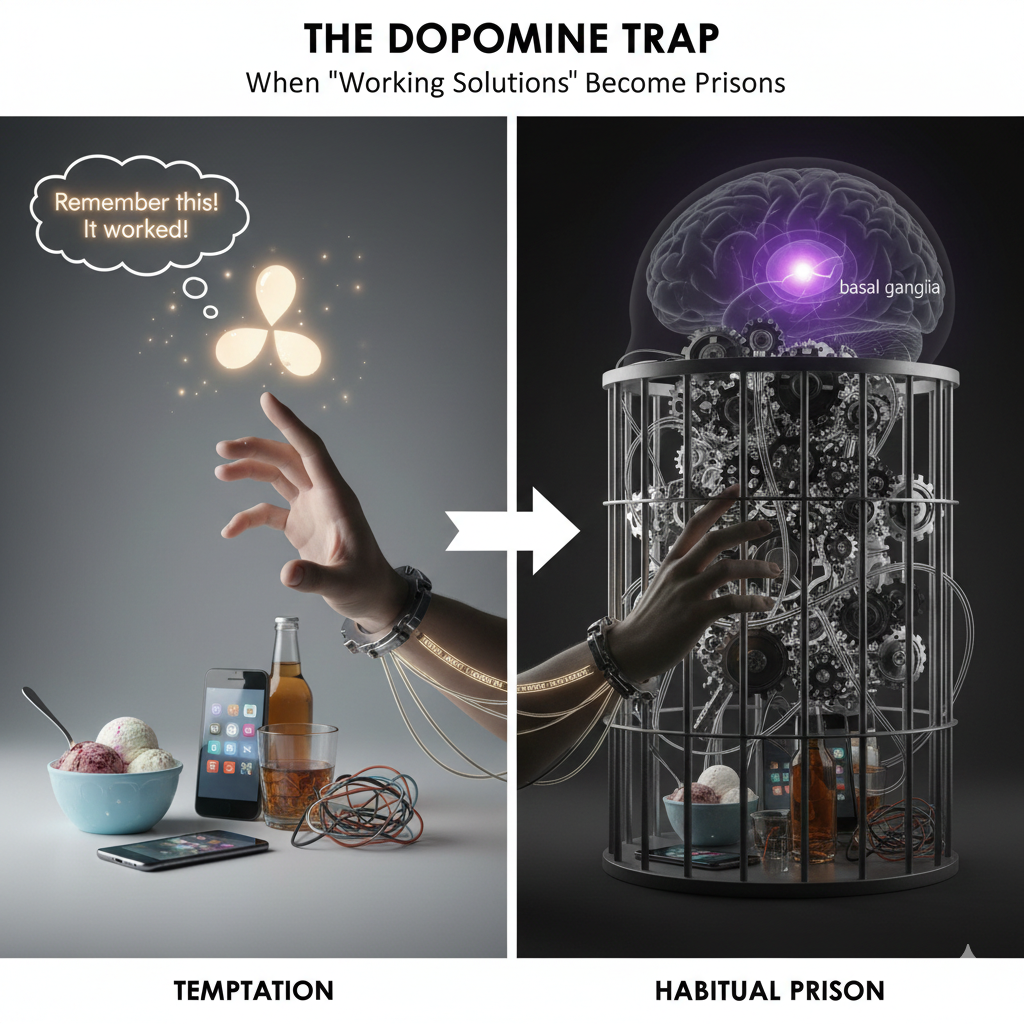
Here’s where things get really sneaky. Every time you do something that makes you feel better—even temporarily—your brain releases dopamine. This isn’t the “pleasure chemical” like pop science claims. It’s more like a learning signal that says “Remember this! It worked!”
The first time you:
- Eat ice cream when sad
- Check your phone when bored
- Have a drink to unwind
- Procrastinate on a hard task
…your brain files it under “successful strategies for dealing with discomfort.”
Do it enough times, and something fascinating happens: the behavior moves from your conscious thinking brain to your automatic habit circuits in the basal ganglia.
Now you’re not choosing to eat the ice cream. The pattern goes:
- Feel sad (cue)
- Brain automatically suggests ice cream (routine)
- Feel briefly better (reward)
And here’s the really tricky part: once this circuit forms, your brain starts releasing dopamine when you see the ice cream, not when you eat it. The dopamine becomes about the anticipation, which is why you feel that magnetic pull toward bad habits even when you consciously know better.
Your Ancient Brain in a Modern World
None of this is a design flaw. For 99% of human history, this system worked brilliantly.
Imagine you’re a hunter-gatherer:
- Food is scarce, so when you find honey or fruit, you should absolutely eat as much as possible
- Immediate threats (predators, injury, starvation) are more important than abstract long-term health
- Quick stress relief (rest, social bonding, high-calorie foods) helps you survive day-to-day
Your brain evolved to prioritize:
- Immediate over delayed
- Certain over uncertain
- Experiential over theoretical
But now you live in a world with:
- Infinite ultra-processed foods engineered to hijack your reward system
- Chronic low-grade stress (work emails, bills, social media) instead of short acute dangers
- Addictive substances and behaviors available 24/7
Your ancient allostatic brain is trying to navigate a world it was never designed for, using tools meant for scarcity in an age of abundance.
So Why Can’t Your Brain Just “Choose Better”?
Because it’s already trying to! But “better” means something different to your predictive brain than it does to your conscious, rational self.
Your conscious brain thinks: “I should eat salad and go to the gym because I want to be healthy at 60.”
Your predictive brain thinks: “I’m tired, stressed, and my energy budget is low. That donut will give me quick glucose, a dopamine hit, and social bonding if I eat it with colleagues. That’s three immediate wins for minimal effort.”
The predictive brain isn’t stupid—it’s just working with different information:
- Short-term predictions only: It can’t “see” your future heart disease
- Past-based learning: If donuts made you feel better before, that’s the data it has
- Energy efficiency: Overriding a habit takes more mental effort than running it automatically
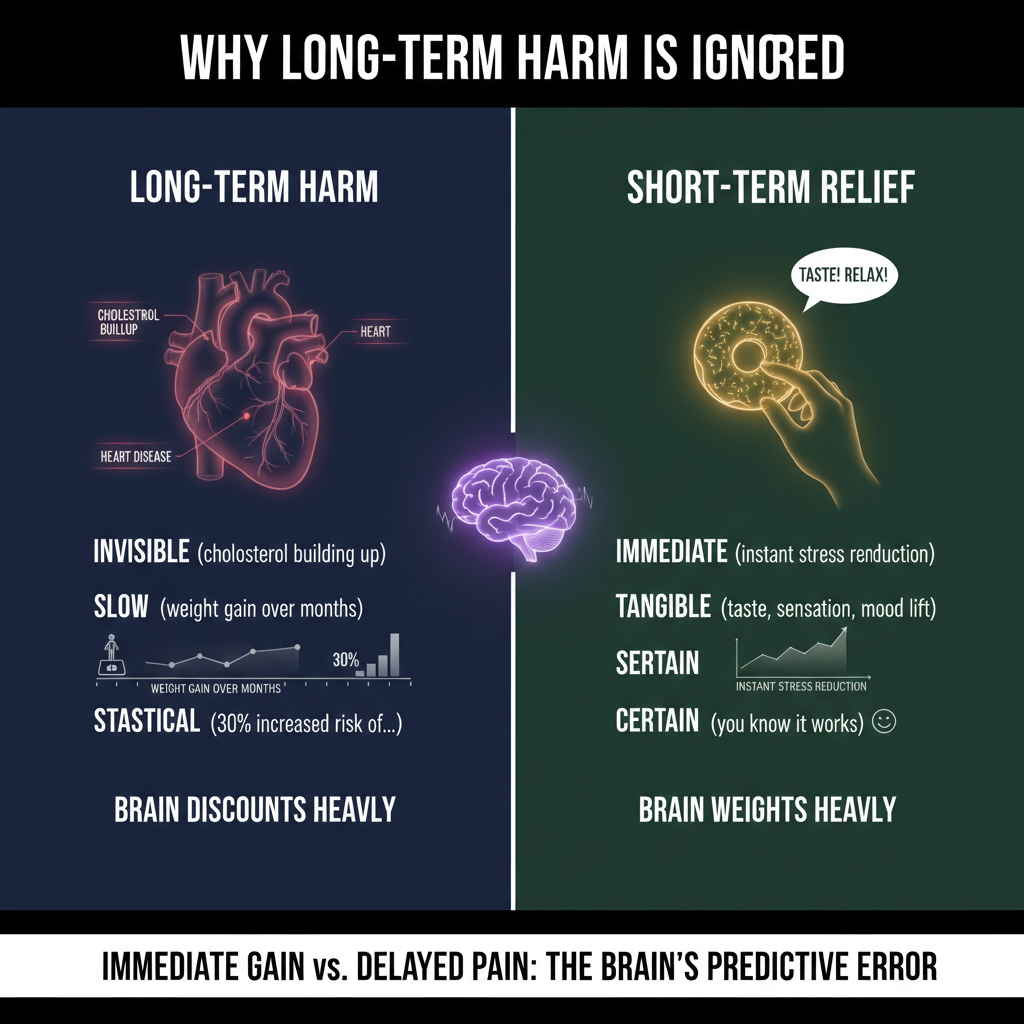
When long-term harm is:
- Invisible (cholesterol building up)
- Slow (weight gain over months)
- Statistical (30% increased risk of…)
…your brain discounts it heavily.
When short-term relief is:
- Immediate (instant stress reduction)
- Tangible (taste, sensation, mood lift)
- Certain (you know it works)
…your brain weights it much more heavily.
The Habit Lock-In Problem
Once a habit becomes automatic—moved from your prefrontal cortex to your basal ganglia—it becomes incredibly efficient. Your brain loves efficiency because efficiency means spending less precious energy.
This is why:
- You can drive home on autopilot without remembering the journey
- You automatically reach for your phone when there’s a lull in conversation
- You bite your nails without realizing it
The habit runs in the background, saving your conscious brain for other tasks. Great for good habits. Terrible for bad ones.
And here’s the kicker: even when you consciously decide to stop, the old habit pathway doesn’t get erased. It just gets suppressed by a new one. This is why stress, tiredness, or distraction can make old bad habits come roaring back—your brain defaults to the most energy-efficient option when resources are low.
Breaking Free: Working With Your Brain, Not Against It
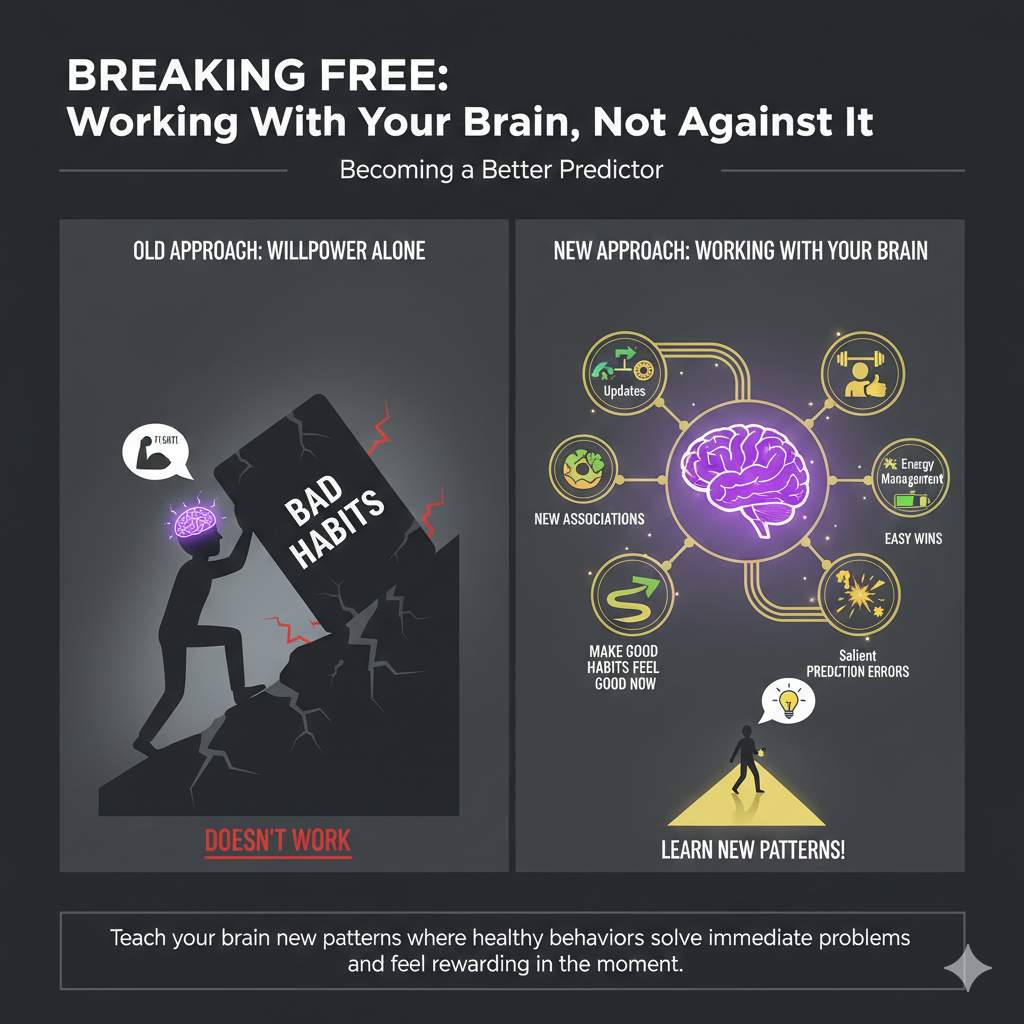
Understanding all this doesn’t magically fix bad habits, but it does change the game. Instead of fighting your brain with willpower alone, you can work with its actual operating system:
Your brain responds to:
- Prediction updates (creating new associations)
- Reward restructuring (making good habits feel good now)
- Energy management (making healthy choices the path of least resistance)
- Salient prediction errors (big enough surprises to force relearning)
The key isn’t becoming more “disciplined.” It’s becoming a better predictor—teaching your brain new patterns where healthy behaviors solve immediate problems and feel rewarding in the moment.
Because your brain isn’t sabotaging you. It’s trying to save you, one short-term crisis at a time. It just needs better intel about what “saving you” actually looks like in the 21st century.