Picture a deer in a forest. A twig snaps. The deer’s head jerks up, muscles tense, ready to bolt. But there’s nothing there—just wind. Within seconds, the deer returns to grazing, completely absorbed in eating, no lingering worry about what might have made that sound. Now picture yourself hearing a strange noise at night. Hours later, you’re still thinking about it, creating scenarios, wondering if you should have checked more carefully, planning what you’ll do if it happens again. The deer moved on instantly. You’re still there.
This difference—this gap between animal consciousness and human consciousness—didn’t happen overnight. It unfolded across millions of years, through six distinct stages that transformed not just how we think, but whether we can stop thinking at all.
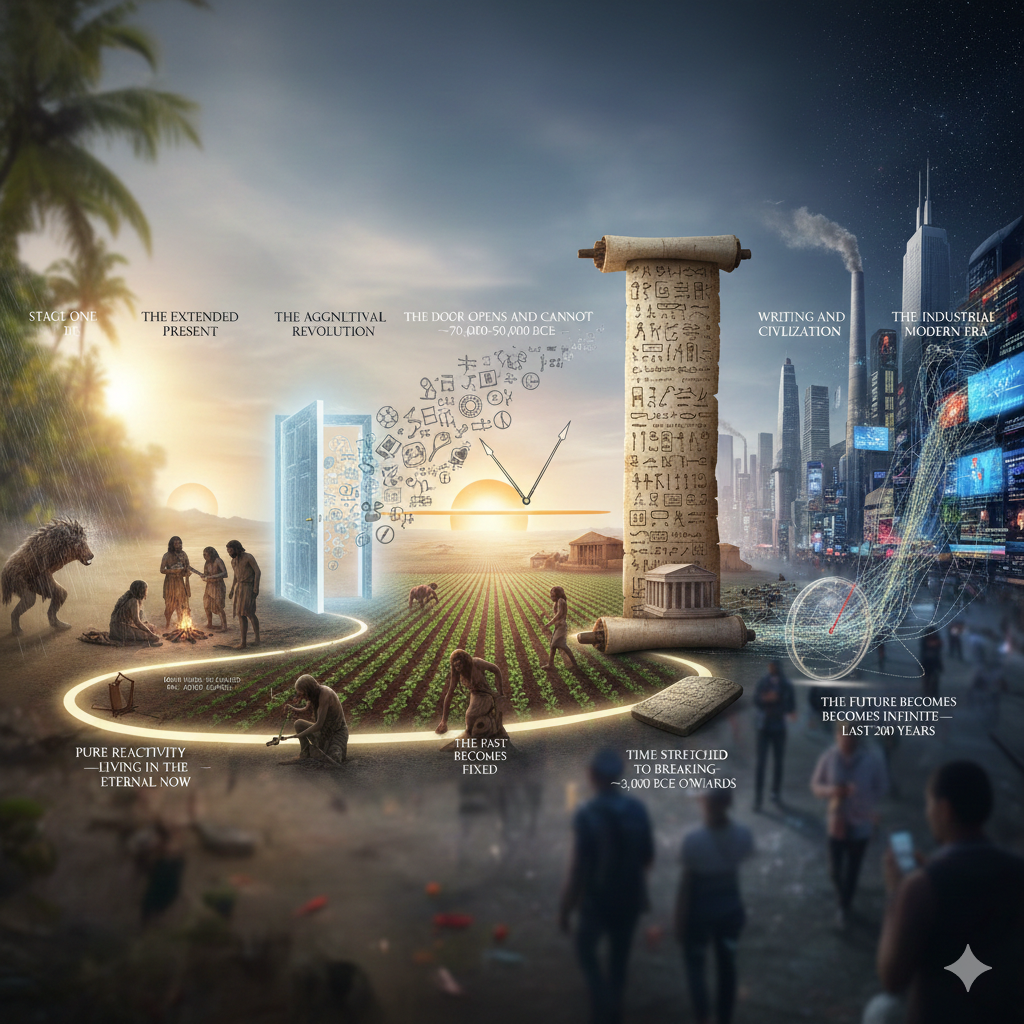
Stage One: Pure Reactivity—Living in the Eternal Now- Million years ago
Go back millions of years, to our earliest ancestors and the animals we shared the world with. Life operated on a simple principle: stimulus, response, outcome. See food, eat food. Sense danger, run from danger. Feel tired, sleep. This wasn’t thoughtless existence—the brain was constantly computing, processing, making split-second survival calculations. But it was all happening in an eternal present tense.
A chimpanzee swinging through trees makes incredibly complex decisions about which branch will hold its weight, how far to jump, where to grab next. Its brain is performing sophisticated physics calculations in real time. But it’s not thinking about yesterday’s swings or planning next week’s route. The time horizon is measured in seconds, perhaps minutes. When the immediate problem is solved or the immediate opportunity is seized, thinking stops. The mind returns to quiet alertness, simply being.
This is pure reactivity. Not mindless, but present-minded. Every ounce of cognitive energy focused on what’s happening right now, in this moment, in this place. There’s a profound freedom in this, though the animals experiencing it don’t know they have it. They cannot miss what they’ve never imagined losing.
Our earliest hominid ancestors lived this way too. Walking upright on African savannas three or four million years ago, they were more intelligent than other animals, certainly, with larger brains and better problem-solving abilities. But their mental life was still tethered firmly to the immediate. Thinking was survival computation—nothing more, nothing less. When the computation was complete, the thinking stopped.
Stage Two: The Extended Present—The First Glimmers of Tomorrow-(Early Homo sapiens, ~300,000-70,000 BCE)
Something began to shift between three hundred thousand and seventy thousand years ago, in the brains of early Homo sapiens. The present moment started to stretch, like taffy being pulled, extending forward and backward in time just a little bit.
Imagine one of these early humans, perhaps a woman, sitting near a cave entrance as evening approaches. She looks at the sky, sees gathering clouds, and thinks: “Tonight we will need shelter from rain. We should move deeper into the cave and gather the sleeping furs now, before darkness comes.” This is different. This is planning within visible time—projecting just a few hours ahead, connecting current observations to future needs.
Or imagine a hunter who remembers that three days ago, he saw deer tracks near a certain water source. Tomorrow morning, he decides, he’ll go there to hunt. That’s episodic memory at work—the ability to recall specific events and use them to guide future action. But notice something crucial: there’s no sense of “I” as a continuous character in a life story. It’s more like, “Deer were there. Deer might be there again. Go there.” The memory serves tactical purpose, nothing more.
The time horizon had expanded from seconds and minutes to hours and days. Early humans could now hold tomorrow in mind, could remember yesterday with enough clarity to shape today’s choices. But they were still primarily reactive, still mostly present, still living in what we might call an extended now. Thinking had purpose and boundary. It arose when needed and subsided when the task was complete.
This was a stable state, lasting perhaps two hundred thousand years. Humans were getting smarter, using more complex tools, coordinating in larger groups, but still essentially living in the same mental time zone as their ancestors. And then, something extraordinary happened.
Stage Three: The Cognitive Revolution—The Door Opens and Cannot Close-(~70,000-50,000 BCE)
Around seventy to fifty thousand years ago, human consciousness underwent a transformation so profound that archaeologists can see it in the ground. Suddenly, explosively, humans began creating symbolic art. They painted on cave walls, carved figurines, made jewelry from shells and stones, buried their dead with ritual and ceremony. These weren’t gradual changes accumulating over millennia. They appeared suddenly, like someone had flipped a switch in the human mind.
Something had awakened. Three transformations happened simultaneously, each reinforcing the others, creating a new kind of consciousness that had never existed before on Earth.
First came symbolic thought. A cave painting of a bison isn’t a bison. It’s an abstraction, a representation, a symbol. To create it means to think about something that isn’t present, to make one thing stand for another thing, to operate in the realm of meaning and representation. When you bury your dead with flowers and tools, you’re thinking about an afterlife, about continuation, about things that cannot be seen or touched. This was the birth of abstraction—the ability to think about things not immediately present in time or space.
Second came the narrative self. Language became recursive, meaning we could tell stories within stories, think about our thinking, talk about our talking. And from this emerged something unprecedented: the “I” as a character with a continuous existence across time. Not just “hunger now, eat now” but “I who was hungry yesterday, am eating today, will be hungry again tomorrow.” The autobiographical self was born—the sense of being a person with a history and a future, a protagonist in an ongoing story.
This created a strange new relationship with time. Suddenly, there was someone who persisted across moments, who connected past to present to future. You weren’t just experiencing moments sequentially anymore. You were experiencing them as part of a life, your life, the life of this continuous “I.”
Third came mental time travel, the ability to project consciousness into futures that didn’t exist yet and recall pasts that no longer existed. A human could now sit by a fire and imagine next winter, could plan for events months or years away, could think about children not yet born and ancestors long dead. The mind had learned to leave the present entirely, to roam freely across time.
This was our superpower. This was what allowed humans to spread across the entire planet, to survive in environments from arctic tundra to tropical rainforest, to plan elaborate hunts, to develop complex social structures, to accumulate knowledge across generations. We could think about the tribe’s future, prepare for seasonal changes, remember the dead and learn from their experiences.
But there was a price, though our ancestors didn’t know they were paying it. With the ability to imagine distant futures came anxiety—the awareness that bad things might happen that haven’t happened yet. With the awareness of past and future came the awareness of death, the ultimate future event. And with that awareness, humans were pulled perpetually out of the present moment. The door had opened, and it could not be closed again.
For the first time in Earth’s history, there were beings who could be physically safe but mentally distressed, who could be surrounded by food but worried about future hunger, who could be alive but contemplating their inevitable death. The present moment was no longer enough to contain consciousness.
Stage Four: The Agricultural Revolution—Time Stretched to Breaking-(~10,000 BCE)
For tens of thousands of years after the cognitive revolution, humans were still nomadic hunter-gatherers. Yes, they could think far ahead, but their lives still had a rhythm tied to immediate needs. You hunt today because you’re hungry today. You gather berries this afternoon because you’ll eat them tonight. The extended time consciousness was available when needed, but life itself still pulled you back to the present regularly.
Then, around twelve thousand years ago, everything changed again. Humans began to farm. And farming operates on a completely different temporal logic.
When you plant a wheat seed, you’re making a bargain with a future that’s six months away. You’re doing work today for food you won’t eat until tomorrow’s tomorrow’s tomorrow, repeated a hundred times. This requires a new kind of thinking: systematic delayed gratification. Every day, you must resist eating the seed grain. You must tend fields for months with no immediate reward. You must trust in a future harvest that isn’t guaranteed.
Agriculture created the concept of surplus and storage. For the first time, humans could create “future security”—granaries full of grain that would feed you through winter, through lean times, through emergencies. But with surplus came new anxieties. What if the crops fail? What if raiders steal our stored grain? What if we didn’t store enough? Should we plant more fields? What if next year is worse than this year?
This was the birth of systematic overthinking. For a hunter-gatherer, worry has natural boundaries. You’re hungry or you’re not. Game is nearby or it isn’t. The situation is concrete and visible. But a farmer must worry about dozens of interconnected future scenarios that haven’t happened yet. The mental simulator that evolved to help us prepare for real dangers now had abstract, distant, uncertain scenarios to chew on endlessly.
Agricultural societies also created settlement, property, and inheritance. These concepts fundamentally changed the relationship with time. Now you weren’t just thinking about your own life, but about your children’s lives, your grandchildren’s lives. You were building structures and systems meant to last beyond you. Time had stretched from days and seasons to generations.
The present moment receded further. A farmer’s mind was always partially in the next season, the next year, the next generation.
Stage Five: Writing and Civilization—The Past Becomes Fixed, The Future Becomes Infinite-(~3,000 BCE onwards)
Around five thousand years ago, humans invented writing, and with it, something unprecedented happened: memory became external. Before writing, the past was fluid, changeable, alive only in human recollection. Stories changed with each telling. Knowledge died with its holders. The past was a living thing, adapted and reshaped by each generation.
Writing froze the past. It made it fixed, recoverable, analyzable. You could now compare today’s accounts to yesterday’s records. You could study the accumulated knowledge of people dead for centuries. You could plan across generations with precision because you could record agreements, laws, debts, histories.
This created a new relationship with time. The past became something you could examine like a scientist examines a specimen. What happened? Why did it happen? Could we have done it differently? Should we have done it differently? The past became a source of regret, nostalgia, longing, and analysis. It became heavy with meaning because it was no longer flowing naturally away—it was captured, preserved, available for endless reconsideration.
Similarly, the future became something you could plan with increasing precision and distance. Governments could make policies meant to unfold over decades. Religions could make promises about eternity. Individuals could plan careers, dynasties, legacies. The future stretched out infinitely, full of possibilities and anxieties.
Civilization also brought social complexity that required multi-level temporal planning. You had to think about this year’s harvest (immediate), paying next year’s taxes (near future), arranging your daughter’s marriage (medium future), building infrastructure for the next generation (distant future), and pleasing the gods to secure the afterlife (eternal future). Each layer of temporal planning added another layer of mental occupation.
For the first time, thinking began to detach from immediate survival. Philosophers could think about thinking. Mathematicians could work on abstract problems with no practical application. Artists could create for posterity. The mind had become powerful enough to operate in realms completely divorced from the present moment’s demands.
This was magnificent—it gave us philosophy, mathematics, literature, law, accumulated wisdom. But it also meant that fewer and fewer moments of an ordinary person’s life were actually spent fully present. Your body might be weaving cloth, but your mind might be worrying about debts, planning a festival three months away, or remembering a slight from last year that still stings.
Stage Six: The Industrial Modern Era—The Vanishing Present-(Last 200 years)
The last two hundred years, and especially the last fifty, have brought the most radical transformation of all. We’ve created systems that have almost entirely outsourced our physical survival. You don’t hunt or gather your food—supply chains do that. You don’t build your shelter—contractors and landlords do that. You don’t protect yourself from predators or enemies—governments and police forces do that. You don’t even need to remember information—search engines do that.
We’ve achieved what our ancestors worked toward for hundreds of thousands of years: comprehensive physical security for vast numbers of people. Yet this achievement has created a crisis of consciousness.
When survival is outsourced, what does the mind do? That simulator that evolved to keep us safe from real dangers doesn’t turn off just because the dangers are gone. Instead, it manufactures new scenarios to worry about, most of which will never happen. What if I lose my job? What if my children don’t succeed? What if I’m not good enough? What if I made the wrong career choice fifteen years ago? What if climate change destroys everything in fifty years?
The past has become a source of regret, nostalgia, and trauma that we can replay endlessly through social media, photo archives, and recorded history. We can compare our current selves to idealized past versions or remind ourselves of every mistake and missed opportunity. The past is no longer something that flows away naturally—it’s cached, retrievable, shareable, analyzable.
The future has become a source of anxiety, ambition, and fear. We can plan decades ahead, but that also means we can worry decades ahead. We can imagine thousands of possible futures and feel inadequate for not achieving the best ones. Every choice is haunted by the roads not taken.
And the present? The present has become the vanishing point, the one place we’re almost never actually located. We’re physically here but mentally everywhere else. Eating breakfast while reading news about distant events. Talking to our children while thinking about work deadlines. Walking in nature while listening to podcasts about productivity. The present moment is something we pass through on our way to somewhere else in time.
This is temporal displacement as the dominant mode of existence. We’re not occasionally thinking about past and future anymore—we’re almost always thinking about past and future, only occasionally aware of the present.
The Three Forces That Locked This In
Understanding the stages helps, but to really grasp why we’re stuck here, we need to understand three underlying mechanisms that developed alongside these stages and now hold us in place.
The first is neurological. As our brains evolved, our prefrontal cortex expanded dramatically. This region enables us to simulate futures, to plan, to imagine scenarios that don’t exist. It’s the neural hardware for mental time travel. But our brains also developed something called the Default Mode Network, a set of brain regions that activate when we’re not focused on immediate tasks. This network is responsible for mind-wandering, self-referential thinking, remembering the past, and imagining the future. It’s literally the “overthinking” network, and it activates automatically whenever we’re not engaged in something that demands present attention.
Evolution also gave us language, which created recursive loops—we can think about our thinking, worry about our worrying, remember our remembering. This creates infinite regress, layers upon layers of mental abstraction that pull us further and further from simple present-moment awareness.
The second force is cultural. Writing externalized memory, making the past fixed and analyzable rather than flowing and forgettable. Social complexity required us to plan across multiple time scales simultaneously—what you’re doing today, this season, this year, your lifetime, your children’s lifetimes. And the creation of surplus severed the immediate need-action link. When you don’t need to act right now to survive, your mind is free to wander anywhere in time. That freedom becomes a curse.
The third force is existential. Humans became aware of mortality—the ultimate future event that casts its shadow over every present moment. The German philosopher Heidegger called this “Being-towards-death,” the way our awareness of our eventual non-existence shapes every moment of our existence. You’re not just living in the present; you’re living toward death, which pulls you perpetually out of the present into contemplation of the future and reflection on the finite time you have.
This awareness of mortality creates what we might call existential displacement. We’re always somewhat aware that time is running out, which makes us analyze whether we’re using it well, whether we’re accomplishing enough, whether we’re living correctly. This analysis itself takes us out of the present we’re supposedly trying to live well.
The Paradox: Security Created Suffering
Here’s the cruel irony at the heart of human evolution. More physical security has led to less present-moment focus. Less survival pressure has created more mental suffering. The tools we built to solve our problems freed our minds to create entirely new categories of problems.
Think about our ancestors at different stages. The early human three hundred thousand years ago probably faced genuine threats—predators, starvation, injury, hostile groups. Their lives were problem-saturated. Every day brought real challenges requiring real solutions. But when those problems weren’t immediately present, their minds were likely quiet. There was nothing to overthink because the problems were concrete and visible.
Now consider yourself. You’re almost certainly physically safer than any human in history. You have food, shelter, medicine, protection from predators and enemies. Your life is problem-free in the ways that haunted all previous generations. Yet your mind generates an endless stream of problems: social anxieties, status concerns, existential questions, future worries, past regrets, comparisons with others, fear of not being enough or having enough or doing enough.
We’re psychologically saturated with problems that don’t actually exist in the present moment. The simulator runs constantly, generating scenarios, comparing outcomes, judging ourselves, planning futures, analyzing pasts. And because our basic needs are met, there’s no natural shutoff valve. The worrying doesn’t stop when you’re safe because you’re always safe, so the worrying never has a reason to end.
Why Animals Think Differently Than We Do
This brings us to the critical difference between animals and modern humans. Animals think when there’s a problem to solve. Their mental simulator turns on when there’s a real stimulus requiring a response. Predator nearby? The simulator runs threat-assessment calculations. Food available? The simulator evaluates approach strategies. No problem? The simulator turns off. The animal returns to simple awareness, neither bored nor anxious, just present.
Modern humans think despite having no immediate problem. Why?
First, our mental simulator became autonomous. What started as a brilliant adaptation—the ability to project into possible futures and prepare for them—became compulsive. The tool escaped our conscious control. The Default Mode Network generates scenarios endlessly, even when not needed. It’s like a computer program that starts running on its own, independent of whether anyone wants it to run.
The simulator became so sophisticated that it can feed on itself. You worry about something, then worry about how much you’re worrying, then feel anxious about your anxiety, then judge yourself for being anxious, then wonder why you can’t stop judging yourself. The recursion is infinite.
Second, once our physiological needs were met, our psychological and social needs became dominant. And unlike hunger or thirst, which have natural satiation points, these needs are infinite. There’s always someone of higher status to compare yourself to. There’s always a way you could be better, richer, more accomplished, more respected. Your ancestors could satisfy their hunger by eating. You can never satisfy your status anxiety because the comparison set is infinite.
This creates perpetual dissatisfaction despite unprecedented security. You’re safe, fed, sheltered, and miserable because the goalpost keeps moving. The simulator keeps generating new problems to solve because that’s what it evolved to do, but the problems now are abstract, infinite, and unsolvable.
Third, the narrative self requires constant maintenance. Remember, you’re not just a present-moment experiencer anymore—you’re a character in a story, the story of your life. But this story requires constant editing, constant comparison. Am I living up to my potential? Is my story good enough? How does my story compare to their story? What will my story’s ending be? Every comparison generates thought, pulls you out of the present into analysis of whether your narrative arc is satisfying.
The self becomes a project you’re always working on, which means you’re never simply being. You’re always becoming, always editing, always comparing current self to past self to ideal self to others’ selves. This self-construction is exhausting and endless because the story is never finished until you die.
The Return Home
Understanding this evolutionary history doesn’t solve the problem of overthinking, but it does something important: it reveals that this isn’t a personal failing. Your mind isn’t broken. You’re not doing it wrong. Your brain is actually functioning exactly as millions of years of evolution shaped it to function. The problem is that it’s now operating in an environment completely different from the one it was designed for.
Your ancestors needed to escape the present to survive it. That capacity saved humanity. But you need to find your way back to the present to enjoy the life that capacity created.
The deer in the forest doesn’t need tools to return to the present because it never left. You need practices—meditation, mindfulness, breath work, physical absorption in tasks—because you have the capacity to leave that the deer doesn’t have. This isn’t weakness. It’s the price of possessing mental time travel.
What we’re learning, slowly and painfully, is that the next evolution of human consciousness might not be about thinking better or more or faster. It might be about recovering the choice of when to think and when to simply be. About using our extraordinary cognitive gifts consciously rather than being used by them.
The present moment hasn’t actually vanished. It’s still here, still the only place where life actually happens. We’ve just forgotten how to inhabit it. But unlike the deer, we have one advantage: we can understand why we left, we can see what we lost, and we can choose to come home.
The water is still running. The moment is still here. And now, perhaps, we understand better why it’s so hard to simply be in it—and why it matters that we try.