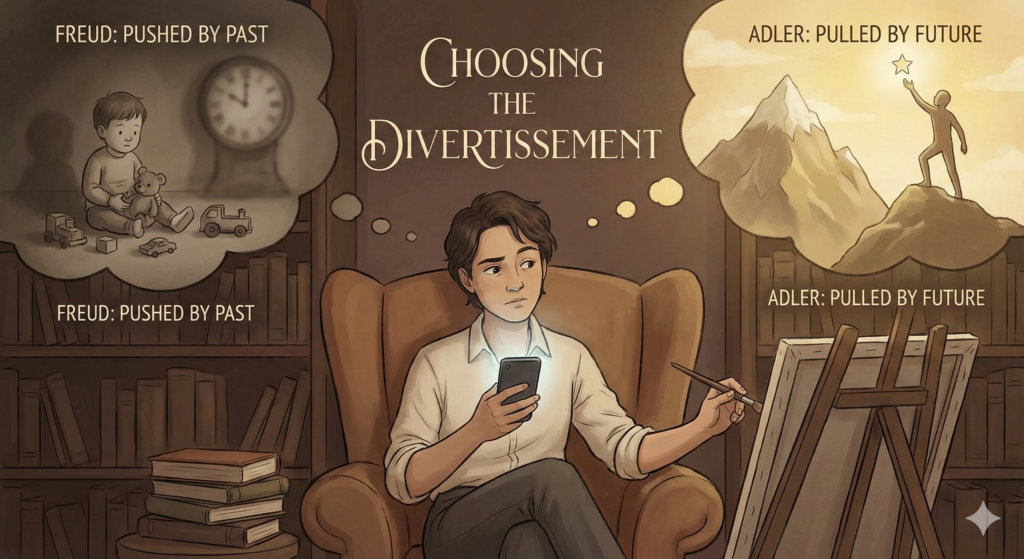
Have you ever picked up your phone to check the time, only to find yourself, thirty minutes later, deep in a rabbit hole of cat videos or celebrity gossip? You aren’t alone. In fact, you are participating in a philosophical struggle that has puzzled great thinkers for centuries.
We often think of our hobbies, our Netflix binges, and our social media scrolling as just “passing time.” But what if these choices are actually complex responses to the human condition?
To understand why we do what we do—and how to do it better—we need to invite three very different thinkers to the table: Blaise Pascal, Sigmund Freud, and Alfred Adler.
The Problem: The Unbearable Weight of Boredom
Let’s start with the 17th-century French philosopher, Blaise Pascal. He had a very keen observation about human nature. He famously noted that all of humanity’s problems stem from our inability to sit quietly in a room alone.
When we are alone with our thoughts, without distraction, we are forced to confront the “heavier” stuff: our fears, our mortality, and the sheer vastness of the universe. It’s uncomfortable. It’s anxious. It is, in a profound sense, boredom.
To escape this, Pascal said we seek divertissement (diversion). We hunt for wars, gambling, jobs, and entertainment not necessarily because we love them, but because they save us from thinking about ourselves.
The Predicament: We need distraction to cope with life. But how do we choose which distraction? This is where psychology steps in.
The Conflict: Are You Pushed or Are You Pulled?
When you decide to play a video game or go for a run to escape that “Pascalian boredom,” who is actually holding the steering wheel?
1. Sigmund Freud: The Ghost of the Past
Freud, the father of psychoanalysis, would look at your choice of distraction through the rearview mirror. He believed in psychic determinism.
In simple terms, Freud argued that your current behavior is pushed by the past. Your choices are shaped by unconscious drives, childhood experiences, and unresolved conflicts.
- Why are you doom-scrolling? Freud might say you are unconsciously seeking a dopamine hit to soothe a childhood anxiety or a lack of comfort.
- Why do you overeat as a distraction? Perhaps it links back to an oral fixation or a past coping mechanism for stress.
To Freud, you aren’t really “choosing” freely; you are reacting to old programming.
2. Alfred Adler: The Pull of the Future
Alfred Adler, a contemporary of Freud who broke away to form Individual Psychology, disagreed. He believed humans are teleological—meaning we are purpose-driven.
Adler argued that we aren’t just pushed by the past; we are pulled by the future. We act according to goals we have set for ourselves, usually involving a striving for superiority (overcoming feelings of inferiority) or success.
- Why are you doom-scrolling? Adler might say you are doing it to avoid the difficult work you should be doing, thereby protecting your ego from the potential failure of that work. The goal isn’t “comfort” (Freud); the goal is “safety from failure.”
- Why do you go to the gym as a distraction? Because your future goal is to be perceived as strong, attractive, or disciplined.
The Synthesis: How to Choose Your Divertissement
So, here is the human predicament:
- Pascal says we must distract ourselves to avoid existential dread.
- Freud says we often pick distractions based on old, unconscious habits.
- Adler says we pick distractions that serve a hidden goal (often to protect our ego).
If we aren’t careful, we end up choosing “junk” distractions—activities that numb us (Freud) or help us avoid responsibility (Adler), leaving us feeling empty once the distraction ends.
The solution is not to stop distracting yourself. Pascal knew that was nearly impossible. The solution is to move from mindless diversion to mindful diversion.
Here is a 3-step guide to choosing your divertissement wisely:
Step 1: The “Why” Check (The Freudian Pause)
Before you lose three hours to social media, pause. Ask yourself: “Is this a reaction to the past?” Are you reaching for this distraction because you are stressed, lonely, or reverting to a childhood comfort habit?
- If the answer is yes: Acknowledge the feeling, but choose a distraction that actually heals rather than numbs. Instead of scrolling (numbing), call a friend (connection) or take a warm bath (soothing).
Step 2: The “What For” Check (The Adlerian Analysis)
Ask yourself: “What is the goal of this distraction?” Are you doing this to avoid a difficult task? Are you procrastinating because you are afraid you aren’t good enough?
- If the answer is yes: You are using distraction as a shield. Change the goal. Choose a divertissement that aligns with who you want to be.
- Bad Goal: “I will watch TV to avoid writing my essay.”
- Good Goal: “I will go for a 15-minute walk to clear my head so I can write a better essay.”
Step 3: Choose “High-Quality” Divertissement
Pascal noted that some diversions leave us feeling worse (like gambling or gossip), while others can be elevating.
The ultimate solution is to choose distractions that allow for Sublimation (a Freudian term for turning primal urges into productive outcomes) and Striving (Adler’s term for self-improvement).
- Create, don’t just consume. Painting, writing, or cooking distracts you from “the void” just as well as TV does, but it leaves you with something tangible.
- Active, not passive. Exercise forces you into the present moment (escaping the mind) but builds your future health (Adlerian goal).
- Social, not isolated. Board games or team sports provide the diversion of play while fulfilling our deep need for community.
Conclusion
We cannot escape the need for divertissement. As Pascal said, we are fragile creatures who find silence difficult. However, we are not slaves to our past (Freud) nor are we forced to have selfish goals (Adler).
We have the power of choice. The next time you feel the itch of boredom, don’t just let your unconscious drive take the wheel. Ask yourself what you are running from, and what you are running toward. Choose a distraction that doesn’t just kill time, but brings you to life.
Here is a video about difference between Alfred Adler and Sigmund Freud.