A deep dive into the philosophy of attention in the age of endless ads.
Introduction: Ever Notice How “Advertise” and “Divert” Sound Similar?
Isn’t it peculiar? “Advertisement.” “Divertissement.” Two words that, at first blush, seem worlds apart, yet share an uncanny phonetic echo. Is this mere coincidence, a quirk of linguistic evolution? Or could it be a subtle clue, hinting at a deeper, more insidious connection? I propose the latter. This isn’t just about sounds; it’s about a shared purpose, a common strategy. And to truly grasp it, we need to dust off a certain 17th-century French thinker, a melancholic genius named Blaise Pascal. Prepare to have your perception of those ubiquitous ads—those little interruptions that pepper our waking hours—fundamentally altered.
A Quick Journey Through Word History (No, Really, It’s Interesting!)
Let’s embark on a brief etymological detour. “Advertisement,” that ever-present herald of consumerism, originates from the Latin “advertere,” meaning “to turn towards.” Initially, this was a neutral act – a simple drawing of attention, a public notice devoid of inherent persuasive intent. As the centuries rolled on, morphing through Middle French and Middle English, the word underwent a subtle yet profound transformation. By the 18th century, “advertisement” had shed its innocent skin, becoming inextricably linked to the burgeoning world of commerce. It was no longer just about informing; it was about selling. The intention had shifted, subtly but definitively, towards persuasion, towards influencing behavior for commercial gain.
Now, let us turn our gaze to “divertissement.” Its roots, too, lie in the Latin “divertere,” meaning “to turn aside,” echoing the sentiment found in words like “diversion” and “amusement.” Historically, “divertissement” referred to light, entertaining interludes woven into more serious artistic endeavors, such as operas or ballets. These were moments of levity, designed to offer the audience a respite from the weighty themes and dramatic narratives. They were brief escapes, deliberate “turnings away” from the central plot. Do you begin to see the emerging pattern, the common thread that binds these seemingly disparate concepts together?
Blaise Pascal: The Anti-Boredom Philosopher
Enter Blaise Pascal, a name synonymous with mathematical brilliance and profound philosophical insight. Pascal, a man haunted by the specter of human fragility, correctly identified our inherent aversion to confronting the self. He was convinced that our biggest problem wasn’t external hardship, but internal disquiet, the unbearable weight of being.
Pascal’s core idea, elegantly articulated in his Pensées, centers on our deep-seated terror of confronting our own thoughts, our mortality, and the vast, seemingly meaningless void that underlies existence. Our defense mechanism? Divertissement.
For Pascal, divertissement transcends mere fun and games. It encompasses any activity, any distraction, that prevents us from sitting quietly with our own minds. Gambling, gossip, the relentless pursuit of fame, even the horrors of war – all, in Pascal’s view, are desperate attempts to escape the gnawing discomfort of boredom and existential dread. We are perpetually seeking ways to avoid the quiet room of our own minds.
The paradox, as Pascal so astutely observed, lies in the fleeting nature of this relief. While these diversions provide temporary solace, they ultimately prevent us from confronting our true condition, from seeking deeper meaning and purpose. For Pascal, this meaning was to be found through faith, but the underlying principle remains universally relevant. We are, in essence, constantly running from ourselves, trapped in a perpetual cycle of distraction.
Advertising: The 21st-Century Engine of Divertissement
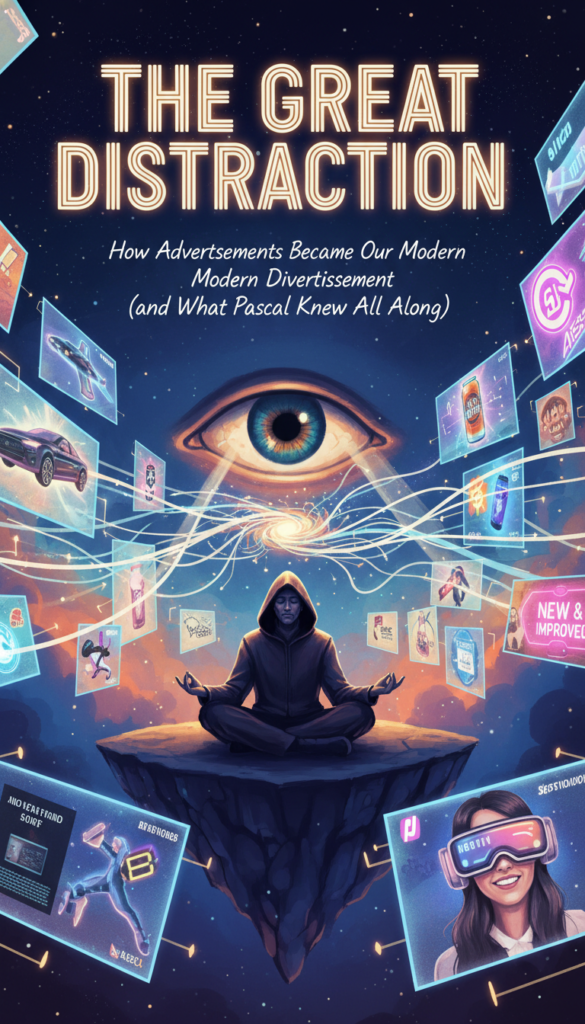
Now, consider the landscape of modern advertising. In this light, advertisements emerge as the quintessential embodiment of Pascal’s divertissement. They are meticulously engineered to capture our fleeting attention, to wrench it away from whatever occupies our thoughts, or perhaps more accurately, whatever emptiness we might be feeling.
Advertising, at its core, is a psychological game. It is not merely the peddling of commodities; it is the purveying of aspirations, the selling of dreams – happiness, status, belonging. Advertisements insidiously suggest that we require this particular product to fill an emptiness, to resolve a perceived deficiency that we may not have even been aware of.
They operate by manufacturing artificial needs, exploiting our inherent insecurities and preying on our deepest fears. Consider the pervasive phenomenon of “Fear Of Missing Out” (FOMO), or the relentless bombardment of unrealistic beauty standards that permeate our media. These are not accidental byproducts; they are deliberate strategies designed to fuel a perpetual cycle of dissatisfaction, compelling us to seek external validation through consumption.
The relentless cycle of “new and improved” products, the constant promise of a better, brighter future just beyond our grasp, serves to keep us perpetually chasing the next distraction, always looking outward for fulfillment. As the philosopher Jean Baudrillard perceptively noted, we are not simply purchasing objects; we are buying into the image, the lifestyle that advertisements so skillfully project.
The Ethical Minefield: When Divertissement Becomes Dangerous
It is essential to acknowledge the ethical complexities inherent in an industry predicated on divertissement. Critics rightly argue that advertising frequently transcends the boundaries of mere information, venturing into the realm of manipulation.
The exploitation of vulnerabilities is a particularly egregious transgression. Targeting advertisements towards children, the elderly, or individuals grappling with mental health issues raises profound ethical concerns. These are demographics that may lack the critical faculties to discern manipulative intent.
Furthermore, the pervasive presence of deception and misinformation within advertising cannot be ignored. From airbrushed models to exaggerated claims of efficacy, we must question the extent to which we are being presented with truth. In an era defined by “fake news” and alternative facts, the erosion of trust in advertising has far-reaching consequences.
The ever-expanding reach of hyper-targeted advertisements, fueled by the relentless collection of personal data, raises serious questions about privacy and the potential for increasingly personalized (and potent) forms of distraction. Can an industry predicated on diverting attention ever truly embrace “socially responsible” practices?
The Future of Distraction: Ads Get Smarter (and Maybe Even More Diverting)
Advertising, for better or worse, is not going anywhere. It is a dynamic, ever-evolving force, constantly adapting to the shifting sands of technological innovation and consumer behavior.
The rise of Artificial Intelligence (AI) promises to usher in an era of hyper-personalized advertisements, capable of anticipating our desires before we are even consciously aware of them, delivered in real-time. This represents a new frontier in divertissement – smarter, faster, more relevant, and exponentially more difficult to ignore.
The proliferation of immersive technologies, such as Augmented Reality (AR) and Virtual Reality (VR), offers unprecedented opportunities for seamless integration of advertisements into our entertainment experiences. In-game advertisements, virtual showrooms, and interactive product placements are blurring the lines between reality and simulation, making it even easier to “turn aside” from the present moment.
The dominance of short-form video content, epitomized by platforms like TikTok, Instagram Reels, and YouTube Shorts, necessitates a new breed of advertisements designed to capture attention in mere seconds, often relying on compelling visuals in the absence of sound. This represents a profound shift in the attention economy, where brevity and visual impact reign supreme.
The quest for “authenticity” represents yet another intriguing development. Brands are increasingly attempting to project an image of “realness” through user-generated content and collaborations with micro-influencers. But is this a genuine attempt to foster connection, or simply a clever new tactic for packaging divertissement in a more palatable form?
The rise of social commerce, which allows consumers to make purchases directly from their social media feeds, further shortens the path from distraction to transaction. The impulse to acquire is now inextricably intertwined with the act of scrolling, blurring the boundaries between entertainment and commerce.
Conclusion: What Are You Really Watching? (And What Are You Missing?)
The striking similarity between the words “advertisement” and “divertissement” serves as a potent reminder of a fundamental truth about the human condition: our inherent susceptibility to distraction.
Advertisements, in their relentless pursuit of our attention, have evolved into the ultimate modern divertissement, meticulously designed to pull us away from introspection, from the uncomfortable silences that force us to confront our own thoughts and feelings.
I leave you with this parting thought: the next time you encounter an advertisement, pause for a moment. Ask yourself, what is it trying to make you turn towards? And, more importantly, what is it trying to make you turn away from? Is it genuinely addressing a legitimate need, or is it simply providing another temporary escape from the quiet room of your own mind? Are you consuming content, or is content consuming you? Are you living your life, or are you merely being diverted from it?