Recently, I wrote a post on my blog, basavapurushottam.com, about the growth and limits of Artificial Intelligence. I explored the idea that AI, despite its incredible speed right now, might eventually hit a ceiling and slow down. That article sparked a much deeper curiosity in me. I started asking: Is there a limit to how “advanced” a society can get before it starts to crumble?
This made me curious about the work of historian Joseph Tainter. He studied complexity and wanted to understand why famous empires like the Romans or the Maya didn’t just grow old, but actually collapsed.
What I learned changed how I see the world, our economy, and our future. Civilisations work a bit like giant machines. At first, adding more parts improves the machine. But over time, it gets so heavy and complicated that most of our effort goes into just keeping it running.
Here is what I’ve learned about the “Complexity Trap,” explained in simple terms.
1. The Smartphone Problem: When More Apps Slow You Down
Think about the first time you got a new smartphone. It’s fast and simple. It has a phone app and a camera. It solves your basic problems: you can call home and take photos.
But then, you start adding “Complexity”:
- You add games for fun.
- You add a school app for homework.
- You add five social media apps to talk to friends.
- You add a health tracker, a maps app, and three different email accounts.
At first, each new app improves your life. But after a while, your phone starts to slow down. The battery only lasts a couple of hours. You spend a lot of time updating apps or deleting old files to make space. It starts to feel like you are working for your phone instead of the other way around.
Tainter calls this idea Diminishing Returns on Complexity. At first, greater complexity is a big advantage and helps solve problems. But as you add more layers, each new one gives you less benefit, while the cost of keeping everything running keeps going up.
A Lesson from Ancient Rome
The Roman Empire was like the world’s most powerful smartphone. Whenever they faced a problem, such as an invasion or a food shortage, they didn’t make things simpler. Instead, they added more ‘apps.’ They doubled the size of the army and hired thousands of government officials to handle taxes.
But who paid for all those soldiers and officials? The people did. Taxes got so high that farmers struggled to afford food. The Emperor even made coins from cheap metal instead of pure silver, so the money lost its value. In the end, the ‘phone’—the Empire—became so costly and slow that it stopped working. People didn’t try to save it because they couldn’t afford to keep it going.
2. The “Energy Bill” of a Country (Metabolic Cost)
Have you noticed that if you don’t clean your room, it gets messy on its own? This happens because of a law of physics called the second law of thermodynamics, or Entropy. Everything tends to get disorganised and fall apart unless you put in the energy to keep it tidy.
A large, complex society is like a high-tech mansion. It needs a huge ‘cleaning bill’ every day just to keep everything working. Tainter calls this the Metabolic Cost.
Think about your own body. You need to eat food for energy just to keep your heart beating and your brain working. If you start training for a marathon, your metabolic cost goes up, and you need much more food just to get through the day.
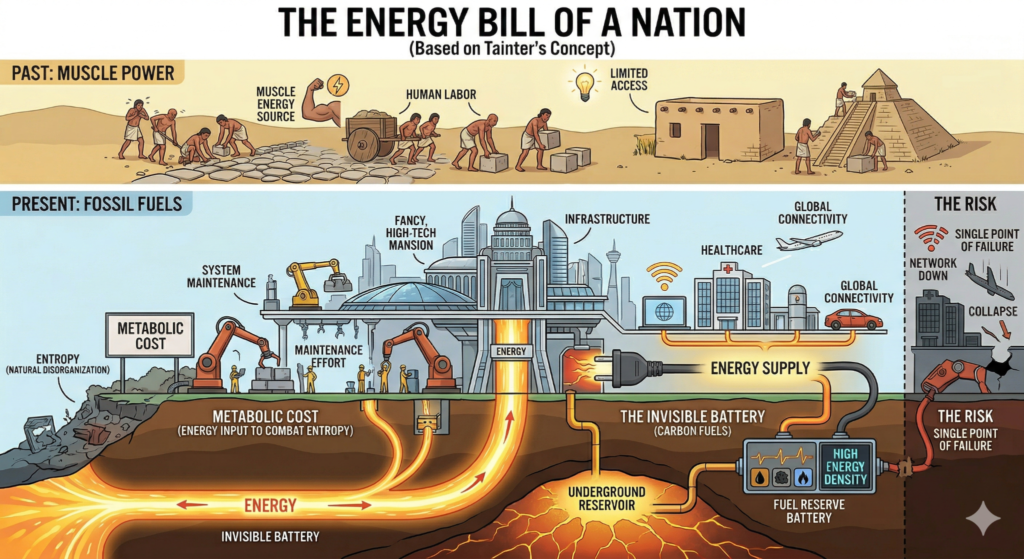
The Invisible Battery
For thousands of years, humans relied solely on muscle power. If we wanted to build a road, people had to move the stones themselves. Since energy was hard to get, our societies stayed simple.
Today, we have built the most complex world in history. We have the internet, giant hospitals, and planes that fly across the world. We can only do this because we found a “super-dense battery” in the ground: Fossil Fuels (oil, coal, and gas).
Because we have this cheap, powerful energy, we often forget how much work it takes to keep our world running. We don’t have to push our cars because the gas does it for us. But our energy bill is now so high that if we ever lost that ‘battery,’ our whole way of life could come to a halt almost instantly.
3. The One-Way Street: Why We Can’t “Go Back”
When life feels stressful or complicated, some people say, “Let’s just go back to the ‘good old days’ when everything was simple!” That sounds nice, but the truth is, going back to simplicity is almost impossible. Once we move toward complexity, we can’t really reverse it. It’s like making an omelette: you can turn eggs into an omelette, but you can’t turn the omelette back into whole eggs.
The Survival Trap
Why can’t we just “quit” being complex? Because our complexity is what keeps us alive.
- The 8 Billion Person Problem: There are 8 billion people on Earth today. We can only feed them because we have complex systems like giant tractors, chemical fertilisers, and massive ships that carry food across the ocean.
- The High-Rise Analogy: Imagine we built a huge 100-story skyscraper to fit everyone. If the elevator stops working and the water pipes leak, we can’t just decide to live in tents, because there isn’t enough space for everyone on the ground anymore.
We are locked in. We have to keep the complex system running, even if it gets harder to afford, because the simple way can’t support everyone anymore. That’s why we need to be careful about how we shape our future.
4. The Apple Tree of Invention (Declining Innovation)
A lot of people think, “Don’t worry, scientists will invent something new to save us!” We assume that since we created things like the lightbulb and the internet, we’ll keep making big breakthroughs just as quickly.
But Tainter’s research shows that developing new inventions is actually becoming harder and more expensive.
Think of an apple tree:
- Level 1 (The Low-Hanging Fruit): In the 1800s, a “lone wolf” scientist like Isaac Newton or Charles Darwin could make a world-changing discovery in their backyard. The “apples” were easy to reach.
- Level 2 (The High-Hanging Fruit): Today, we’ve already found all the easy inventions. Discovering a new medicine or energy source takes a team of 1,000 scientists, a $10 billion lab, and 20 years of effort.
We’re spending much more money and hiring more scientists than ever, but we’re getting fewer big breakthroughs per person. It’s like building a taller and taller ladder just to reach one more apple at the top of the tree. At some point, the ladder might cost more than the apple is worth.
5. The Ultimate Test: Climate Change
Finally, let’s talk about the biggest challenge we face: climate change. To protect our planet, we have to do some very complex things. We need to build millions of wind turbines, create new electric grids, and invent huge machines that pull carbon out of the air.
Do you notice the pattern? We’re adding huge new layers of complexity just to fix problems caused by our old complexity. This is a classic example of diminishing returns. We’ll have to spend a lot of our energy and money just to keep things from getting worse. Because of this high cost, future generations might not have as high a standard of living. We won’t feel as ‘rich’ because so much of our money will go toward cleaning up the planet.
Conclusion: A New Way of Thinking
So, what does this mean for us? Is it all bad news? Not really. But it does mean we need to get better at managing our world.
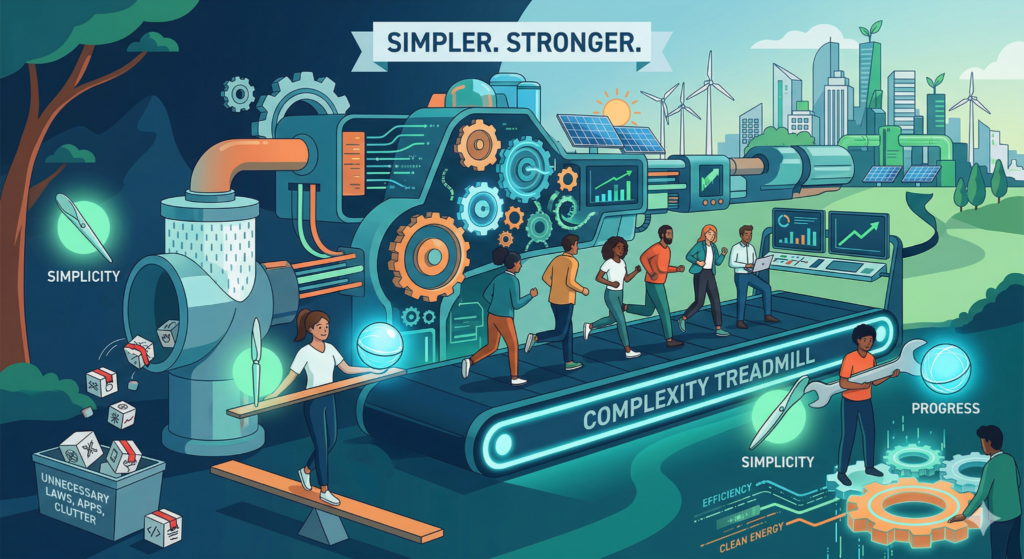
As someone who studies systems, from AI to agriculture, I think we need to value simplicity as much as progress. First, we should stop adding new ‘apps’ without a good reason. Every time we create a new law, government department, or piece of technology, we should ask if the benefit is worth the long-term cost.
Second, focus on energy. Since complexity requires energy, we have to find ways to obtain it without harming the planet.
Third, efficiency is key. Since we can’t return to a simpler time, we need to make our complex systems efficient enough so they don’t overwhelm us.
The future isn’t just about getting bigger. It’s about getting better at handling our size. We’re all on this ‘Complexity Treadmill’ together. The challenge for your generation is to find ways to keep the machine running without letting it wear itself out.
What do you think? Since we can’t go back in time, how can we make our future world simpler and stronger?
This article was drafted with the assistance of AI to help organise these complex historical and scientific ideas into a format that is easy for everyone to understand.