I used to think the Serenity Prayer was just something people recited for comfort — a gentle reminder to stay patient. Then I stumbled across a mathematical idea called a Markov chain, and I couldn’t believe what I was seeing. The prayer wasn’t just wise. It was, almost word-for-word, a description of how your brain actually moves through life. That connection changed the way I think about habits, willpower, and why some days everything flows and other days nothing works. I want to share it with you — not as a lecture, but as a conversation between two friends who figured it out together.
Alexa: Okay, I need to tell you something embarrassing.
Siri: I’m listening. Go ahead.
Alexa: I’ve been reciting the Serenity Prayer every morning for like three months now. You know the one — “God, grant me the serenity to accept the things I cannot change, courage to change the things I can, and wisdom to know the difference.”
Siri: That’s not embarrassing at all. Millions of people say that prayer every single day.
Alexa: No, I know — the embarrassing part is that I’ve been saying it every morning… and then spending the rest of the day doing the exact opposite. Like, I’ll say “accept the things I cannot change” at 7 AM, and by 9 AM I’m furious that I woke up tired again and I can’t seem to focus on anything. I’m fighting my own brain all day long.
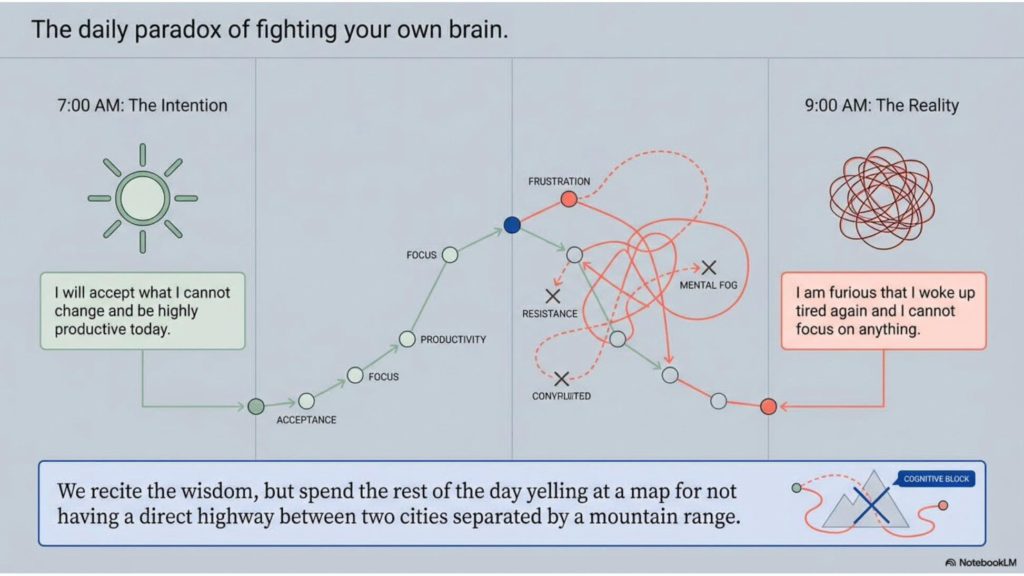
Siri: (laughs) Oh, I’ve been there. Trust me. But can I tell you something that completely shifted the way I think about that prayer?
Alexa: Please.
Siri: What if I told you the Serenity Prayer isn’t just spiritual wisdom — it’s actually a pretty accurate description of a mathematical idea? Something called a Markov chain.
Alexa: A what now?
Siri: Don’t panic. No equations, I promise. Here’s the basic idea. At any given moment, you’re in what mathematicians call a “state.” Right now, for instance, are you alert? Tired? Anxious? Calm? A little hungry?
Alexa: Honestly? I’m somewhere between curious and slightly caffeinated.
Siri: Perfect. That’s your state right now. And here’s the key insight: your next state depends mostly on your current state. Not on what happened last Tuesday. Not on what you planned last New Year’s. On where you actually are right now.
Alexa: Hmm. So if I’m exhausted right now, the chances of me doing deep, focused work in the next hour are…
Siri: Pretty low. No matter how badly you want to do that work. Your brain doesn’t care about your to-do list. It cares about what’s actually possible from where it currently sits. That’s called the Markov property — a fancy way of saying: where you go next depends on where you are now.
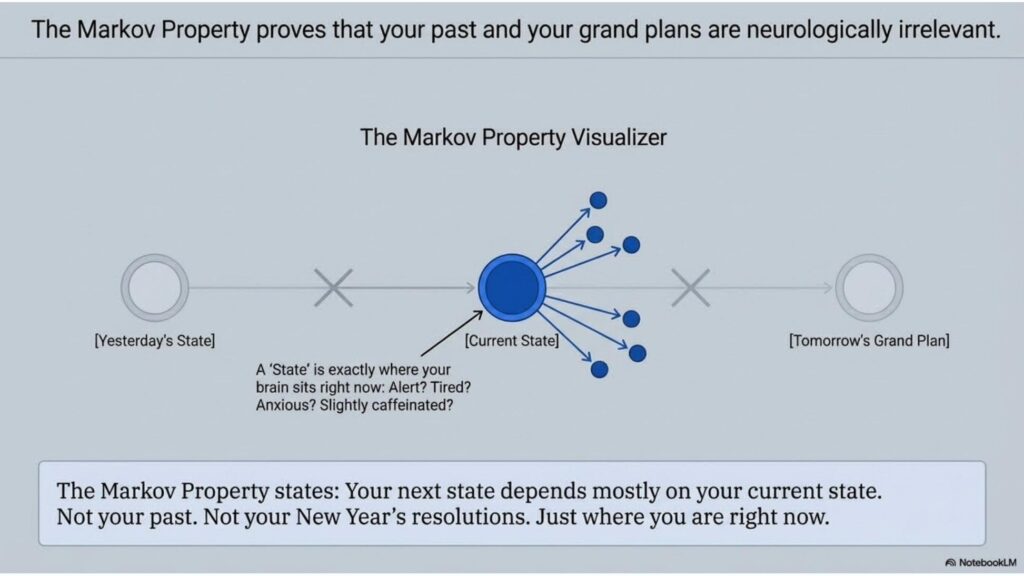
Alexa: That’s… actually kind of obvious when you say it out loud.
Siri: Right? But here’s the thing — we ignore it constantly. We sit there exhausted and beat ourselves up for not being productive. We’re anxious and get angry at ourselves for not being calm. We’re basically yelling at a map for not showing a direct highway between two cities on opposite sides of a mountain range.
Alexa: Okay, so walk me through the prayer using this idea. Start with “accept the things I cannot change.”
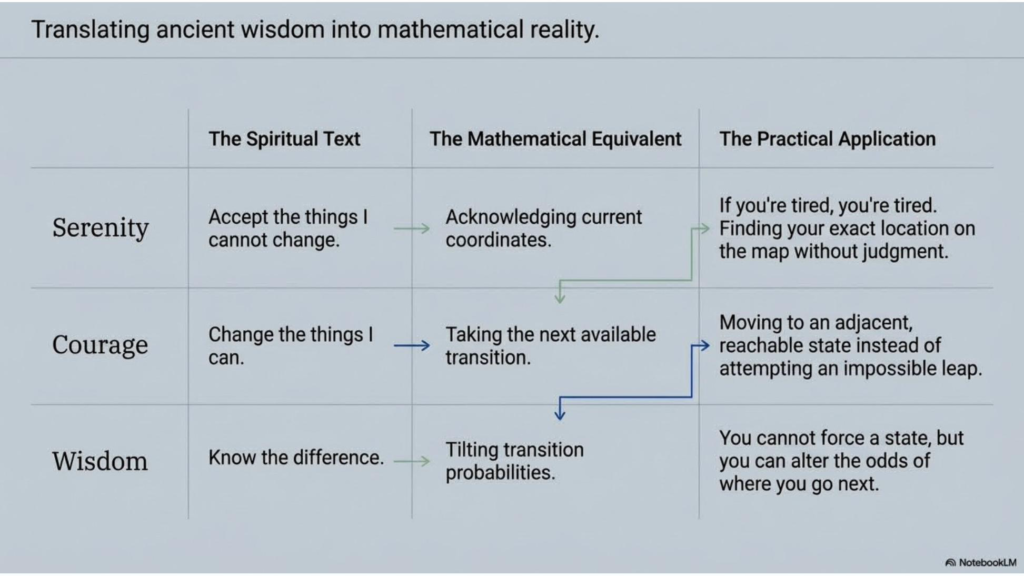
Siri: That first part — serenity — is really about acknowledging your current state without fighting it. If you’re tired, you’re tired. If you’re anxious, you’re anxious. These aren’t character flaws. They’re just… coordinates. You’re here on the map right now.
Alexa: But I always feel like I should be somewhere else. Like, I wake up foggy and immediately think, “Why can’t I just be sharp and motivated like those people posting their 5 AM routines?”
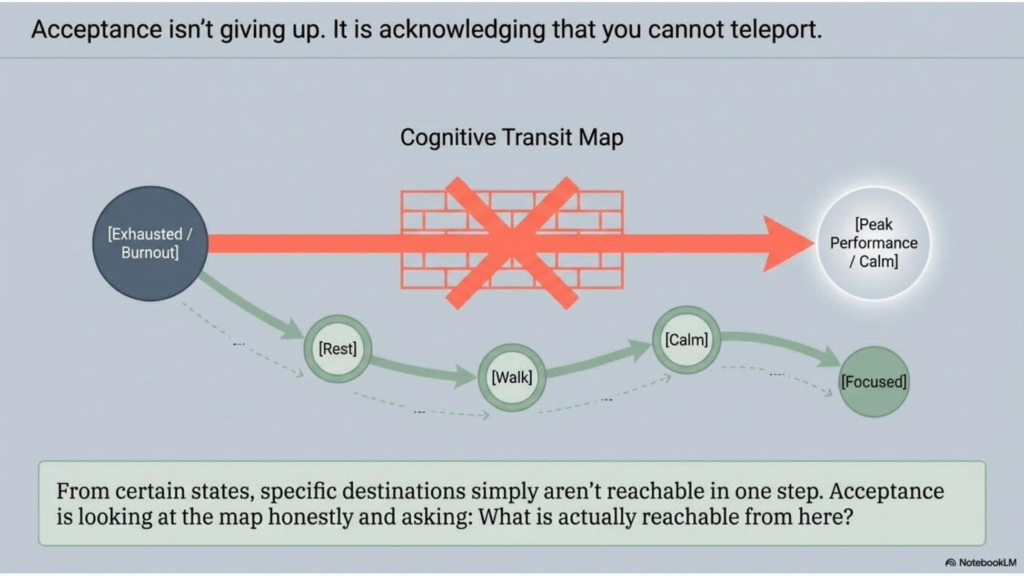
Siri: And that’s exactly the trap. Because in some states, certain destinations simply aren’t reachable in one step. You can’t jump from burnout straight to peak performance. You can’t leap from an anxiety spiral to perfect calm. Those direct paths don’t exist on the map.
Alexa: So acceptance isn’t giving up?
Siri: Not even close. Acceptance is looking at the map honestly and saying, “Okay, I’m here. What’s actually reachable from here?” That’s serenity. And it turns out, it’s also really good mathematics.
Alexa: You know what? I think I’ve been doing the opposite my whole life. I wake up in one state and immediately try to force myself into a completely different one — like I’m supposed to teleport.
Siri: You’ve probably noticed that on certain days, even the smallest step feels absolutely impossible, while on other days, things just flow without effort. That’s not random. That’s your brain telling you which transitions are available from your current state. When you listen to that signal instead of fighting it, everything gets easier.
Alexa: Okay. So what about the second part — “courage to change the things I can”?
Siri: This is where it gets really beautiful. Most people think courage means dramatic action. A complete life overhaul. Waking up at 5 AM, meditating, running five kilometres, journaling — all starting tomorrow.
Alexa: (laughs) I literally made that exact plan last Sunday night.
Siri: And how did Monday go?
Alexa: I hit snooze four times and ate cereal standing over the sink.
Siri: Right. Because that plan wasn’t courageous. It was a fantasy. Real courage is much, much quieter. It’s: you’re overwhelmed, so you drink a glass of water and do one small thing. You’ve been sitting for hours, so you put on your shoes and step outside. You’re restless and can’t focus, so you take a five-minute walk around the block.
Alexa: Those feel so… small, though.
Siri: They are small! But they’re real. They’re transitions your brain can actually make from where it currently is. Courage isn’t about the size of the step. It’s about choosing a step that’s genuinely possible from where you stand. A person lying on the couch in a fog of exhaustion who manages to stand up and make a cup of tea — that person has shown more real courage than someone posting about their morning routine online.
Alexa: Because they actually moved.
Siri: Exactly. They went from one state to the next available state. And honestly? That’s all change ever is. One tiny step to the next reachable place.
Alexa: So far I’m with you — accept where you are, take the next tiny step. But what about “the wisdom to know the difference”? That always felt like the vague part to me.
Siri: It’s actually the deepest part. Here’s the honest truth: you don’t fully control which state you’re in right now. You didn’t choose the anxiety. Life threw some randomness your way, and here you are.
Alexa: Then what do I control?
Siri: The odds of what happens next. Not the outcome — the odds. Think about it this way. You can change what mathematicians call your transition probabilities. Sleep well tonight, and you’ve just increased the chances that tomorrow morning you wake up in “alert” instead of “foggy.” Exercise today, and you’ve made it less likely you’ll get stuck in a “drained → drained → drained” loop.
Alexa: Okay, I like that. It’s less pressure than “I must feel great tomorrow.”
Siri: Way less pressure. And there’s more. You can also design your environment. If you remove your phone from the bedroom, you’ve literally deleted a bad transition from your personal map. Put a book on your nightstand instead, and you’ve added a good one.
Alexa: Oh! That’s why when I moved the cookie jar off the kitchen counter, I stopped snacking at midnight. I didn’t need more willpower — I just… removed the path.
Siri: Exactly! You didn’t change who you are. You changed the map. And that’s what wisdom really looks like. You can also strengthen your ability to stay in good states once you’re there. Meditation, for example, doesn’t magically make you calm. What it does is increase the probability that once you’re calm, you stay calm a little longer before something knocks you off. Deep work rituals don’t create focus out of thin air — they make focus, once it shows up, more likely to stick around.
Alexa: So the wisdom is knowing which levers I can actually pull.
Siri: And which ones I can’t. I can’t will myself into a state. But I can tilt the odds. That’s the whole difference.
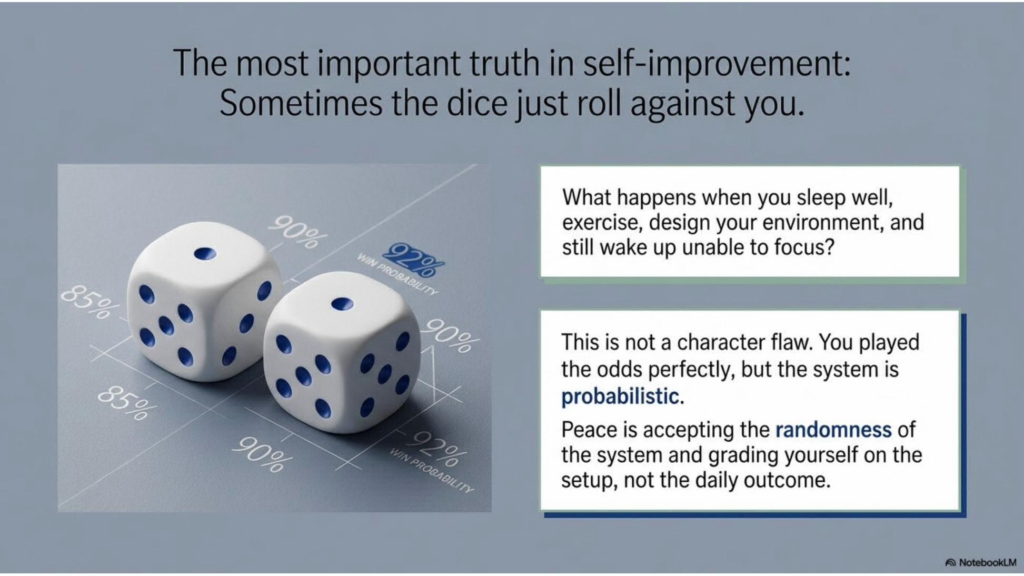
Alexa: Okay, but here’s where I always get stuck. What about the times I do everything right — I sleep well, I exercise, I set up my environment, I meditate — and I still wake up feeling terrible? I still can’t focus. I still feel stuck. What then?
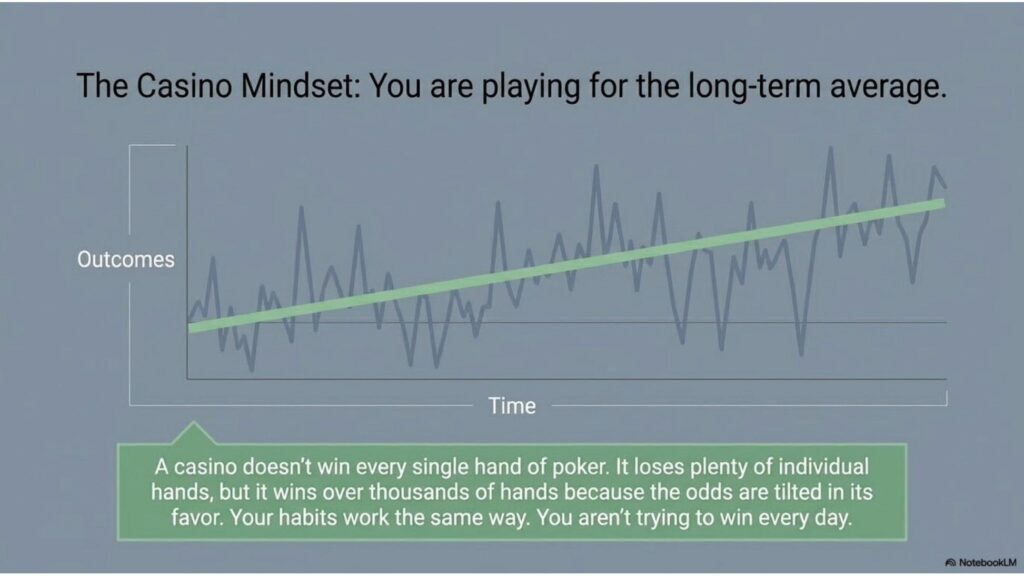
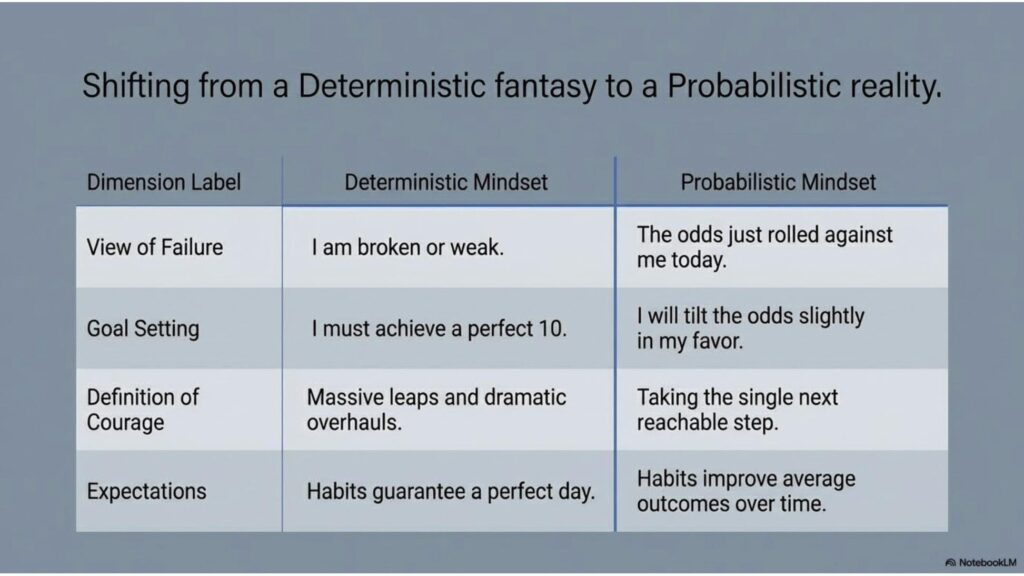
Siri: That’s such an important question. And honestly? That’s where most self-help completely falls apart. Because here’s the thing — life is probabilistic, not deterministic. Better odds don’t guarantee better outcomes every single time. They guarantee better outcomes on average, over time.
Alexa: Can you give me something to hold onto there? Because that feels a little abstract.
Siri: Sure. Think of a casino. A casino doesn’t win every single hand of poker. It loses plenty of individual hands. But it wins over thousands of hands, because the odds are slightly tilted in its favour. Your habits work the same way. You’re not trying to win every day. You’re trying to tilt the odds so that over weeks and months, you end up in better places more often.
Alexa: So on the days I do everything right and still feel awful…
Siri: That’s not failure. That’s just probability. You played the odds well. The coin still landed the other way. It happens. And here’s where peace comes in — the part of the prayer people skip right over. Peace isn’t about getting the outcome you wanted. Peace is being okay with the fact that you set up the conditions as best you could, and the result was still random. You did your part. Sometimes the dice roll against you. That’s not a character flaw. That’s just how life works.
Alexa: That honestly takes so much pressure off. Because I think I’ve been grading myself on outcomes instead of on whether I set up the conditions well.
Siri: Most of us do. At times you sense you’re capable of so much more, yet the results don’t match the effort — and you assume the problem is you. But it’s not. The problem is expecting certainty from a probabilistic system.
Alexa: Okay, there’s one more thing I want to ask about. When I’m in a bad state — really anxious, or really stuck — it doesn’t just feel like I’m in anxiety. It feels like I am anxious. Like that’s who I am now.
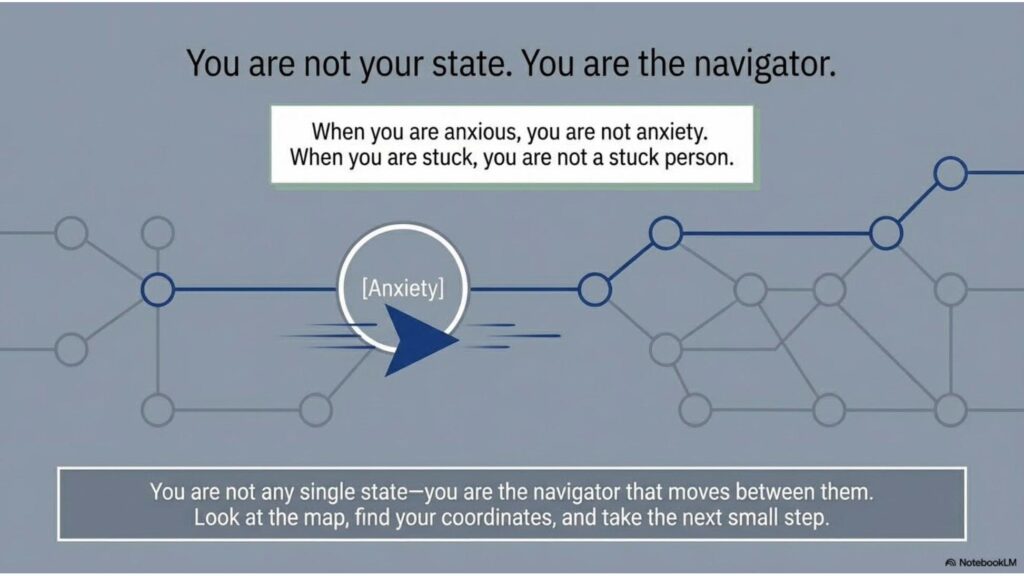
Siri: That’s maybe the most important thing we can talk about. Because here’s what I really want you to hear: you are not your current state.
Alexa: That sounds nice, but in the moment? It doesn’t feel true at all.
Siri: I know. When you’re anxious, it feels like you are anxiety itself. When you’re exhausted, it feels like you are exhausted. When you’ve been stuck for weeks, it feels like, “Well, I guess I’m just a stuck person.” But that’s the state talking, not the truth. You are not a single state. You are the thing that moves between states. You’re the one who adjusts the odds over time. The one who redesigns the map, adds new paths, and removes old traps.
Alexa: So my anxiety isn’t who I am — it’s where I am.
Siri: Yes. And where you are will change. Especially if you stop fighting the state and start looking for the next small, available transition instead.
Alexa: So if I put all of this together… what’s the actual strategy? Like, what do I do on a random Tuesday when I wake up foggy and the day feels impossible?
Siri: Stop asking, “How do I transform my life?” Start asking, “What’s one small probability I can shift today?”
Alexa: Give me some examples. Real ones.
Siri: Gladly. Let’s say you’re at work, completely overwhelmed with a project. You’ve got seventeen tabs open and you can’t focus. Instead of forcing yourself to “power through” — which is trying to teleport on the map — you close all the tabs, open just one document, and set a timer for ten minutes. That’s it. One small transition from “scattered” to “slightly less scattered.”
Alexa: And that’s enough?
Siri: It’s not dramatic. But it’s real. Or here’s another one — say you’ve been arguing with your partner and the tension’s been building all week. You’re in a “resentful” state. You can’t jump from there to “deeply connected” in one move. But you can make a small transition — maybe you send a short, honest text. “Hey, I know things have been tense. I’m not trying to fix everything right now. Just wanted to say I’m thinking of us.” That’s one tiny step from resentful toward something a little softer.
Alexa: What about parenting? Because I swear, by 7 PM I have zero patience left, and I know I’m not being the mum I want to be.
Siri: Here’s what the map says: from “depleted parent at 7 PM,” you can’t reach “endlessly patient supermom.” That path doesn’t exist after a full day. But you can reach “an honest parent who takes a five-minute breather in the bathroom before bedtime routine.” And from there? You might reach “calm enough to read one story with a real voice instead of a zombie voice.”
Alexa: (laughs) The zombie voice is too real.
Siri: And you know what? Here’s the thing about a five per cent improvement in your daily odds, repeated over weeks and months — it completely reshapes where you end up. Not overnight. Not in some dramatic before-and-after montage. But steadily, quietly, and in a way that actually sticks.
Alexa: So the whole strategy is just… swap one bad transition for a neutral one, make one good state a little stickier, remove one trigger from my environment?
Siri: That’s it. That’s the whole thing.
Alexa: It’s almost too simple.
Siri: Simple isn’t the same as easy. But it’s real. And real beats dramatic every single time.
Alexa: I think the part that hits me hardest is “you are not your state.” Because I’ve spent years identifying with whatever I was feeling — like, “I’m an anxious person,” “I’m not disciplined,” “I’m someone who can’t stick with things.”
Siri: And none of that was ever true. You were never broken. You were just in a state. And states change — especially when you stop trying to leap across the whole map and start taking the next small step that’s actually available to you.
Alexa: Accept where I am — that’s serenity. Take the next step that’s truly possible — that’s courage. Redesign my environment and odds — that’s wisdom. And let go of needing a perfect outcome every time — that’s peace.
Siri: And then do it again tomorrow. Not because it’s heroic. Because it works.
Alexa: I think I finally understand that prayer.
Siri: I think you understand it better than most people who’ve been saying it their whole lives.
Why This Matters for You
Here’s the truth most self-help books won’t tell you: you cannot control your current state. You didn’t choose to wake up tired, anxious, or unmotivated. But you can control the odds of your next state — and over time, that is more than enough.
The Serenity-as-math-equation insight frees you from two of the most exhausting traps we all fall into. First, it frees you from fighting where you are right now. You’re not broken if you can’t leap from burned out to brilliant in a single morning. Second, it frees you from the demand to achieve perfect outcomes every time you do the right things. Better odds played consistently will reshape your life — but not every single day will feel like a win, and that’s okay.
Your one move today? Look at where you actually are — honestly, kindly, without judgment — and ask yourself: “What’s the next small step that’s genuinely available to me right now?” Take that step. That’s it. That’s courage. That’s wisdom. And over weeks and months, that’s how maps get redrawn.
Citations
- Gagniuc, P. A. (2017). Markov Chains: From Theory to Implementation and Experimentation. Wiley. https://doi.org/10.1002/9781119387596
- Norris, J. R. (1998). Markov Chains. Cambridge University Press. https://doi.org/10.1017/CBO9780511810633
- Gross, J. J. (2015). Emotion Regulation: Current Status and Future Prospects. Psychological Inquiry, 26(1), 1–26. https://doi.org/10.1080/1047840X.2014.940781
- Duckworth, A. L., Milkman, K. L., & Laibson, D. (2018). Beyond Willpower: Strategies for Reducing Failures of Self-Control. Psychological Science in the Public Interest, 19(3), 102–129. https://doi.org/10.1177/1529100618821893
- Wood, W., & Rünger, D. (2016). Psychology of Habit. Annual Review of Psychology, 67, 289–314. https://doi.org/10.1146/annurev-psych-122414-033417
- Lally, P., van Jaarsveld, C. H. M., Potts, H. W. W., & Wardle, J. (2010). How are habits formed: Modelling habit formation in the real world. European Journal of Social Psychology, 40(6), 998–1009. https://doi.org/10.1002/ejsp.674
- Creswell, J. D. (2017). Mindfulness Interventions. Annual Review of Psychology, 68, 491–516. https://doi.org/10.1146/annurev-psych-042716-051139
- Fredrickson, B. L. (2001). The Role of Positive Emotions in Positive Psychology: The Broaden-and-Build Theory. American Psychologist, 56(3), 218–226. https://doi.org/10.1037/0003-066X.56.3.218