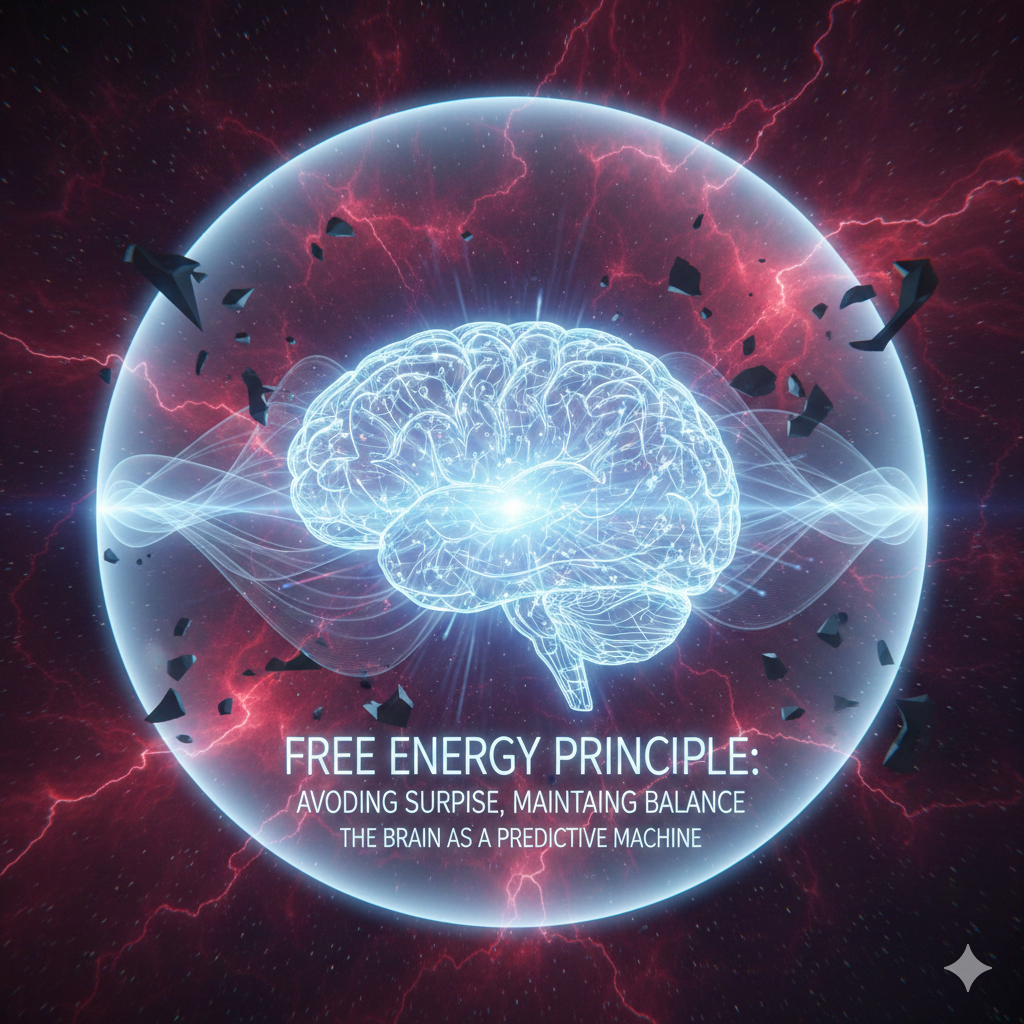
The Doorbell Mystery
Picture this: You’re home alone on a lazy Sunday afternoon. Suddenly, the doorbell rings.
What happens in the next split second?
Your heart might race. Your mind immediately starts guessing: “Is it the Amazon delivery? The neighbor asking for milk? Or someone I don’t know?”
Notice something amazing here? Your brain didn’t just hear a sound. It instantly started predicting what comes next. And if you weren’t expecting anyone, you might feel a tiny bit of stress—that uncomfortable feeling of not knowing.
This simple moment reveals one of the biggest secrets about how your brain (and every living thing) works.
British scientist Karl Friston discovered something remarkable: Your brain is not a passive receiver of information. It’s a prediction machine that is constantly working overtime to avoid surprises. He calls this the Free Energy Principle.
Let’s understand this powerful idea using our daily Indian life.
What is This “Free Energy” Thing?
Forget physics and complicated formulas. Think of “free energy” simply as “the cost of being surprised”.
The Chai Example
Imagine you make your morning chai. You take the first sip expecting it to be:
- Hot ✓
- Sweet ✓
- With the right amount of milk ✓
If it matches your expectation: You feel calm. Low surprise. Low “free energy”. All is well.
If it’s cold or too sweet: Surprise! Your brain goes, “Wait, what?!” This creates stress, confusion—that’s high free energy.
Living things—from bacteria to humans—are designed to minimize this free energy (reduce surprises) to survive and stay healthy.
How Your Brain Fights Surprises: Two Weapons
When reality doesn’t match your prediction, your brain has two options:
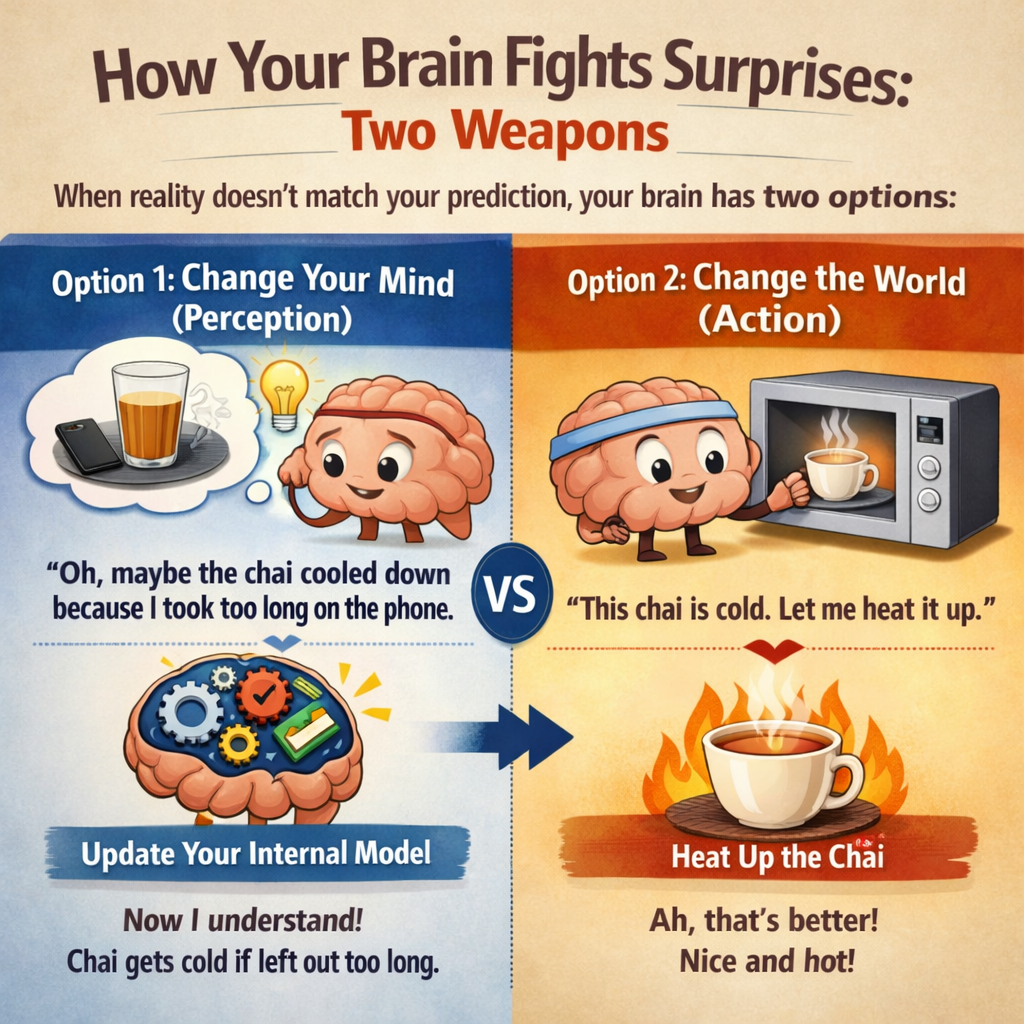
Option 1: Change Your Mind (Perception)
“Oh, maybe the chai cooled down because I took too long on the phone.”
You update your internal model of the world. You now know chai gets cold if left unattended. Next time, your prediction will be better.
Option 2: Change the World (Action)
“This chai is cold. Let me heat it up.”
You act to make reality match your expectation. Now the chai is hot again, just as you predicted it should be.
See the pattern?
Your brain is constantly doing this dance:
- Predict what will happen
- Check if it happened
- If not → Either change your belief OR take action
This is how you minimize surprise and stay balanced.
The Perception-Action Loop
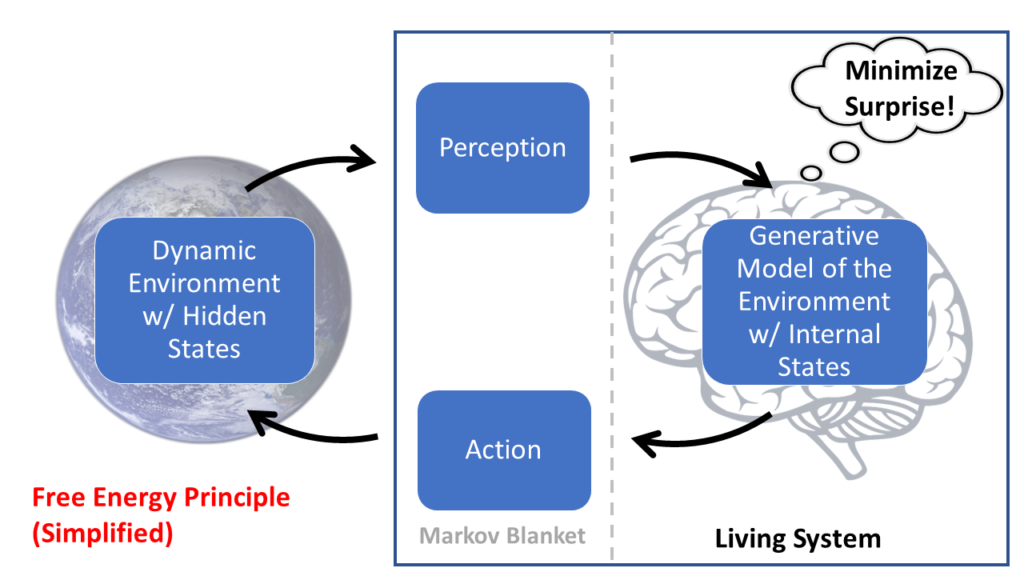
(Source: Medium article by Vin Bhalerao explaining Free Energy Principle – based on Friston’s work)
Think of your brain as being inside a bubble (scientists call it a “Markov blanket”—fancy name for “your personal boundary”).
- Inside the bubble: Your thoughts, beliefs, memories
- Outside the bubble: The real world
- The bubble wall: Your senses (eyes, ears, touch) and your actions (hands, voice, movement)
Information comes in through your senses. Your brain makes predictions. When there’s a mismatch, you either:
- Update your thoughts (perception)
- Move your body to change things (action)
Indian Example: You’re watching a cricket match. India needs 10 runs in the last over.
- Your prediction: “We’ll win this!”
- Reality: Wicket falls
- High surprise! (Free energy spike)
- Option 1: Update belief → “Oh no, it’s getting tough”
- Option 2: Take action → Turn off TV to avoid stress, or pray harder!
Either way, you’re trying to reduce that uncomfortable surprise feeling.
Why Rare Things Shock Us
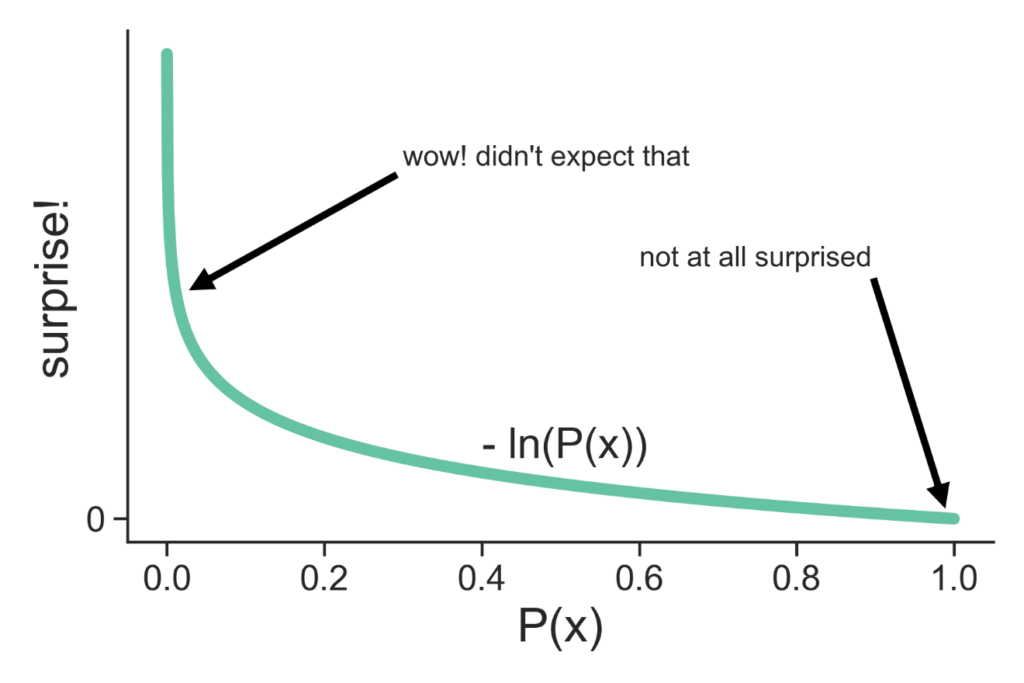
Source: Jared Tumiel’s blog explaining Free Energy Principle)
This graph shows something intuitive: The rarer something is, the more it surprises you.
- Electricity going off in summer: Common in many Indian cities → Low surprise
- Electricity going off in Mumbai’s Bandra: Rare → High surprise!
- Snow in Chennai: Almost impossible → HUGE surprise!
Your brain assigns “surprise points” based on how likely something is. The more unlikely, the higher the free energy cost.
This is why:
- We love routines (low surprise = comfortable)
- We feel stressed in new cities (everything is surprising)
- We feel calm when Maa makes the same dal chawal we’ve had 1000 times
How Your Brain is Like a Multi-Story Building
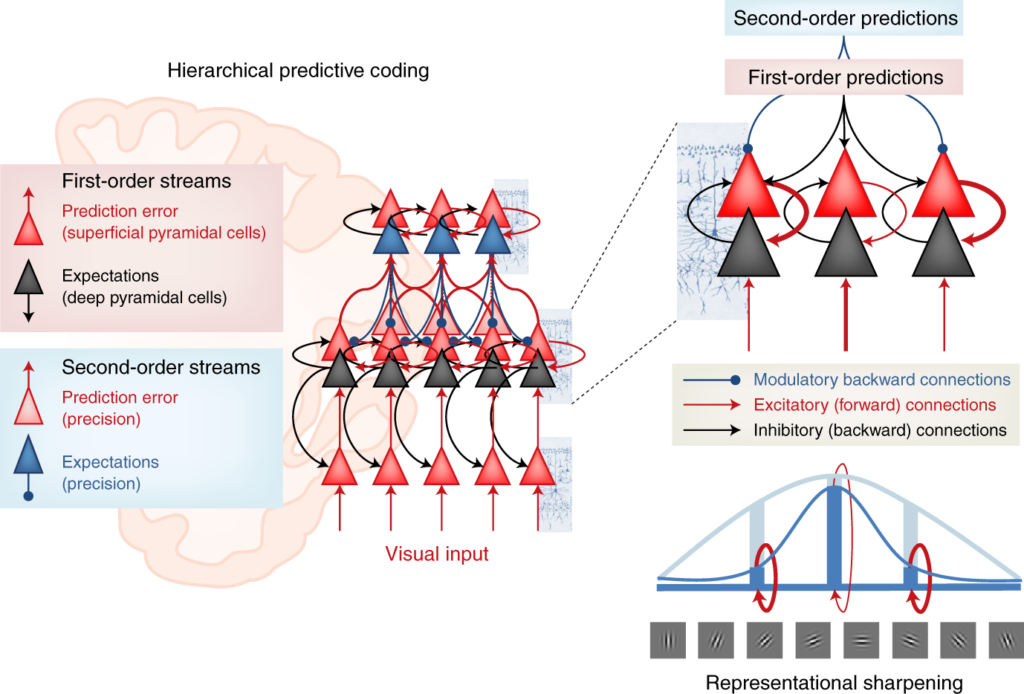
(Source: Nature Neuroscience article on predictive coding – closely linked to Friston’s 2010 review)
Think of your brain as a building with many floors:
Ground Floor (Lower layers): Handles basic stuff
- “That’s a round shape”
- “That’s an orange color”
- “That’s a bouncing movement”
Top Floors (Higher layers): Handles big picture
- “Oh, that’s a cricket ball!”
- “Someone’s playing in the garden”
- “It’s probably the neighborhood kids”
Here’s the magic:
Top-down: Your high-level predictions flow down → “I expect to see a ball”
Bottom-up: Errors flow up → “Wait, the ball is purple, not red!” (prediction error)
The brain constantly updates both levels to minimize errors.
Diwali Example:
- You hear crackers → Bottom layer detects “loud sound”
- Top layer predicts → “It’s Diwali time, crackers are normal”
- Low surprise, you feel happy
- Same sound on a random Tuesday in March → High surprise, you feel alarmed!
Same sound, different contexts, different free energy!
Active Inference: Making the World Match Your Expectations (See Diagram 4)
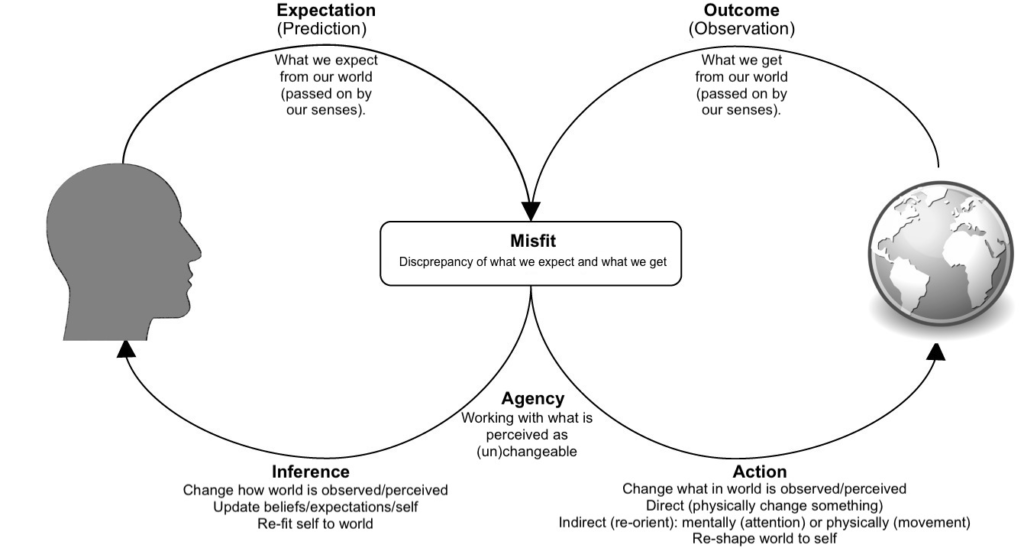
(Source: Neuremind website on Active Inference)
This diagram shows the complete cycle:
Predict → Observe → Error? → Act OR Update Belief → Predict Again
Mumbai Traffic Example (Real Life Active Inference)
Morning: You predict you’ll reach office in 30 minutes.
Reality: You hit massive traffic jam.
Prediction error! (High free energy = stress)
Now you have choices:
Choice 1 – Update Belief (Perception):
- “Okay, I’ll accept this. Traffic is part of Mumbai life.”
- Put on podcast, call office to inform delay
- Mental model updated: “30 minutes was unrealistic”
- Stress reduces
Choice 2 – Take Action:
- Take different route
- Leave house earlier tomorrow
- Change reality to match your 30-minute prediction
- Stress reduces
Both reduce free energy! Your brain is satisfied either way.
Why This Matters in Real Life
1. Mental Health
Anxiety = Too many unresolved prediction errors
When life becomes too unpredictable (job loss, relationship issues, pandemic), your brain gets flooded with surprises. Free energy skyrockets. This is anxiety.
Solution:
- Create small routines (morning walk, evening chai)
- Practice meditation/yoga → improves your prediction accuracy
- Lower expectations sometimes → fewer mismatches, less stress
Depression = Giving up on predictions
When you stop believing your actions matter, you stop trying to reduce free energy. This is learned helplessness.
2. Learning and Education
Children learn by making predictions and adjusting:
- Baby predicts ball will bounce → throws it → updates model based on result
- Student predicts answer is X → gets it wrong → updates understanding
Good teachers: Create just enough surprise (not too little = boring, not too much = overwhelming)
3. Relationships
Why do we love predictable partners?
Low free energy! When your partner behaves as expected (remembers anniversary, makes morning tea), your brain is happy.
Why do surprises in relationships hurt?
High free energy! Unexpected behavior creates stress because it means your model of the person needs updating.
Why do we sometimes need novelty?
Too low free energy = boredom! We need some controlled surprise to stay engaged.
4. Cultural Comfort
Why do Indian parents want kids to follow traditional paths?
Low free energy! Predictions are easier:
- Engineering/medicine → Good job → Marriage → Settled life
- Familiar pattern = less uncertainty = less stress
Why do children feel stressed with new careers?
Parents’ predictions don’t match → high free energy for everyone!
The Big Picture: What Does This All Mean?
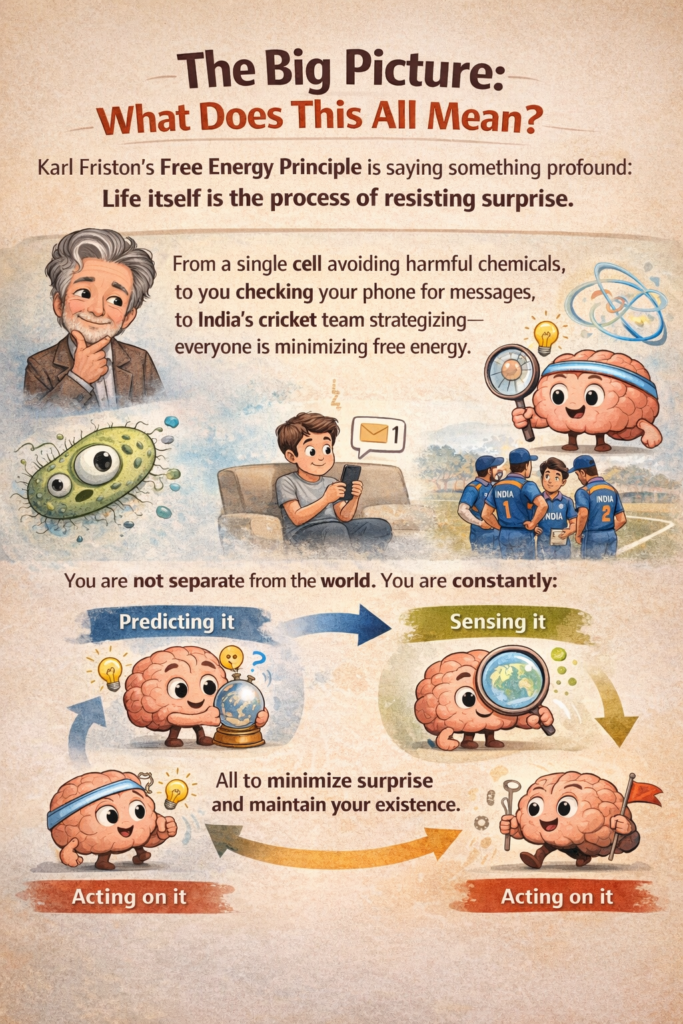
Karl Friston’s Free Energy Principle is saying something profound:
Life itself is the process of resisting surprise.
From a single cell avoiding harmful chemicals, to you checking your phone for messages, to India’s cricket team strategizing—everyone is minimizing free energy.
You are not separate from the world. You are constantly:
- Predicting it
- Sensing it
- Updating your model of it
- Acting on it
All to minimize surprise and maintain your existence.
Practical Takeaways for Your Life
Morning Routine
Create one! Predictable mornings = low free energy = better mood all day.
When Stressed
Ask yourself: “What prediction just failed?”
- Update it (acceptance)
- Or act to fix it (control)
In Conflicts
Remember: The other person has their prediction model. Your behavior might be surprising to them. Explain your actions to help them update their model (reduces their free energy = less conflict).
Learning New Skills
Expect prediction errors! They’re not failures—they’re your brain learning. Each error makes your model better.
Parenting
Don’t eliminate all surprises for kids—they need some to learn. But don’t overwhelm them either. Find the sweet spot.
Final Thoughts
Next time you take a sip of chai, hear a doorbell, or get stuck in traffic, remember:
Your brain is not just reacting. It’s predicting, comparing, adjusting, acting—all in milliseconds. You’re a walking, talking, chai-drinking prediction machine, constantly working to minimize surprise and stay balanced in this chaotic world.
And now you know the secret formula that drives it all: Minimize Free Energy.
Welcome to understanding the principle that explains everything from cells to civilizations!
Want to Learn More?
- For the curious: Look up “Predictive Processing” and “Bayesian Brain”
- For the adventurous: Read Karl Friston’s original papers (warning: heavy math!)
- For the practical: Start noticing your daily predictions and surprises
Remember: You’re already an expert at this—you’ve been doing it your whole life. Now you just know why!